Market Hill
Evidence of Conflict between the lord of Woodbridge market and shopkeepers
After the priory was dissolved the right to hold a markets was transferred to the lord of the manor of Woodbridge late Priory. In Woodbridge, as elsewhere, there were reports of traders who persistently refused to sell goods on the market but hawked them round the town on Market Day instead, thereby avoiding the Market tolls and stallage.
For example, the 1583 Court Rolls of the manor of Woodbridge late priory, record that Sir Humphrey Seckford, and others sought, to evade the market dues by selling their pigs and cattle in the churchyard and streets. For their offence a fine of two-pence for each head of cattle sold was inflicted. There are also reports of traders who were buying up goods before they could be brought to market, a practice called 'forestalling'.
The papers, at the Record Office, relating to the Woodbridge Market, are all concerned with attempts made to maintain the lord of the manor's income from the market. The earliest of these documents, dated July 1756, is a letter requesting legal advice from a barrister. It starts :-
‘There are commodious stalls in the Market Place built at the expense of the lord where the country butchers and also the greatest part of the butchers who reside in the town were used till lately to bring their meat to meat on market days and each paying a toll to the clerk of the market for his stall but of late years the butchers in the town, of which there are many more than were formerly living in different parts of the town distant from the market have exposed their meat to sale only in their own houses on Market days and refuse to come to market.
The butchers insist on a custom in the Vill to sell in their own houses on market days and on strict inquiry it is found that although many of the town butchers did keep Market yet there were always some of them who refused to come into market but sold in their houses. This proves that such a custom is good and the butchers will be able to prove it.
Do you advise the lord of the market to bring an action against the butchers?’
The answer received, from F Norton of Lincoln's Inn, was to bring an action
against the butchers and ‘thereby put a stop to this practice amongst them’.
The second part of the document relates to those bringing goods for sale:-
‘The lords of this manor have since time immemorial taken toll for every stall upon market and fair days for all things exposed for sale at these times in the Market Place and Market House (which is a large commodious building in the middle of the Market Place for the country people to sell their goods in) and no persons were suffered to hawk about the town with their commodities upon Market day but were to take their stand in the Market place so as the inspection of the clerk of the market (an officer kept by the lord for that purpose) but of late they are endeavouring to break these customs and many refuse to come into Market on Market day to avoid paying toll but carry their commodities from door to door and even those who do pay their toll instead of taking a stand in the Market place do in a like manner carry their goods from house to house to the great inconvenience of the inhabitants and the detriment of the Lord.
What method to you advise the lord of this manor to pursue to compel the country people to sell the commodities on a Market day in the open Market House and to pay their toll to the clerk of the market and not to hawk about the town after they have paid their toll as above stated and upon the whole how should the Lord proceed to keep the Market from being lost and what is your advice to him upon the whole of the case?’
The answer received was:-
‘I think the most proper remedy for this suit will be an action by the suit of the lord who is owner of the market but let it be brought against the most notorious and richest of the offenders that this example may strike terror into the rest of them and the right has been established in favour of the lord by a verdict and judgment I presume the rest will submit.’
Note:-The Market House was presumably the open lower part of the Shire Hall. This was bricked up in 1803 and was then used for a corn exchange.
Soon after receiving the advice from the barrister, Thomas Carthew, the lord of the manor, wrote the following letter to the butcher John Cracknall:-
‘Being determined to assert the rights and properties now belonging to me as lord of the manor of Woodbridge late Priory and in particular that of the market with the customs and tolls belonging to the same I do hereby give you personal notice that unless you and the rest of the butchers vend your meat on market day – being Wednesday in every week – in the open market at the shambles and stalls erected there for that purpose – and not out of the market in shops or at your own houses I will shortly commence a prosecution at law to establish my rights.’
Thomas Carthew also wrote the following letter to the shopkeeper Joseph Allen:-
‘Whereas a practice has very much prevailed amongst the shopkeepers in this town of buying butter, cheese and other such commodities coming into this town to be sold before the said commodities are taken into the market contrary to the Laws and Statues against forestallers. And whereas I have received sufficient proof that you are one of the most notorious of this sort of offender I therefore give you notice that unless you lay aside this practice for the future you will be indicted at the next Quarter Sessions as a forestaller.’
Another document appears to be a notice that was displayed:-
‘This is to give notice to the persons who come to town with fish, fowl, fruits, butter, cheese, eggs or any other commodities on market days; that they do not hence forward presume to carry their commodities from house to house but that they take a stand or stall on the market place and there expose their goods for sale and that all persons who do so to the contrary shall be prosecuted by the lord of the market at the next assizes.’
There is no evidence that Thomas Carthew subsequently took any legal actions against shopkeepers. Documents written in 1814 indicate that, at some point, he decided not to exercise his market rights. This decision may have been influenced by his appointment as Rector of St Mary's.
Thomas Carthew had inherited the manor of Woodbridge late priory in 1741. He had trained as a lawyer but found it hard to make a decent living and so he decided to become a clergyman. As lord of the manor of Woodbridge late Priory he held the advowson, the right of presenting a clergyman to the benefice (living), of St Mary’s Church. He exercised that right in 1779 and served as Rector of St Mary’s until his death in 1791.
The manor was subsequently bought by Philip Riches, a banker. He sold the manor in 1805 to William Wood Page and, a year later, it was purchased by Jacob Whitbread. (For more on the manor see the article on the Carthews of Woodbridge in the section on Notable People.)
In 1841 a letter was written by a solicitor acting for Jacob Whitbread requesting legal advice from a barrister. It starts by stating that the market stalls were taken down some time before 1814 and that tolls had ceased to be collected on market day. It then refers to the map which is reproduced below and states that:-
‘The permanent stalls which used to be laid out on the south western end of the market were taken down some years ago. The lord used to be paid stallage and tollage for these, and other temporary stalls and erections at the markets and the fairs, but he has not of late years, been paid for the use of any such erections, or any stallage or tollage of any kind upon the market days.
Since Mr Whitbread became lord of the manor, he erected a fence of railing, on the north side of the Hill, upon the dotted line, from the west end of the houses of Ashford and Lynn to the Hall, but did not include the Lower Hill. After this fence had been sometime erected by the present Lord, Mr Lynn, the owner of the house at the north-west corner of the Hill, and Mr Cobbald, the owner of the house at the south-west corner, strongly objected to it. In consequence of the above threats, the Lord was induced to remove the railings.’
The document continues thus:-
‘The lord now wants to enclose the market but to leave a carriage way for the houses on the west side of the Hill. He also wants to erect permanent buildings where the huts stood and was anxious to establish his right to demand tolls of all Cattle Dealers, and other Dealers, who expose Cattle, and other Stock and commodities, to sale on the Market days in addition to the tolls and stallage which are constantly paid to him, without the slightest objection, at the fairs.
Would you please give your opinion on the following points. Whether the lord can enclose the Market Hill in the manner described? Whether he can erect the buildings he desires? Whether he can demand toll of the cattle dealers, and other dealer, who expose their cattle and other commodities to sale on Market Days, on the Market Hill, and whether he cannot prevent their coming upon the Hill, for this purpose in case of refusal to pay toll. Should he be able to establish this Right he means to have a regular Clerk of the Market, and the profits are expected to be considerable, Woodbridge being a large Market Town.’
The legal advice received was that:-
‘He (the lord of the manor) can enclose the market provided be does not obstruct the right of way of the houses.
He can erect stalls for the use of a market but not buildings for habitation.
It does not appear that toll has ever been taken for cattle exposed on the market hill on market days except when stalls were there and then stallage was only paid for the use of such stalls, the lord cannot not demand tolls for cattle offered for sale where there are no stalls. He may erect stalls as they were in former times and may demand stallage for their use – but he cannot prevent dealers from coming to the market if they refuse to pay toll which never has been hither paid.’
From this response it would appear that, some time between 1756 and 1814, the lord of the manor had removed the stalls from the market place and had ceased collecting tolls or stallage for any goods sold on the Market. Presumably the shops in the town were thus free to sell goods, and to buy produce from the surrounding countryside, on market day.
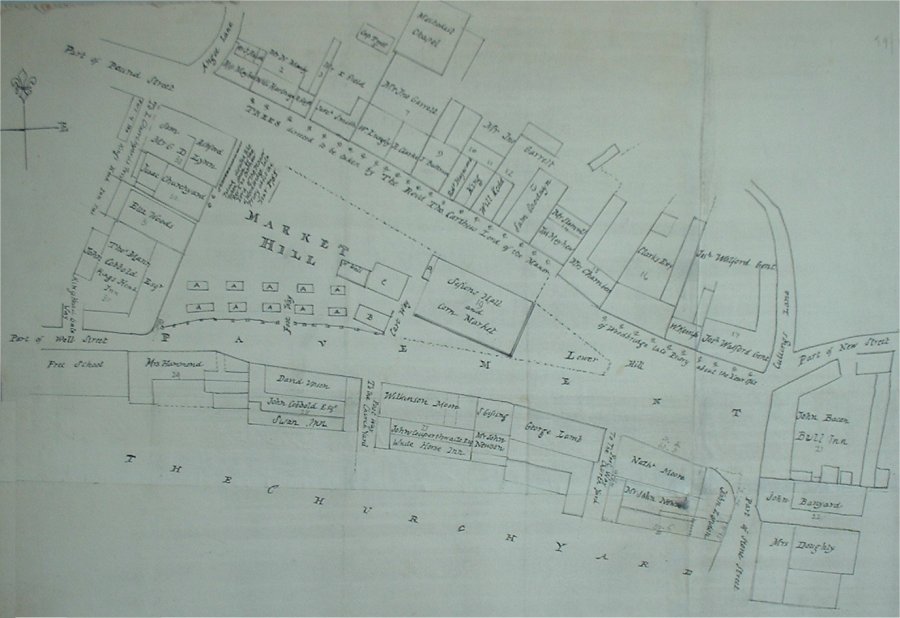
Map of Market Hill in 1814
Shortly after Jacob Whitbread received the advice set out above he sold the manor to the bankers Dykes and Alexander. They subsequently sold the manor to Rolla Rouse and it remained in his family after he died.
In 1854 the Rouse family leased the markets and fairs to Mr Austin and others for 14 years. In July of that year the market day was changed from Wednesday to Thursday as a result of several large meetings of the inhabitants and the farmers in the neighbourhood. They decided that the declining state of the market during the previous twenty years was due chiefly to its being held on the same day as Bury. Nevertheless the trade directories at that time describe the market as being plentifully supplied with cattle and corn.
In April 1896 Urban Council of Woodbridge bought the Market Rights from the Rouse family. A committee was formed in June of that year "for the purpose of considering the most advantageous course to be adopted for the management of the Market Hill and the rights over the same for the benefit of the town". By December it was decided to advertise a yearly lease of the of the market rights. The tenancy conditions required:-
· That the market close by 10.20 pm
· Activities to be confined to the areas marked out by the council
· That the tenant hold a livestock market each week.
The Council Minute Books contain details of the leases that were agreed. For example, in 1898, Robert Bond leased the market rights for the yearly rent of £30. From the references in the Council Minute Books it can be seen that the Market became less and less popular and the yearly rents obtained by the Council gradually diminished. Kelly’s 1925 trade directory reports that a cattle market was being held every other Thursday rather that weekly.
The Council Minute Books for the early 1930s barely mention the lease of the market and in 1936 the Urban District Council, by resolution and public notice, declared a portion of the Market Hill to the west of the Shire Hall to be a public parking place under the provisions of Section 68 of the 1925 Public Health Act. Market trading lapsed until 1960 when the Town Council were then approached with a request from a Mr. Collins of Bramfield, near Halesworth, to sell fruit etc. regularly on the Market Hill on a Thursday. This forced the council to take stock of their position as holders to the Market rights and, as part of the deliberations, a report was written by the Clerk of the Council. The eventual outcome was that Mr Collins was allowed to trade. For many years the reinstalled market was a thriving concern with standing being available for up to about 15 traders, but by 2002 the number of regular traders had reduced to 5 and they lobbied to Town Council to allow them to move down to the Turban Centre. The last market was held on 9th May 2002.
Little is recorded about the corn market. When the lower part of the Shire Hall was bricked up in 1803 it was subsequently used for a corn exchange. In about 1829 the then owners of the manor sold the lower part of the Sessions House to the County Court who continued to lease it to the corn exchange until this closed in November 1941. According to press reports, the decision to close the corn market was made by the ‘Corn Market Committee’ who also agreed to disburse their residual funds to local charities. It would thus appear that the corn market was run as separate entity after the market rights were transferred to the Urban District Council in 1896.
AHT003j Return to History of Market Hill