Shipbuilding
Ships were probably built in Woodbridge from at least the fourteenth century but this activity did not become a major industry until the seventeenth century when men-of-war were built here.
High Suffolk was a prime source for the timber used to build men-of-war and large quantities of it were shipped from Woodbridge to the Royal dockyards.
Phineas Pett, Master Shipwright at Deptford, used to come to Suffolk to select the timbers and he realized that it would be easier to build men-of-war at Woodbridge rather than to transport ungainly logs to the dockyards. Between 1630 and 1680 at least 15 men-of-war were built at Woodbridge and it is believed that many of them were commissioned by Phineas or by his son Peter.
Peter Pett was initially his father’s assistant but he eventually became Superintendent of Chatham dockyard and one of the three commissioners of the navy.
This painting is a portrait of Peter Pett. It also shows
the Sovereign of the Seas which he and his father
built at Woolwich for Charles I in 1637.

Many of the larger ships were not completed at Woodbridge but were sailed under jury-rig, or were towed, to the Thames to be masted and rigged with Woodbridge rope. This drawing is of the 550 ton Maidstone which carried 40 guns and was built by Edward Mundy in 1654. She was re-named the Mary Rose after the Restoration of the Monarchy. She was the last wooden ship to bear this illustrious name.
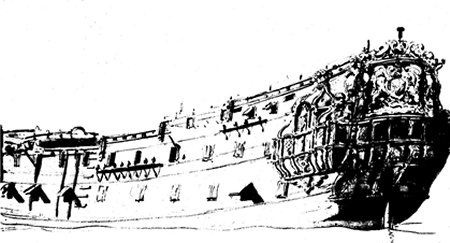
Drawing of the 550 ton Maidstone built by Mundy in 1654.
The locations of two shipyards in Woodbridge are indicated by this map as is that of the rope-walk where rope was made until the end of the eighteenth century.
Peter Pett may have benefited from having the men-of-war built at Woodbridge. In 1632, he had married the daughter of the owner of the Lord’s Quay and of other riverside land. Seventeen years later Peter held this land and he appears to have rented it to relatives who built some of the ships that Peter and his father commissioned. This conflict of interests does not appear to have attracted attention. His dismissal in 1667 was because he was judged not to have taken adequate precautions to prevent a Dutch raid on the Chatham dockyards.
The building of men-of war at Woodbridge continued for some time after Peter Pett’s dismissal but it was over by about 1680 and the shipyards reverted to building commercial vessels.

Location of the two shipyards used to build men of war at Woodbridge.