Other Sources of Employment and the Growth of the Town
Until the mid-nineteenth century employment opportunities in the town were increasing and thus, as this graph shows, the population of the town rose steadily. Maritime trade and shipbuilding were the key sources of employment but a range of other industries, such as leather working, linen weaving, rope making and salt refining, were also important.
The surrounding agricultural areas thrived during the Napoleonic Wars (1793-1815). The conflict disrupted the supply of goods from overseas and consequently the prices paid for locally grown corn increased. This brought added prosperity to the town as did serving the needs of 4,000 troops who were in a barracks on the outskirts of Woodbridge.
When the troops left in 1814 there was a dip in population. This then started to rise again, albeit at a reduced rate, until the arrival of the railway in 1859 sent the maritime trade into terminal decline. Over the next 12 years the population dropped by 13%. The population then remained almost static for the next 70 years because of two factors. Firstly, the collapse of the agricultural economy of the surrounding area during what became known as the Great Agricultural Depression. Secondly, although new employment opportunities were created in the town, they only just matched those being lost as older sources of employment disappeared.

The changes in the population of Woodbridge and the events which influenced them.
Employment Opportunities from 1800 to 1925
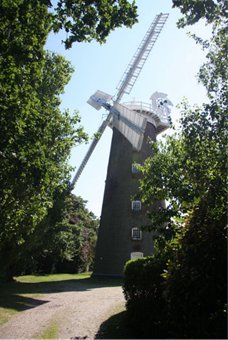
By the start of the nineteenth century many of the long established non maritime industries had faded away. Nevertheless, by 1838 there were still seven windmills and the tide mill grinding corn. By 1880, however, only two windmills were left standing. Buttrum’s mill, shown on the right, was the last working windmill in Woodbridge. It continued until 1928 and is now a visitor attraction.
The number of malt houses, where barley was germinated to make the malt used for beer, increased during nineteenth the century. By 1880 there were 14 malt houses in the town but the work was soon transferred to towns where a more automated and compact method of malting was being used.
Link to more on maltings and windmills in the town.
Buttrum's mill was the last working windmill in Woodbridge.
It continued until 1928 and is now a visitor attraction
In 1814 a local builder discovered how to make cement, which resembled Portland stone, and he used it to clad houses and to mould architectural features and ornaments. Many examples of this artificial stone, such as the key stone shown on the right, can still be found in the town.
The business expanded and had an office in London until competition increased. Its two key employees, the Pulham brothers, left to start a successful business (at Broxbourne) which produced ornate garden ornaments in artificial stone. The company had a national reputation and it also created large rock gardens, using artificial rocks made out of cement, for many prestigious customers.
Link to more on artificial stone
John Grout, the Landlord of the Bull Hotel, was a horse dealer of international repute. By 1861 he had extensive stabling in the hotel and a farm on the outskirts of the town. When he died in November 1886 his horse dealing business was taken over by William Miles but it did not survive the onset of the First World War.
Link to more on John Grout and his successor
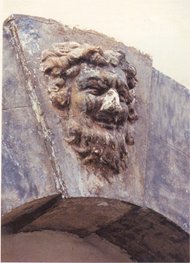
A cement key stone and doorway which were moulded in Woodbridge.
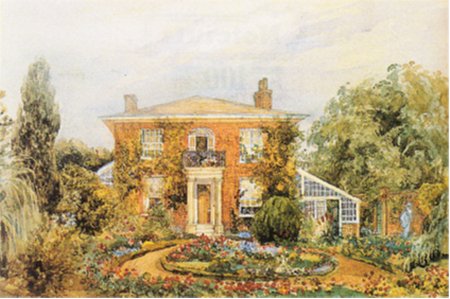
The only nineteenth century business which was a sustained success was a nursery started by Thomas Wood in 1749. His customers were principally the owners of country estates and of large town houses. A painting of his house which was by the entrance to the nursery is shown here.
The business was purchased in 1897 by Roger Notcutt. He expanded the business and developed extensive nursery fields in the town and the surrounding area. The company now has garden shops across the country.
Painting of Thomas Wood's house and garden
which were by the entrance to his nursery..
Last edited 15 Sept 21