Retailing
Introduction
Across the country retailing, the sale of goods in small quantities, started in markets. The first regulated markets were created during the Anglo-Saxon era and, after the Norman Conquest, their numbers increased considerably. Markets were the key link between the growing urban centres and the surrounding agricultural hinterland. They were the urban dwellers' source of food and of the raw materials needed for their occupations.
Each market was established by the grant of a charter by the Crown to a lord of a manor who was thereby entitled to hold a market on a given day of the week, to charge rent for a space in the market and collect a tax on the goods sold. In return the lord had to enforce the use of standardized weights and measures.
On the days at which the market was held the lord could ban the buying or selling of goods in all other places in the manor. Such bans caused conflict when rising trade led to shops being set up in the fifteenth century.
Shops eventually became an essential feature of everyday life because they were more convenient than markets, and they were open much longer and often sold goods on credit to regular customers. For a while shops and regulated markets vied for retail trade but eventually shops dominated.
Woodbridge Market
Woodbridge Market was established in Woodbridge in 1172 following the grant of a Market Charter to the lord of the manor of Woodbridge Priory. A charter to hold two fairs per year was probably granted at the same time.
At Woodbridge Market there was a burgeoning local trade in livestock, leather and dairy produce. The market was dominated by butchers and leather workers and, in the 1440’s, the manorial income from butchers' stalls was four times that generated by bakers and grocers.
When Woodbridge Priory was dissolved in 1535 and the right to hold a market passed to the lord of the manor of Woodbridge late Priory. In 1574 the then lord, Thomas Seckford, improved the market by building the Shire Hall in the centre of the town. The lower part, which then had open arches rather than windows, was used as a covered market. Other market stalls and animal pens continued to be laid out around the rest of the Market Hill. The upper floor of the Shire Hall was used for Quarter Sessions of the County Court.
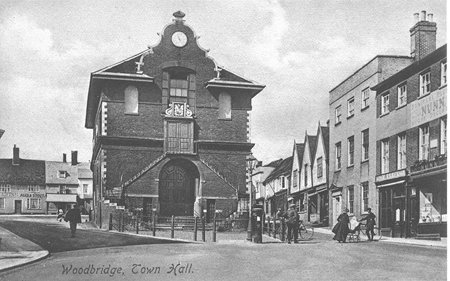
When the Shire Hall was built in 1575 the lower part was open and was used as a covered market.
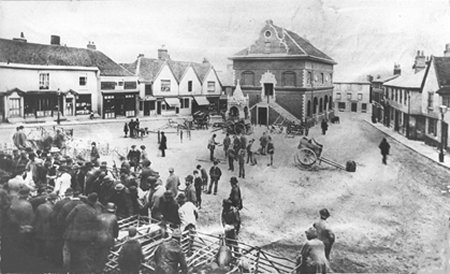
Woodbridge Market circa 1880. All the stalls and pens were in the upper part of what is now Market Hill.
 .
.
.
By the fifteenth century markets were increasingly facing competition from shops because the latter were open daily. The best local example is Ipswich where, throughout the 1460s and 1470s, there were attempts to ensure that butchers sold their produce from market stalls at fixed times, rather than from their own homes where their hours of business were more flexible.
In 1756 the lord of the manor of Woodbridge late Priory requested legal advice on what to do about some butchers who refused to close their shops on market days. He was also concerned about the ‘shopkeepers who were buying butter cheese and other such commodities coming into this town to be sold before the said commodities are taken into the market.'
By 1800 it is clear that the lord of the manor of Woodbridge late Priory had ceased to exercise his market rights. Although the market was still taking place he was no longer erecting stalls on the Market Hill and he was not collecting tolls or stallage on market days.
In 1803 the open arches in the lower part of the Shire Hall were partly bricked up and windows were installed. The space created was used as a corn exchange which was run by the ‘Corn Market Committee’ until they decided to close the exchange in 1941.
During the first half of the nineteenth century various trade directories describe the market as being plentifully supplied with corn and cattle. The earliest photographs of the market show livestock in pens.
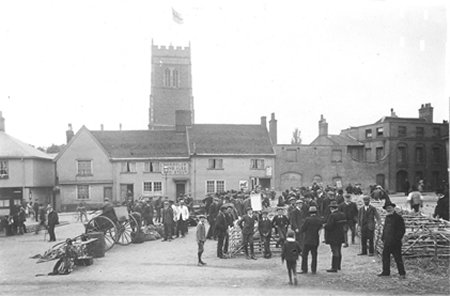
Woodbridge Market circa 1910.