Diversification of Religious Worship
Introduction
For many centuries all Christians worshiped in Catholic churches which were richly decorated with religious images and where services were conducted in Latin. During the sixteenth century pressure built up in the area which is now Germany for a religious transformation - the Protestant Reformation. There was a desire to recapture the vitality and freshness of the earlier Christian faith, as found in the golden age of its first centuries.
When Henry VIII came to the throne in 1509 he rejected the ideas behind the Reformation and he had no desire to change the church. It was the Pope’s refusal, in 1529, to allow him to divorce his wife, Catherine of Aragon, which drove him to gain the support of Parliament for a break with Rome. Over the next five years all ties with Rome were severed and Henry VIII became Head of the Church in England which could best be described as “English Catholic”. The mass and the other church rituals continued to be in the Catholic form but the Bible was read in English and not Latin.
After Henry VIII died the church became more Protestant during the Regency of his successor Edward VI. When Mary came to the throne in 1553 she set about restoring Roman Catholic beliefs throughout the country and instituted a savage persecution of Protestants. Mary's successor Elizabeth I opted for a compromise. During her reign the churches looked more Catholic and many traditional Catholic ceremonies were retained but the liturgy was more suited to Protestants. The one thing that united these monarchs, and their successors James I and Charles I, was that they had the same ideal - a nation united under a single church. A single Church was what bound people together. The monarchs all resisted the calls of various groups to be allowed to worship in different ways.
During the reign of Elizabeth I, and of her two successors, there was a growing group of Protestants who sought to purify the Church of England - the 'Established Church', of its remaining Roman Catholic practices. By the reign of Charles I this group, known as the Puritans, had become a major force in Parliament and they took the lead in the dispute which eventually resulted in the Civil War. During the war, and the Commonwealth which followed it, parishes were encouraged to accept Puritan preachers and other religious groups, such as the Quakers and the Congregationalists or Independents, were formed.
When the monarchy was restored in 1660, Charles II strove for a broad based national church and toleration for those Protestants who felt that they could not be part of it – a group that became known as the Dissenters. However, he was soon forced by Parliament to demand strict conformity to the words and practices of the Established Church and to restrict the activities of Dissenters and Catholics.
Despite this setback Charles II continued to fight hard for toleration and, in 1672, he proclaimed an Indulgence which enabled preachers and preaching places to be licensed. Some 1,500 licences for meetings were issued and soon the first purpose-built chapels were constructed. Parliament was incensed and by 1681 the persecution of Dissenters was in full spate again. Some meeting houses were broken up and burnt; ministers died in gaol, or fled abroad.
It was not until 1689 that Dissenters were able to escape the penalties for either not attending the Established Church or for attending their own forms of worship. Although they were treated with more consideration they were still not allowed to be members of parliament, hold any government job, or even go to University. Widespread Anti-Catholicism prevented the lifting of the restrictions on Catholics at that time. Some of these restrictions were removed in 1778 and then in 1791. Those which remained were lifted by the 1829 Catholic Emancipation Act. This Act also removed remaining restrictions on the Dissenters, who by 1900 were known as Nonconformists.
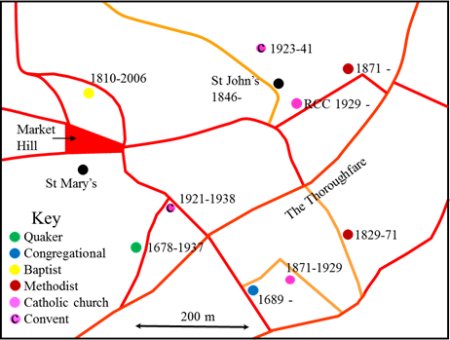
In many towns and villages the Dissenters built their places of worship well away from the parish churches but as this map shows this was not the case in Woodbridge. The map shows the locations of parish church of St Mary’s, the associated church of and St John's and the places of worship of the Dissenters and Roman Catholics. The events leading up the to the building of these places of worship, and their subsequent development, are set out in the displays that follow.
Map showing the locations of the parish church of St Mary,
the associated church of St John and the places of worship
of the Dissenters and the Roman Catholics. The dates
shown are the year of consecration and when
the place of worship closed.