The Liberty of St Etheldreda
From the late Anglo Saxon period until 1930, the legal system in Woodbridge, and in the surrounding area, was linked to the Liberty of St Etheldreda. The evolution of this Liberty, and that of the legal system and the policing within it, will be described here.
When the small Anglo-Saxon kingdoms began to coalesce into bigger ones, the kings started to compose laws which sought to compensate the victims of crime rather than punish offenders. To cover the cases where the parties could not agree on the amount of compensation there was a tariff fixed according to the social status of the injured party.
Enforcing these early laws proved to be difficult so, by the late Anglo Saxon period, kings started to intervene to punish those who committed crimes. This led to the gradual emergence of the concept of a breach of the king’s peace. An offender could no longer redeem himself by the payment of compensation to the injured party, but was now entirely at the mercy of the king. For serious offences, which ranged from theft to murder, the penalty was usually death and the king received the land and worldly goods of all those who were executed. Minor offences were dealt with by a period in a pillory or stocks.
The duty of identifying and apprehending the persons believed to have committed crimes remained the responsibility of the community. The community in each hundred, a subdivision of the counties (shire) also played an essential part in the trials of those accused of committed a crime.
The Hundreds
Domesday Book, complied in 1086, lists 25 hundreds in Suffolk, but by 1800 the number had been reduced to 21. Woodbridge was part of the Loes hundred.
Each hundred had a court which administered the law and endeavoured to spread equitably the fiscal demands of the king. Most men living in the hundred could attend its court and its judgments were decided by them. The men were guided, but not controlled, by the sheriff (the ‘king’s reeve’) who presided. All crimes committed in the hundred were presented to the court and those which were considered to be outside its jurisdiction were forwarded to a biannual county court which was presided over by an eorl and a bishop.
The Liberties in Suffolk
In some parts of the country the rights of the king were passed to privileged magnates or ecclesiastic foundations. The legal system within these areas, which are called Liberties, was structured in the same way as that in the rest of the country but it was supervised by the magnates or the ecclesiastic foundations. Moreover, they received any fines imposed and the land and goods of those who were executed. In effect the legal system in each area operated as a mini-shire and there was a steward and bailiff rather than a sheriff.
The county of Suffolk was unusual in that it contained two Liberties and the boundaries of each are shown here. The Liberty of St. Edmund was granted to St Edmund’s Abbey and The Liberty of St Etheldreda was granted to Ely Abbey. Less than half of Suffolk was under royal jurisdiction and, because of this, Suffolk shared a sheriff with Norfolk until 1576.
The extent of the Liberty of St Edmund and the Liberty of St Etheldreda. The latter encompassed the hundreds of Loes, Thredling, Plomesgate, Carlford, Wilford and Colneis.

.
The Origin of the Liberty of St Etheldreda
The Liberty of St Etheldreda was first recorded in a document relating to the rededication of Ely Abbey in 970. This abbey was the result of an endowment at Ely by Etheldreda, the daughter of King Anna, who ruled East Anglia from 636-654. It is believed that the Liberty of St Etheldreda was even older than the earliest reference to it, and that it was part of the original endowment of a convent founded at Ely by Etheldreda in 673. This convent eventually became part of Ely Abbey.
The Liberty of St Etheldreda encompassed the former Royal Hall at Rendlesham and the royal pagan ship burials at Sutton Hoo and Snape. It was thus the heartland of the pagan Kingdom of East Anglia. Some historians suggest that the decision to grant away this area to a monastery may have been an action to distance the, then Christian, royal family from its pagan past. The first Christian Kings of East Anglia, Sigeberht and Anna, were both buried outside the area which became the Liberty as was the Royal Hall which Anna moved from Rendlesham to Blythburgh.
Link to more on St Etheldreda.
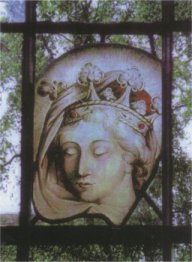
St Etheldreda depicted in a window at Ely Cathedral