Local Governance
The Role of the Parish Vestry
For many centuries most aspects of people's lives were determined by the lord of the manor in which they lived. By the sixteenth century, however, people in towns and villages were increasingly working together to improve their living conditions.
During the sixteenth and seventeenth centuries successive Acts of Parliament made the parish vestry responsible for many functions which are now associated with central or local government. The vestry had previously been a purely ecclesiastical organisation which brought together parishioners to discuss church business. It was also able to levy a rate for improvements and so it was a logical step for Parliament to require it to impose a rate for social purposes. The vestries were initially made responsible for the management of the highways and subsequently for the dealing with the poor, enforcing the law, organising defences against fire and for local militia. Various parish officers were required for these tasks and their service was often compulsory and unpaid.
The period from the mid sixteenth century until second half of the nineteenth century was the heyday of local government at the parish level. The state's main responsibilities were to conduct foreign policy and to defend the realm. There were no state departments to oversee the implementation of the Parliamentary Acts so all matters of governance, which impinged on the lives of ordinary people, were the responsibility of local people.
Dealing with the poor was by far the most onerous, and most expensive, task that parishes had to perform. From the outset the overriding principle was that the costs of providing relief for the poor should be defrayed out of local taxes gathered by local officials from the inhabitants of the parish in which the expenses had been incurred.
Implementing the First Poor Law Act in Woodbridge - 1597 to 1834
By the start of the sixteenth century enclosures and an increase in sheep farming had left many families without land or an income. They faced the prospect of either starving, begging in their local community or joining the bands of vagrants who were wandering the country in search of a living. Most of the vagrants were passive individuals who were just a nuisance to the people they begged from but the pervading view was that they belonged to organised criminal gangs. This thinking was reflected in much of the early legislation passed from 1495 to 1572. The features which worked best were eventually enshrined in the Poor Law Acts of 1597 and 1601. The procedures and institutions established by these Acts remained in place for just over two hundred years.
To help the deserving poor parishes provided out-relief to those who could continue to live in their own homes and in-relief in workhouses to those who could not. Care for the aged, orphans, widows and the sick could be provided in institutions which became known as hospitals. Pauper children were to be apprenticed and the undeserving poor, usually vagrants from other parishes, were to be punished in a house of correction.

Vagrants who wandered the land
seeking employment were feared
rather than pitied.
The money required to provide these services had to be raised by levying a Poor Rate on everybody who occupied land and the amount paid depended on the annual rental value of the land. The poor rate was set by the two Overseers of the Poor who were appointed annually by each vestry. Justices of the peace were made responsible for ensuring that the vestries carried out the duties assigned to them.
There are few details of collections for the poor in Woodbridge during the sixteenth century but in the 1580s the Court Rolls of the manor of Woodbridge late Priory refer to houses which had been given to the town for the relief of the poor. The houses are later referred to the poors' houses or the town's houses. In many cases the town was not given money to maintain these houses so they fell into disrepair and some had to be sold.
The earliest reference to a house of correction in Woodbridge is in the Court Rolls for 1587. It appears to have been in what is now the house at 93, New Street. From other references it seems that the workhouse was also established in the same building.
After the battle of Sole Bay in May 1672 Woodbridge was forced to take some of the large number of Dutch who had been captured. To do so the churchwardens decided to enlarge the house of correction on New Street and to create a separate workhouse.
The New Street house of correction closed in 1804 and the building was converted into a hospital for the frail poor. It was divided up into many apartments where the poor lived rent free. In the 1960s it was sold and became a private residence. The money raised was used to a form a Trust which looks after almshouses which were built, in 1908, at the back of the former house of correction.
Link to Charitable Bequests to Help the Poor
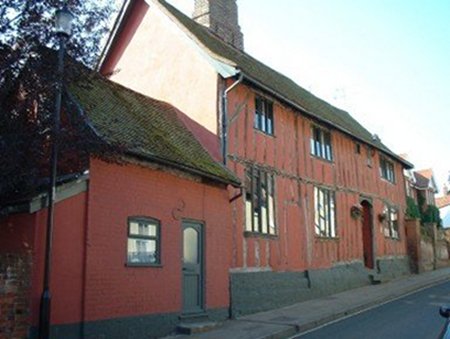
The house on New Street which was initially used both as a house of correction and as a workhouse.