Maintenance of the Highways
By the end of the 15th century most roads were little more than dirt tracks that were very rough and dusty in summer and muddy in winter. Under the Tudors there was an increase in commerce and as a result traffic on the roads increased. Rising concern about the state of the main roads - the highways - led to Parliament passing the Highways Act in 1555.
The Act made each parish vestry responsible for the maintenance of the highways within its boundaries and required them to appoint a surveyor of highways who had to survey the highways three times a year. The surveyor also had to organise any necessary repair to them by calling on all householders to provide labour.

Most highways were in a terrible state especially in winter.
The State of the Roads in Woodbridge
The streets within Woodbridge during the sixteenth century, as in most towns, had a surface of compressed gravel and sand. The parish would have paid for the upkeep of its roads by collecting tolls from the owners of carts that came to the weekly market. The toll levied often depended on the size of the cart wheels. The first major improvement in the roads running through the town appears to have been the paving of Church Street with stones in the early seventeenth century. By 1662 its name had been changed to Stone Street. The Thoroughfare was paved by general subscription in 1753.
William Lockwood, who was born in Woodbridge in the early nineteenth century, recalls that by then the main streets of Woodbridge were paved with cobble stone “not dissimilar in shape to Swedish turnips”. The narrowest streets, Church Street, Cumberland Street and New Street were paved with such stones from side to side close up to the houses. They sloped towards a gutter in the middle of the roadway to collect rainwater. There were no pavements for pedestrians. They had to hobble as best they could on the sloping roadway. The other streets in Woodbridge still had a surface of compressed gravel and sand.
.
Introduction of Charging Those Who Used the Roads
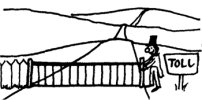
A major step forward in improving the maintenance of the nation’s highways was achieved in 1663. An Act of Parliament was passed enabling justices of the peace to levy tolls on travellers for the repair of that part of the Great North Road which passed through Hertfordshire, Huntingdonshire or Cambridgeshire. To prevent people avoiding paying these tolls, further legislation was passed in 1695 to allow the roads to be blocked by spikes. When the toll had been paid the spikes were turned so they lay on the highway and the carriage was thus able to pass through. Although turnpikes were soon replaced by gates, the name “Turnpike” survived and is still used in America.
By 1700 seven Local Acts of Parliament authorizing Turnpike Trusts had been passed. From 1700 to 1750 they averaged ten a year and between 1750 and 1790 as many as forty a year. The last decade of the eighteenth century saw an average of fifty Local Acts of Parliament setting up Turnpike Trusts every year. This was, however, not always an altruistic action. It was also a means by which some owners of large amounts of land could make money. Nevertheless it soon became an accepted principle that those who used the roads were made to pay for the maintenance and improvement of them.
The Suffolk Turnpikes
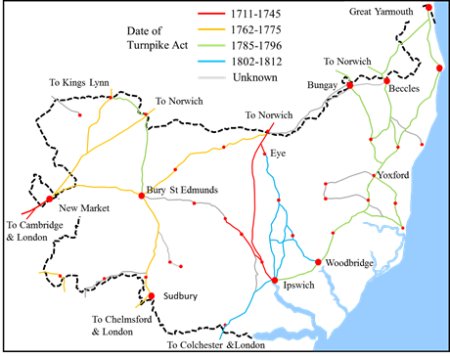
This map shows the turnpikes created in Suffolk. Each is colour coded to indicate when the Act creating them was passed. The Ipswich-Woodbridge-Great Yarmouth turnpike was approved by Parliament in 1785, and the Woodbridge-Debenham-Eye Turnpike in 1802.
The 18th century was the great era of coaching. Improved roads and better coach design increased the speed of travel considerably. The 'expresses' were the Royal Mail coaches which were first introduced in 1784. The service from London to Norwich was started in 1785, and from London to Ipswich in1791. By 1836 four Royal Mail routes crossed Suffolk: London to Norwich via Newmarket, Bury and Thetford; London to Norwich via Ipswich and Scole and London to Yarmouth via Ipswich and Lowestoft. Complementing these services were cross-country and local coaches.
The Suffolk Turnpikes. The colours indicate
the period when the Local Act of Parliament
which created them was passed.