Thomas Seckford - Benefactor of the Aged and the Poor
Throughout the Middle Ages men of fortune followed the customary practice of leaving from a third to a half of their movable goods to endow an institution of permanent value to the community. Such benefactions appealed to the constructive and practical outlook of many of the wealthier merchants and tradesmen. Sometimes schools or public granaries were founded but almshouses for the aged poor were much more popular.
Of all the bequests made by Woodbridge people to benefit the poor, it is the one by Thomas Seckford in 1587 which had the greatest impact at the time. Moreover, it eventually led to the creation of the Seckford Foundation which continues to a play a major role in the life of the town today.
.
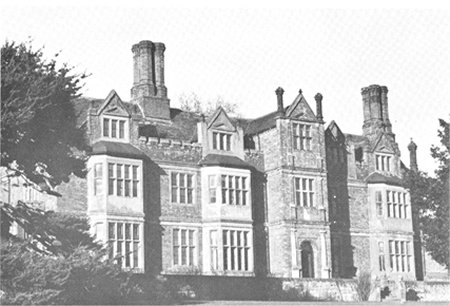
Thomas Seckford, who was born in 1515 at Seckford Hall near Woodbridge, became an eminent lawyer and was one of the two masters of the Court of Requests. The function of this court was to "hear and settle poor men's complaints with as little cost as possible and to exercise compassion as far as this was compatible with speed and justice." Complaints were presented in the form of petitions to the Queen as she moved around the country and one of the two Masters of the Court of Requests always travelled with her. Thomas Seckford had a large house and estate in Clerkenwell (London) and another in Ipswich where he was MP for a number of years. In 1564 he purchased the manor of Woodbridge late Priory from Elizabeth I and built his third house, which he named The Abbey, on the site of the former Priory.
The Abbey, the house which Thomas Seckford
built on the site of the former priory.
.
Thomas Seckford’s Bequest
Seckford died in 1588 and, during that year, he obtained a licence from Elizabeth I to found an “almshouse, based on seven tenements which he had recently built in Woodbridge, for the constant residence of thirteen poor men”. Seckford ordained that the 13 almsmen should have a yearly supply of fuel and gowns and an annual stipend. They were also to have use of the gardens, of about 3 acres of land near the almshouses, and of the well and fountain in his newly enclosed park around The Abbey.
The Almshouses consisted of "seven rooms of brick and stone, and a garret in every one of them". One of the almsmen, called the "Principal poor man" was held responsible for the good behaviour and discipline of the others. The Principal poor man had a room to himself, but the other almsmen had to share two to a room. Each of these rooms was attached to a piece of garden. The annual stipend was £5 (£6 13s 6d for the Principal).
Thomas Seckford also ordained that the tenement called Copthall, and 2 acres of land, should be used for 3 poor widows to act as nurses to any of the poor men who should happen to be sick or infirm. The annual stipend of these nurses was £2 13s 4d.
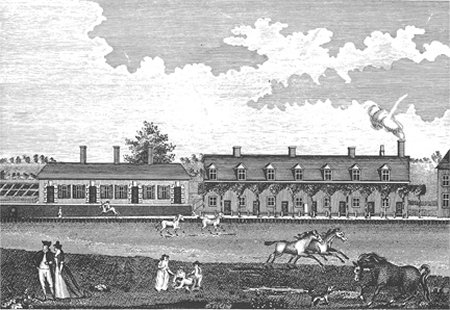
An engraving showing the almshouses (right) and nurses' residence (left) in 1792. The almshouses had been rebuilt in 1733 following a fire. The nurses' residence was built in 1748 because the old one proved to be inconveniently situated and needed repair.
Seckford died within months of his almshouses being licensed by Queen Elizabeth and in his will the almshouses were endowed with various houses, buildings, yards and gardens in the parish of St James, Clerkenwell. The rents from these properties yielded £112 per annum. This provided the £94 needed to cover the pensions, gowns and wood for the poor almsmen. From the residue Seckford wanted payments to be made to the poor of Clerkenwell and of Woodbridge and to Christ's Hospital, Ipswich.
The size of Seckford’s bequest was not extraordinary by Elizabethan standards but the land in Clerkenwell, with which he endowed his almshouses, became much more valuable as London grew. The rents received for this land soon became far more than was needed by the almshouses and the residue was allowed to accumulate for over two centuries. It was this accumulated revenue which was to have a significant impact, during the nineteenth century, on both the care of the elderly and on education in Woodbridge.
Seckford’s wife died the year before he made his bequest and, as there were no children, he specified that the affairs of the almshouse were to be managed by two governors, the Chief Justice of the Court of Common Pleas and the Lord of the Manor of Seckford Hall. In the event that the male line of Seckfords failed, the other governor was to be the Master of the Rolls. It was just as well that Seckford made this provision because the male line ended in 1683.
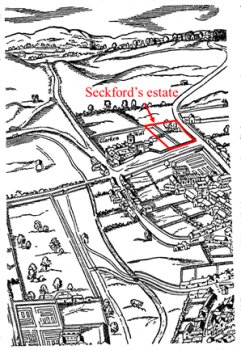
Seckford’s estate marked on an extract of a Ralph Agas’ map of London in circa 1560-70. It was about 1 mile away from St Paul’s Cathedral. It was where the air "was clean and wholesome".