Evolution of Education
Woodbridge Grammar School
For centuries the children of the rich were taught at home by tutors and some of the less wealthy paid for their children to attend small schools that sprang up to meet a local need. For children from the poorest strata of society education was not usually a possibility - every child had to earn their keep as quickly as possible. Only those who were very bright would have been invited to attend a grammar school established either by ecclesiastical bodies, religious guilds or private benefactors.
In 1577 Thomas Arnott, a Lowestoft merchant who had been born in Woodbridge, bequeathed tenements to provide money to support a Free School for boys “knowing that the town was poor and populous and for the love he bore it”. The school was established in what is now 11, Theatre Street. The building later became the parish workhouse.
Thomas Arnott had previously set up a similar institution in Lowestoft to provide education for 40 boys. There he stated his intentions thus “Lowestoft being a populous town facing the sea, inhabited chiefly by mariners and sea faring men, being replenished with a great number of youths, who are very uncivil and ignorant for want of good instruction and education, of my goodly zeal towards the bringing up of the said youths in virtue and learning, I bequeath...". It seems likely that his intentions were similar in Woodbridge.
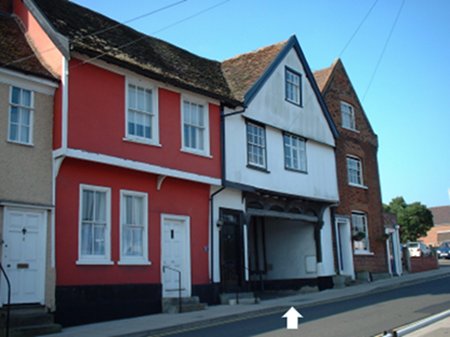
The building on Theatre Street which was used for the Woodbridge Free School.
Legal action over the terms of Arnott's bequest reduced the money available to the Free School which eventually had to close in 1647. The loss of the school was a serious blow to the town so, in 1662, three local people decided to create the Woodbridge Grammar School. They were Robert Marryott, Francis Burwell and Dorothy Seckford, the last of the Seckford family. The constitution of the new school stated that the school master was to receive £25 a year to teach 10 boys “sons of the meaner sort of the inhabitants of the town of Woodbridge”. He could charge £1 per annum to teach the sons of other inhabitants of Woodbridge. The constitution also made it clear that the aim was to educate the pupils “thereby they may be fit for University” but that if they were incapable of learning Latin and Greek “to fit them for trades or to go to sea”.
Robert Marryott gave a house abutting the north end of the churchyard for the use and residence of a Schoolmaster. When the number of scholars increased the house was found to be too small, and it was enlarged in 1665, 1670 and 1694 by public subscription. The income of the school was also increased by the rents received from three acres of agricultural land which was given by Francis Willard in 1679.
During the period 1793 to 1814, when there was a barracks near the town, the Free Grammar School attracted pupils from the families of the officers. After the departure of the troops, however, the school went into decline. A significant improvement in the fortunes of the school did not occur until 1861 and by then the provision of education in the town had been broadened.
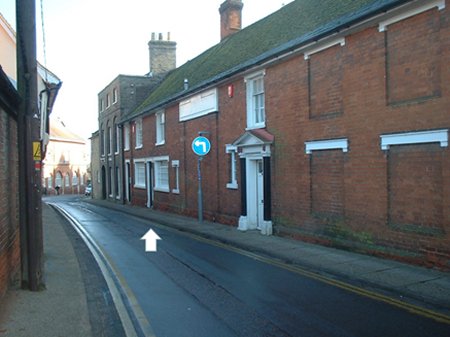
The house on Seckford Street in which the Woodbridge Grammar School started.
Schools providing a rudimentary education to all had been created in some parts of the country by the end of the eighteenth century. During the early decades of the nineteenth century they became widespread. Most of these ‘charity’ or ‘voluntary’ schools were established by religious organizations. Anglicans supported the National Schools and non-conformists supported the British and Foreign Schools. The rudimentary education these schools provided became known as “elementary education”.
A decision to open a National School in Woodbridge was made in 1812 by the “Suffolk Society for the Education of the Poor in the Principles of the Established Church”. The school on Burkitt Road opened in October 1813 and pupils had to pay ½d a week. This was increased to 1d a week in 1818 and parents who could afford it were asked to pay 24s a year. The school was considerably expanded during the 20th century but the original thatched roofed building is still part of the present school.
In 1844 the National School opened an infants department in the former workhouse on Theatre Street. Eighteen years later the department moved across the street into what had previously been the Woodbridge Theatre. The infant department was eventually incorporated into the Burkitt Road site in 1962.
Link to article on Woodbridge Theatre.
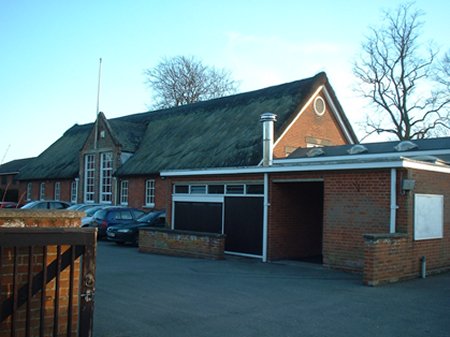
The National School started in the thatched building in the centre of this picture and has since expanded.