Woodbridge During the Napoleonic War
The Barracks
During the Napoleonic War (1796 to 1815) there was a barracks, for over 4000 troops, on the outskirts of the town.
The troops were initially in a tented barracks at Bromeswell. This is on the other side of the Deben just above the Wilford Bridge crossing. From there the troops could be deployed rapidly to defend the coast either side of the Deben estuary.
A painting of the barracks is shown on the right. In the lower right hand corner there is a depiction of “camp followers” - women, and their children, who followed their men around the country. The camp followers lived in dwellings constructed from turfs and earned money by doing the troops’ washing and by nursing sick soldiers. It was a pitiable life and such scenes were common in fields around many other barracks.
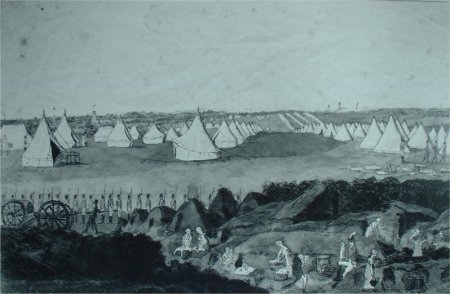
A painting of the tented barracks at Bromeswell
In 1803 the tented barracks was replaced by a timber barracks just within the Woodbridge parish boundary. It could accommodate 765 Cavalry Officers and 4165 Infantry Officers and men.
As the map on the right shows, the barracks was some distance from the built up area of the town. Contemporary accounts indicate that the army tried to minimise the disturbance it caused on the life of the town and that the relationship between the town and the army was harmonious.
Some of the officers and their wives lived in the town, mainly along Cumberland Street. Their presence, and the provisioning of the troops at the barracks, was of great benefit to the commerce in the town. For example, one of the two local breweries was sending a dray, carrying six barrels of beer, to the barracks three times a day.

Location of the barracks relative to the built up area of the town.
A detailed plan of the barracks was produced by the local surveyor Isaac Johnson. A simplified version of it is shown here. The infantry were on the right and cavalry on the left. All the buildings were single storey and had the same general appearance. To alert the troops to an invasion, two signal towers (Gazebos) were built adjacent to the barracks. From these towers it was possible to communicate (by flags and telescopes) with similar towers at Felixstowe and Bawdsey.
The barracks included a large hospital and there was an Inn, The Duke of York, just outside the main gate to provide entertainment and relaxation for the troops.
After Napoleon had been defeated in 1814, and exiled to the island of Elba, it was decided to pull down the barracks and in April 1815 a wide range of items from it were auctioned. The site was returned to agriculture until most of it was used for housing during the second half of twentieth century.
Plan of the barracks superimposed on a 1976 OS map

A simplified version of Isaac Johnson's plan of Woodbridge barracks in 1804.
When the Napoleonic Wars were over the great army built up by Wellington was disbanded as were most of the Auxiliary Forces. The latter consisted of the militia, an ancient force which, from 1558, was organized by the Lord Lieutenants of each county, and various companies of volunteers. These companies had formed, initially without any formal statutory recognition, as a result of widespread fear of an invasion during the Napoleonic War. The only Auxiliary Forces which remained active after the war ended were the militia and the Yeomanry, the mounted arm of the volunteer forces, which drew its men from the landed gentry, tenant farmers and small landowners. The government recognised that such an armed force, which was highly mobile, was needed to deal with riotous mobs.
Images relating to the Suffolk Yeomanry, the East Suffolk Militia and the Woodbridge Rifle Club
One of the troops of the Suffolk Yeomanry was based in Woodbridge and there were several occasions during the nineteenth century when they were called out to counter fears of civil insubordination and unrest resulting from the deterioration of the agricultural economy.
By the mid nineteenth century there was another threat of a French invasion and rifle clubs, up and down the country, started to form Rifle Volunteer Corps which were soon officially made part of the Auxiliary Forces. A Rifle Club was established in Woodbridge. It had an outdoor shooting range on Fen Meadow and an indoor range in the Bull Ride. Whether or not the members were part of Rifle Volunteer Corps remains uncertain.
There were also two quasi military organizations in the town. Woodbridge School had an Officer Training Core and St Mary’s Church had a Church Lads’ Brigade. The origin of the Church Lads’ Brigade is obscure but one source indicates that it was a national institution formed in the late 1880s for boys over 14 and that, from 1911 to 1930, it became the largest force of cadets in the country. The Officer Training Core and the Church Lads’ Brigade both took part in a combined Church Parade in St Mary's during March 1914.