Woodbridge During the Second World War
During the Second World War regiments, including the Liverpool Scottish and the Beds and Herts, occupied some of the larger houses in and around Woodbridge. The Suffolk War Agricultural Committee also had an office at Fern Hill House in the adjoining parish of Melton.
An Officers Commando Army Training School was established across the River on the other side of the estuary Sutton side and soldiers, during their off duty hours, used the services of the ferry to visit the Woodbridge Inns. Those who wished to remain sober could visit the ‘service canteens’, run by members of the churches and chapels, where “a very welcome ‘cuppa’ and homemade cakes could be obtained, for a few pence, and a game of ping-pong played”.
Woodbridge was not bombed during the War but crashed aircraft, both friendly and alien, were quite numerous in the area. The Woodbridge Red Cross Detachments established a First Aid Post in a building behind the Crown Hotel. It was manned every night but never put to the test. The Red Cross Detachments were, however, called upon to help casualties when other towns in the area were bombed.
The Air Raid Precaution Service and the Home Guard
The Air Raid Precaution (ARP) Service was set up in 1938 and it recruited air raid wardens, auxiliary firemen, special constables, gas decontamination squads, first-aid parties, rescue parties, etc. By September 1939, 1 million men and women had been enrolled. They were backed up by other organisations, such as the Red Cross Voluntary Aid Detachment and the Women's Voluntary Services, who operated mobile canteens and cared for evacuees and bombed-out people.
The Woodbridge ARP Service had a post in the former maltings behind the Crown Hotel. They were called out to assist when Wickham Market and Aldeburgh were bombed and when there were air crashes in the Woodbridge Area.
The Home Guard was formed when invasion threatened two weeks before Dunkirk. A few of the men in the Home Guard were issued with Sten guns but the rest had 12 bores. All wore uniforms, carried a spy-light pack and ammunition pouches. They kept their ammunition at home when not on duty.
The Woodbridge Home Guard was recruited at the Army Drill Hall, Station Road, which had built been in 1920 for the Territorial Army. The recruits were under orders to blow up Wilford Bridge should an invasion occur. At first all of them rushed to the bridge every time a siren went off. Later five members of the Home Guard were permanently on duty at the bridge and they called on reserves as needed. Every member had four nights a week when they had to sleep at the Headquarters at Ivy Lodge, Cumberland Street. They took it in turn to keep awake next to the telephone. Officers from the regular army (at Bury St Edmunds) were in charge.
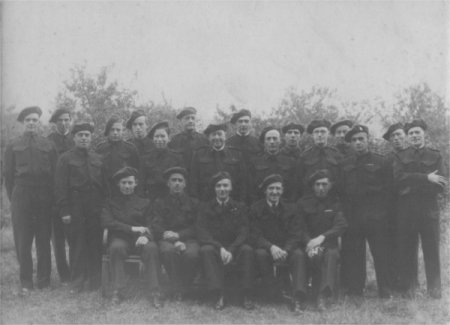
Members of the Woodbridge ARP First Aid Party.
The Women’s Land Army
At times up to a hundred women, the majority of whom were with the Women’s Land Army, were involved in either market gardening or farming in the Woodbridge area. Some of them were volunteers and the remainder were called up. They could expect to do a wide range of agricultural work for a wage of 1 guinea a week (paid by the Suffolk War Agricultural Committee) and they had two paid holidays a year, at Christmas and Easter.
The 'Land Girls' came from all over the country. Some lived with the farmer’s family, and others in hostels under the care of a warden. There were hostels around Woodbridge at Little Manor Hasketon, Sutton Rectory, Sutton Hoo House and Grundisburgh Hall. The girls in the hostels were given a good breakfast and a packed lunch of two rounds of bread plus a piece of cake and a thermos flask for two. A lorry would pick them up at 7.30 in the morning and take them to their place of work. Lunch break was only half an hour.
At a time when conservation of all types of food was vital, Woodbridge Council offered one penny for each rat’s tail taken to their Offices and this gave children an opportunity to help the war effort. A Woodbridge resident recalls that, despite many other shortages, she and her 11 to 13 year old friends were able to get pellets for their airguns from shops in the town and that, every winter evening during the holidays, they would go with torches to farm buildings and stack-yard to shoot rats.
Link to reminiscences of Land Army Girls
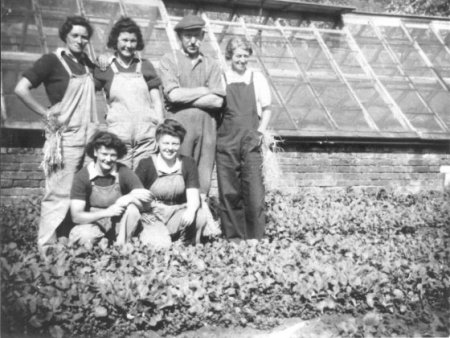
Members of the Women's Land Army with Mr Scarf who ran a market garden in Woodbridge.
Seventy five districts all over the country took part in what was called Warship Week which ran from the 7th to 14th February 1942. In each district there was a drive to get people to lend the Government the money needed to build warships by making deposits in designated Savings Banks. At the start of the week the organizers for Woodbridge, and the 62 parishes of the Deben Rural District set a target of £210,000 for the hull of the destroyer HMS Easton. By the end of the week some £228,633 had been raised, an average of £8 per head of population.
Each district was given a plaque, to commemorate the adoption of the warship for which they had raised money, and a number of copies of the ship's crest. The plaque received by the Woodbridge and Deben district now hanging in the Shire Hall.
There was already a warship bearing a name that would have been more appropriate to the town. She was HMS Woodbridge Haven, a 'Loch' class frigate which had been built at Chatham dockyards.
Prior to raising money for HMS Easton the people of Woodbridge had raised money for the Spitfire Fund and for War Weapons Week.