Evolution of the Town and its Maritime Trade
The Early Anglo-Saxon Settlements in the surrounding area
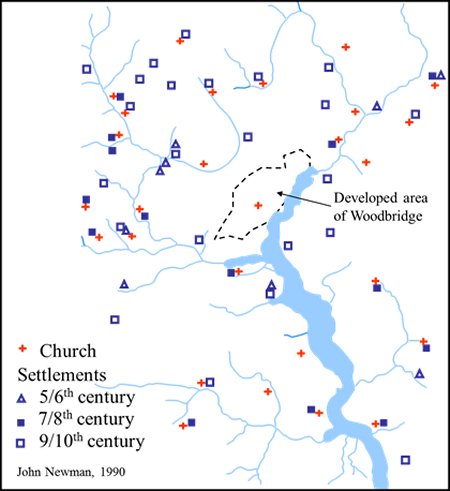
Traces of many Anglo-Saxon settlements have been found around the upper part of the Deben estuary. The locations of these settlements and their dates are indicated by the blue symbols on this map. In most cases the settlements were near churches built during the Anglo-Saxon period. These churches are marked by red crosses.
No evidence of an Anglo Saxon settlement has yet been found in Woodbridge but it is likely to be under the medieval houses near to the church. Although many of the houses now have brick facades their foundations and the layout of the roads have remained unchanged for many centuries.
Hundreds of years of farming and habitation have reduced the signs of the early settlements to scattered pieces of pottery and the occasional pieces of metal work. The only exception in south east Suffolk is at Burrow Hill which is by the coast.
The Anglo Saxon churches and settlements around
the upper part of the Deben estuary
This map below shows the location of Burrow Hill which was at one time an island mainly composed of shingle. The rich farmland which now surrounds it is the result of reclaiming the salt mash which formed when the Orford Ness shingle spit grew and diverted the rivers Alde and Butley.
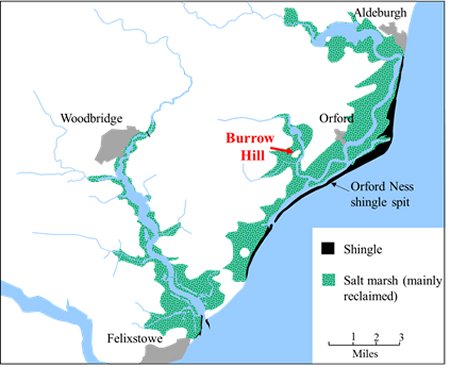
Map showing the location of Burrow Hill.
Burrow Hill is in the foreground the aerial view below. The Butley River in the centre and the River Ore and the Orford Ness shingle spit are in the distance. (The River Alde becomes the River Ore when it passes Orford.)
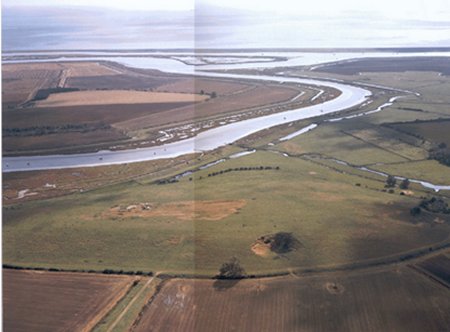
Aerial view with Burrow Hill in the foreground, the River Butley in the centre and the River Ore and the Orford Ness shingle split in the distance.
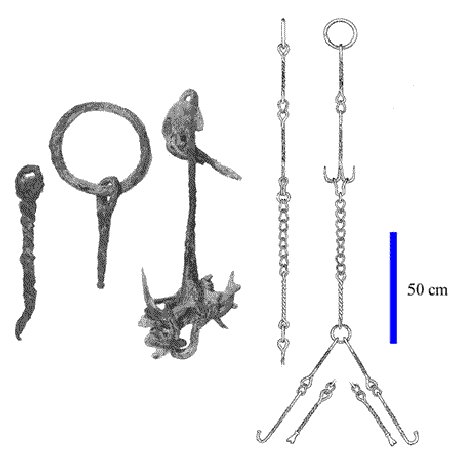
In 1963 the remains of Anglo-Saxon cauldron chain were found, by chance, on Burrow Hill. Parts of the chain, and a reconstruction of it, are shown here. They are both at Ipswich Museum.
A team of archaeologists excavated the site from 1978 to 1981 and found traces of a settlement protected by three V shaped ditches. Within the area enclosed by these ditches there were numerous pits and the post holes of timber framed buildings.
Amongst the objects found on the site were coins from the reign of King Beonna (749 to circa 760). Many of the other objects are on display at Woodbridge Museum, Similar objects would have been used in the settlements which lined the Deben valley 1200 years ago.
Some of the elements of the cauldron-chain found in 1963. They are now on display at Ipswich Museum as is the reconstruction on the left.
Other items from Burrow Hill are shown on the next three pages