The Augustinian Priory
An Augustinian Priory was founded at Woodbridge, in 1193, by Ernald Ruffus on land granted by the Bigod family. (The Augustinians came from Normandy). The Priory was also given other land in Woodbridge, Hasketon, Burgh. The head of the Priory was called a prior and he would have had the same control over the people who lived in the land granted to the Priory as did any other manorial lord. All inhabitants (tenants) of the Manor of Woodbridge Priory thus had obligations to the prior and they had to spend a specified time working on his land. In return they would be given a small amount of land on which they could grow food for their families.
Woodbridge Priory was small, and it probably never had more than the prior and about 12 canons whose main duty was to go out and preach in the surrounding communities. The Priory, the building in which they lived, was built adjacent to the much later St Mary's Church in Woodbridge. The canons did not have a church of their own, they shared the church in Woodbridge with the townspeople for over 200 years.
There had been a Tide Mill by the riverside from at least 1171 when Baldwin of Ufford granted tithes, from his mill in Woodbridge, to the canons of Butley Priory. Then, sometime between 1195 and 1213, Butley Priory transferred these tithes to Woodbridge Priory.
The Priory acquired market rights for Woodbridge in 1224. This gave the Priory the right to organize a market and to levy tolls on those selling goods at it. Soon after the market became established it is likely that Woodbridge began to flourish as a port which exported the produce grown in the surrounding country side.
In 1436 the Lord of the Manor of Woodbridge Ufford (then Robert Willoughby) granted the “Key and Pool” to the Prior of Woodbridge and the canons thereby became owners of the Tide Mill. Their venture by the waterside would have brought benefits to the Priory and would have strengthened the links between the seafaring community of the town and the canons.
The relationship between the Priory and the townspeople appears to have been harmonious. Woodbridge wills contain a number of bequests to individual canons and, when the peasants rose in revolt in 1381, they marched through the town without rioting or touching the Priory. Surrounding areas weren't so lucky. The Manor houses of Melton, Bawdsey and Hollesley were burnt and the Court Rolls and taxation records destroyed.
The people of Woodbridge were also prepared to help the Priory pay for repair costs to its water mill and they lent money to maintain the mill-pond and the river banks. But ultimately the mill and its upkeep put a great strain on the limited resources of the Priory and eventually the poverty of the House was attributed to the expense of maintaining the tide-mill and the mill banks.
Maritime and other commercial activities brought wealth to the town and by the mid-fifteenth century merchants had funded the building of the new parish church of St Mary's in fine perpendicular style. Work on the chancel and the nave started in about 1417 and they were finished about 27 years later. The Anglo-Saxon church was left standing for the use of the Priory.
In 1532 Bishop Nykke, after one the regular visitations (inspections) that Bishops made of monastic houses, reported that Woodbridge Priory was in debt and disrepair and that the Priory Church was in ruins. This was not a good time for such a negative report to be made. Five small Suffolk monastic houses had been among the 30 confiscated in the 1520's by Cardinal Wolsey to support his great educational schemes at Oxford and Ipswich and by 1530 Henry VIII was looking for additional income to fund improved defences against invasion by the French and the Spanish. In 1536 Parliament passed an act which lead to the critical inspection and subsequent dissolution of many of the smaller monasteries and, from 1538 to 1540, the remaining smaller houses and all the larger houses were persuaded to close and surrender their property to the King.
Woodbridge Priory was dissolved in 1536 and Henry Bassingbourne, the last prior of Woodbridge, became Rector of Melton. He had been appointed Prior in 1530. Four years later he, like most of the clergy, swore allegiance to Henry VIII as Head of the Church in England.
Many of the early monasteries to be dissolved were given to supporters of the King. In 1536 the Duke of Norfolk, who had already received a gift of 13 rich abbeys, requested Woodbridge Priory as well. His request was refused but he appears to be granted some of the land the Priory used for its garden. These lands were later passed to Thomas Steynings, of Woodbridge.
The rest of the Manor of Woodbridge late Priory was leased, in 1538, for 21 years to Sir Anthony Wingfield of Hasketon and in 1547 it was transferred to Sir John Wingfield. On the death of Sir John in 1549 his widow Dorothy became Lady of the manor.
The Priory Church was is believed to have been demolished in 1542 and it is probable that the Priory buildings suffered the same fate at that time. However, the Suffolk Historian, Vincent Redstone, was convinced that the Priory Church and St Mary’s stood side by side and that were joined along the south wall of the Chancel of St Mary's.
The distance between the Chancel wall and the boundary wall of the churchyard is only 10.7m at its widest point and it narrows to 7.2m. It is thus likely that there was space for the Priory Church. It is not known the when the Priory Church was eventually demolished, but when it was the boundary wall was coated in cement and there were inscribed lines to make it look like blocks of stone.
The boundary wall of the churchyard appears to be unchanged.
In 1564 Queen Elizabeth granted the Manor of Woodbridge late Priory to Thomas Seckford “In consideration of the sum of £764 8s 4d”.
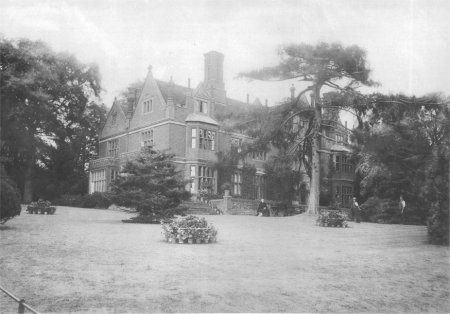
It was Thomas Seckford who constructed the imposing town house which he called The Abbey to give it added status. In order to lay out a park around The Abbey, Seckford had to buy the land which had formerly been the Prior's garden from Thomas Steynings.
Whether or not The Abbey was built on the part of site of the former Woodbridge Priory has long been a matter of dispute. The discovery of some human bones when alteration were made to The Abby, in 1912, to create a long room, has been taken by some to indicate that the site was formerly the burial ground of Woodbridge Priory and not of the former Priory building. An alternative view is set out below.
Rear view of The Abbey in 1885.

This photograph shows that the south wall of the chancel of St Mary's Church is rendered with cement. It is the only part of the exterior of the church not to be finished with knapped flint.
In 1560 a document called an Extent was produced to detail the lands held by the Manor of Woodbridge late Priory. Although the Priory had been dissolved 34 years previously, the Extent contains references to the land surrounding the former priory. From this information it has been possible to produce the map on the right. The roads in the centre of the town were the same as they are today. Those shown in red on the map to the right are based on those on the 1871 OS map. The grey area is where there was housing in 1560. The lime green area was part of the demesne of the manor, the land which the tenants of the manor were obliged to cultivate for the lord of the manor. The blue grey area was mainly parcels of land held by other manors.
The area within the dotted line appears to be extent of the garden around the Priory. It encompassed a large pond referred to as Le Fishponds which is where the canons would have bred fish. The pond depicted on the right is based on the one depicted on an 1827 map so it is important to stress that this pond may not be the same as the one which was there in 1560. It could be that the Le Fishponds was enlarged a few years later to provide the clay needed to make the bricks needed to build The Abbey. It is also possible that Le Fishponds may have been further up Wynchells Brook and the large pond on the map was one created to make the bricks.
By Le Fishponds there was an area called the Pond Yard and nearby there was an area called the Prior's Garden. There is also a reference to Le Dovehouse Garden which was probably associated with the Priory.
The entrance to the Priory was along a path which ran to the south of Fishpond Street (now Seckford Street). This tree line path is clearly shown on an 1827 map of the town and about that time it was being called Monk's Walk. The entrance to the path has long been blocked off but the trees which lined it remain standing and can be seen in the photograph on the right.
The other end of the path is very near the site on which the house named the Abbey was built in the late 1560s. This site is also very near to (i) the former Anglo-Saxon church which once adjoined the southern side of the Chancel of St Mary's Church and (ii) a house which had been occupied by the Prior's farmer (who was presumably responsible for overseeing the tenants who cultivated the demesne of the manor). On the basis of this evidence it seems likely that The Abbey was very near the site of the former Priory.
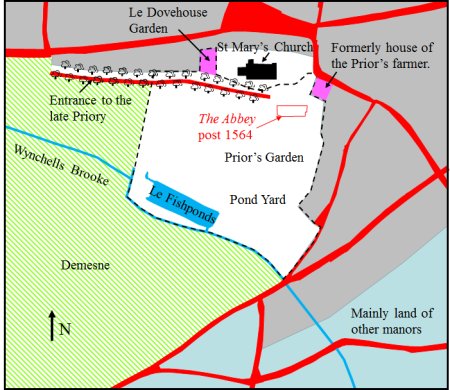
Map, based on the 1560 Extent, of the area around the site of the former Priory
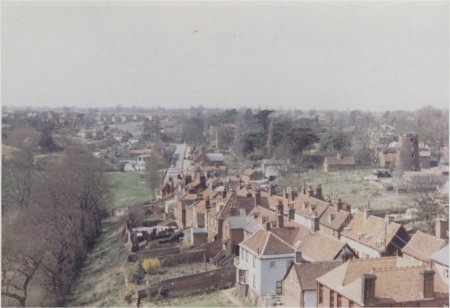
View from the top of St Mary's Church. The trees on the left line the path called Monk's Walk.