Evolution of the Town and its Maritime Trade
The first wave of the Black Death, which was spread by fleas carried by rats, swept through Suffolk in 1349. It, and the waves which followed a few years later, killed between a third and half the population which then remained almost constant for the next two centuries.
The initial impact of the Black Death was devastating but the fall in population resulted in peasants having more land. Consequently their living standards eventually improved and they wanted better quality food, beer, clothing and footwear.
Woodbridge was well placed to provide the food and materials needed and trade through the port thus increased.
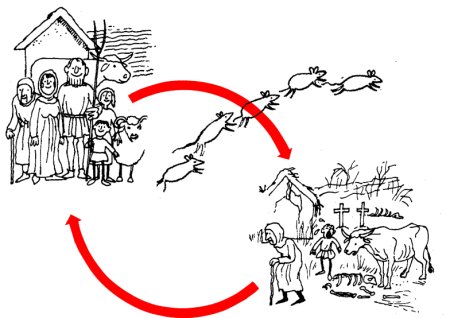
The Black Death was brought by fleas carried by rats. Its initial impact was devastating but the large fall in population eventually resulted in living standards improving.
The increased maritime trade made some Woodbridge Merchants very wealthy and they funded the building of the new Parish Church of St Mary’s in fine perpendicular style. Work on the church, which is shown here, started in 1417 and finished in 1465. The original Anglo-Saxon church remained for the sole use of the priory and the two churches stood side by side.
The priory was dissolved in 1537 and the Anglo Saxon church was demolished 5 years later. It is likely that the priory's other buildings suffered the same fate at that time.
The land formerly held by the priory reverted to the Crown and became the manor of Woodbridge late Priory.
Work on building St Mary’s Church started
in 1417 and ended in about 1465.

By 1524 the towns in Suffolk where woollen cloth was made were becoming prosperous.
The port at Dunwich was in decline because of coastal erosion and this boosted the maritime trade of Woodbridge, Southwold and Aldeburgh.
On the right there is a list of the 25 Suffolk towns and villages whose inhabitants paid the most tax in 1327 and in 1524. The towns and villages are ranked in order of the amount of tax they paid. In 1524 Ipswich paid the most tax and Woodbridge is 10 places below it. The names of the towns which were ports are printed in blue.
Suffolk towns and village listed in order of their wealth in 1327 and 1524. The ports are shaded blue.
1327 1524
Ipswich Ipswich
Bury St Edmunds Lavenham
Sudbury Bury St Edmunds
Beccles Hadleigh
Hoxne Beccles
Mildenhall Long Melford
Eye Sudbury
Stradbroke Nayland
Long Melford Stratford St Mary
Fressingfield East Bergholt
Dunwich Lowestoft
Hadleigh Woodbridge
Orford Dunwich
Walton/Goseford Bures
Mendlesham Bungay
Lavenham Stoke by Nayland
Bungay Glemsford
East Bergholt Southwold
Needham Market Blythburgh
Stowmarket Boxford
Blythburgh Stowmarket
Brandon Aldeburgh
Haverhill Needham Market
Woodbridge Debenham
Debenham Clare