Shipbuilding
Building Boats to be Sailed for Pleasure
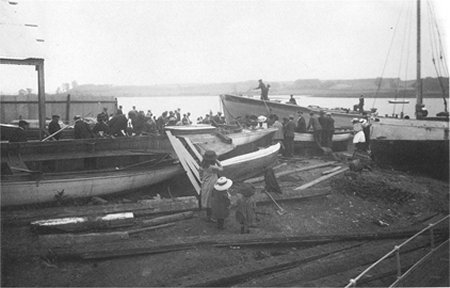
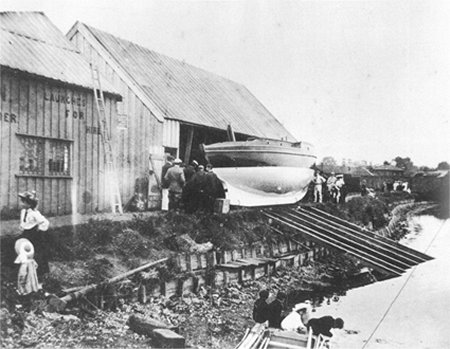
The Lime Kiln Quay boat yard was gradually expanded by Ebenezer’s son 'Robbie’ Robertson and, by the early part of the 20th century, it was well known for its barge yachts. The photographs below show such a vessel being built in 1911 and one being launched in the same year. Their flat bottoms enabled them to sit on the ubiquitous mud of our coast at low tide but their performance in other respects could not match yachts with keels. Accordingly Robertson's switched to making such yachts before the First World War.

A yacht being built at Robertson’s boat yard in 1911.
The yard produced a number of very successful yachts during the 1960s and 70s, and, in 1992, its 28-foot cruising yacht won the accolade of ‘best boat’ at the Plymouth Boat Show. Now repair and refitting are the main activities of the yard but around 70% of this work is still on wooden boats.
A yacht being launched at Robertson’s boat yard in 1911.
Ebenezer Robertson hoped that his son-in-law Alfred Everson would join his son Robbie at the Lime Kiln Quay boat yard but there was ill feeling between the pair. Undaunted Ebenezer, who owned the coal yard at the end of the Avenue, started Everson’s boat yard there in 1889. This yard became well known for building 12ft clinker dinghies and the 3-ton Cherub, a cabin yacht for estuary cruising. The photograph below show a vessel being launched in about 1900 (right) and another in 1934 (left).
In 1912, when Alfred was fifty years old, his yard was destroyed by fire. The yards were rebuilt as the Phoenix works.
The 1939-45 war brought contracts from the Royal Navy to build craft which could use to paint their ships. Enough material was 'liberated' from this project to produce a prototype sailing dinghy, Beaver 1, and then a second version Red Beet which became the first of the 14ft Kingfisher class. A total of 29 Kingfisher dinghies were produced between 1943 and 1963 and several examples of the both Cherub and Kingfisher classes on the Deben today. They are still looked after by the yard that built them. In addition to these craft there has been a regular production of small rowing and sailing dinghies.
A yacht being launched at Everson’s boatyard circa 1900.
In 1989 the yard passed from the Everson family to Peter Derby who had great interest in steam power with his yacht Mrya. A number of yachts were fitted out in the yard using mouldings and equipment from the Pegasus Yacht Company. In the 1980s the business passed to Frank Knights and, in 2001, it was taken over by a small group of local yachtsmen who continued the tradition of individual care for many traditional and modern yachts. The group also provided moorings, winter storage, maintenance and repair.
From 2010 the name of the business was changed to The Woodbridge Boatyard Ltd to make it easier to find on the internet.
In 1889 Alfred Everson had became official time keeper and starter for all Deben Sailing Club races. He started the races from his large jetty using blank cartridges in his 12 bore shotgun.
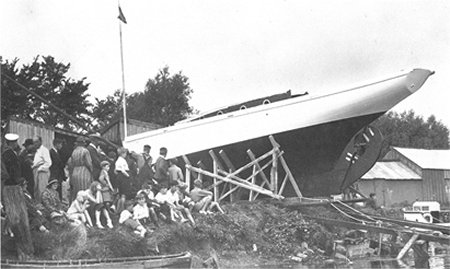
A yacht being launched at Everson’s boatyard circa 1900.
.