Shipbuilding
Building Boats to be Sailed for Pleasure
A third boat yard was created in about 1927 by Claude Whisstock on a marsh abutting the southern side of the causeway leading to the Tide Mill. This marsh is first mentioned in a 1560 document which describes “the land to the south of the causeway leading to towards the tide mill” as being “one acre of marsh, now part built on, late a parcel of le Old Myll Pond”. It is thus likely that the original Tide Mill was replaced when the present, much larger, mill pond was created.
The earliest map showing the area was produced by Isaac Johnson in 1827. By then a causeway had been built which cut the marsh off from the river. An extract from the 1827 map is shown on the right and the red dot identifies the area of marsh which was eventually used for the boatyard.
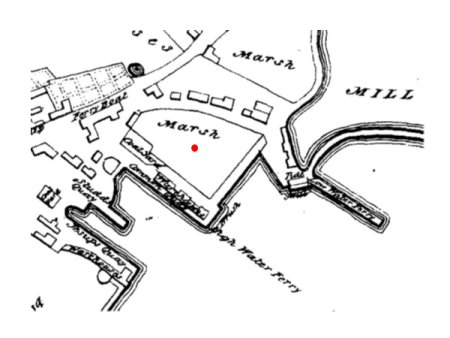
Extract from Isaac Johnson's 1827 map
In 1859 the railway arrived and the top part of the marsh was in-filled to make space for the goods line which ran alongside the main up and down lines. The extent of the remaining marsh is clearly shown by the extract from the 1881 OS map on the right. This map also shows that access to the high water ferry had been moved to the centre of the causeway linking the Ferry Quay to the Tide Mill Quay. Later maps show that the marsh remained unchanged until 1927.
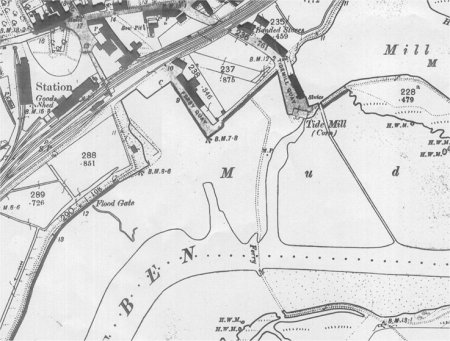
Extract from the 1881 OS map
The photograph on the right was taken from the other side of the estuary in about 1900. It clearly shows the causeway linking the marsh between it and the railway. The steps leading from the causeway to the high water ferry is marked by a red arrow.
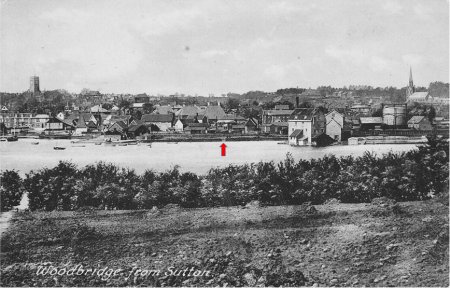
This circa 1900 photograph clearly shows the causeway and the marsh behind it.
In 1926 Claude Whisstock purchased the marsh, between the Ferry Quay and the Tide Mill, and soon after, he built a boatyard there on stilts. When his business expanded all the new buildings and storage areas had concrete foundations. The earliest photograph of his boat yard is shown on the right.

The earliest photograph of Whisstock's boat yard
A slightly later photograph, taken from the other end of the causeway, is shown on the right.
The photograph below show the launching of the Orwell Viking in about 1926, It was a 40ft passenger launch which was used for pleasure trips on the River Orwell. To the right of it is a photograph of the craft after it had been fitted out. Her sister ship, the Deben Viking, was also built at the yard.
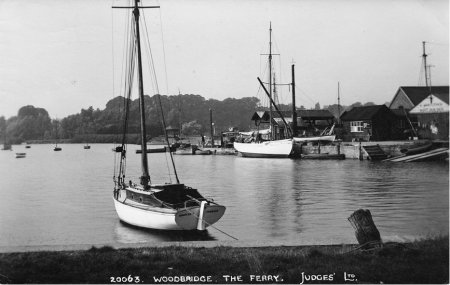
The yacht in foreground is Maritza II which was built in 1937.
She was the first of a series of forty one “Deben Four Tonners”
built at the yard.
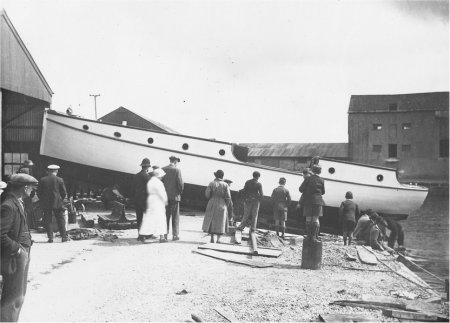
Launch of the Orwell Viking circa 1928.
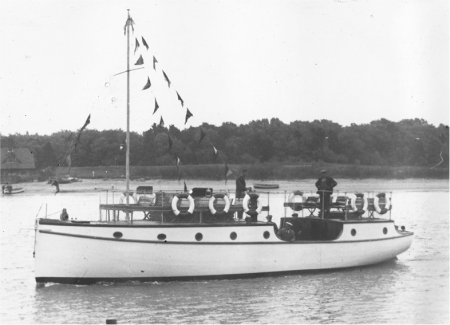
The Orwell Viking after it had been fitted out. It was a 40ft passenger launch which used on the River Orwell.
In 1963 work began on creating a horseshoe shaped Marina as a deep water mooring for over 200 boats.
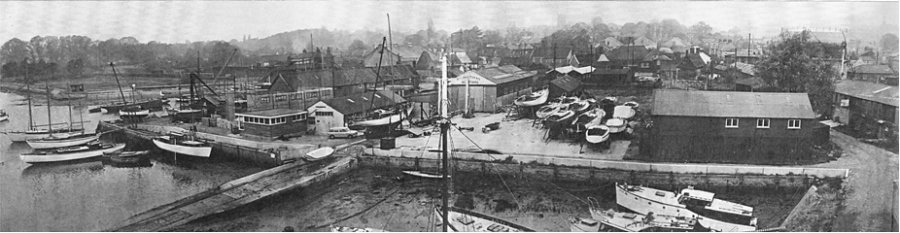
By the 1970s a larger workshop was erected to enable larger boats to be built and to allow more boats to be built concurrently. A photograph of the boat yard at that time is shown below.
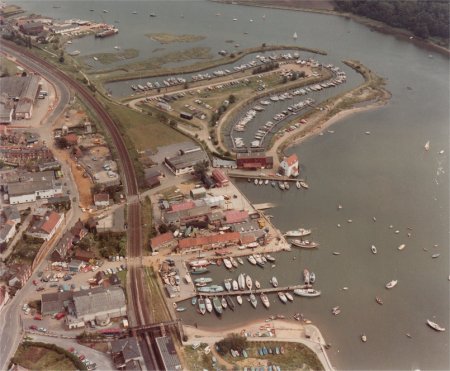
Whisstock’s boatyard flourished and it became the best known yard in Suffolk. It produced a range of wooden, fibreglass and aluminium hulled craft and established a national reputation. Eventually the boat yard filled the whole of area which had formerly been mash and, by mid the 1980s, it was as shown by the aerial photograph on the right.
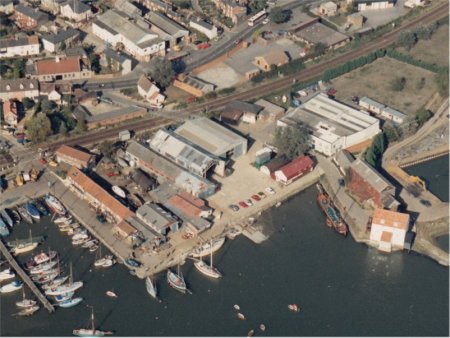
After the Whisstock family sold the yard in 1984 the business soon went into receivership. It managed to start up again only to close finally in 1990. After several attempts to redevelop the site planning permission was eventually given for mixture of residential and commercial developments, a community boat shed and a community heritage building. The latter, which is now the home of Woodbridge Museum, is on the site of Whisstock’s first boat shed.
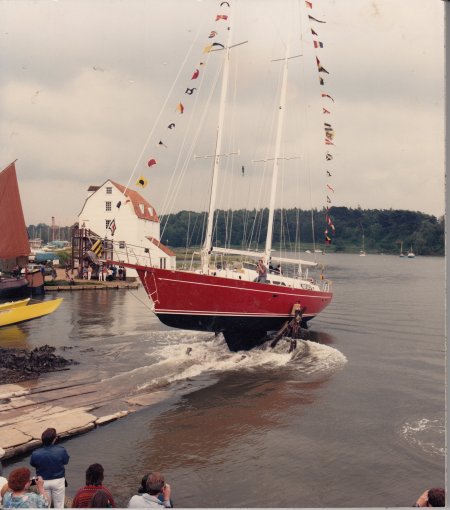
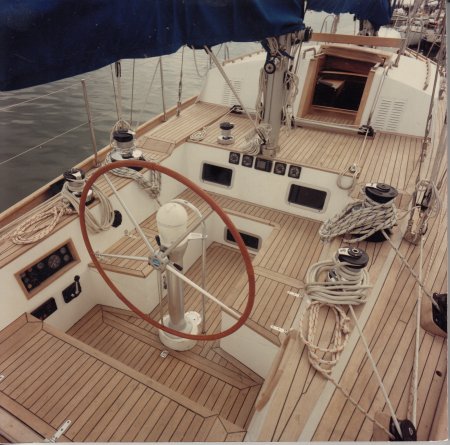
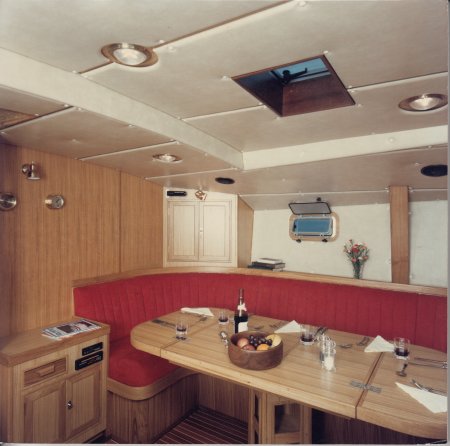
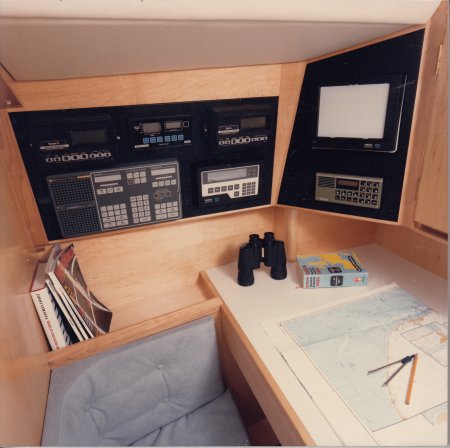
When Claude Whisstock walk out of the boatyard to start a new life in the USA the walls of his office will still decorated with photographs of the last series of boats that he had designed and built. A set of photographs of one of these boats is shown below.
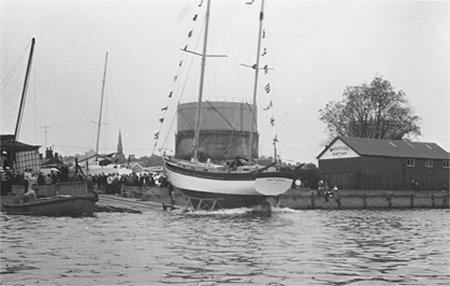
A Launch in 1971