The Maltings and Windmills in Woodbridge
Maltings
By 1838 barley grown on the Sandlings was being turned into malt in the 10 malt-houses which were scattered across the town. The grain was first steeped in water and then laid out on the floor of the malt-house until it had germinated. This process turned the starch in the grain into a form of sugar called soluble maltose. When the conversion had reached the desired stage germination was stopped by placing the spouting barley into a kiln. The malted barley could then be sent to brewers who used it to make beer.
The location and size of the ten malt-houses in Woodbridge by 1838 are shown by the map on the right as are the six other malt-houses built between 1838 and 1874. Malt-houses were a feature of almost all market towns and, in most cases, local brewers used the all the malt produced.
The amount of malted barley produced in Woodbridge would have exceeded needs of the two brewers in to town so the excess was probably shipped elsewhere. The malt-houses in the town would have had easy access to the Newcastle coal that came into the port. It would have been converted to the coke needed the fire their kilns.
From the 1880s a more automated and more compact, method of malting was being widely used and small malt-houses, like those in Woodbridge, were being pulled down or were converted for other applications.
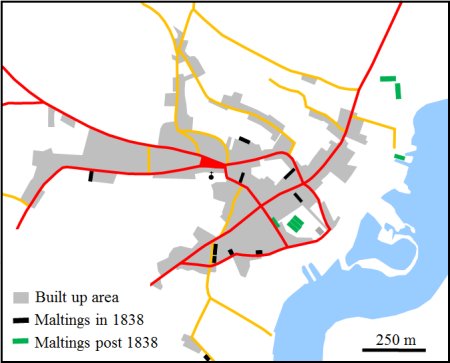
A map of Woodbridge in 1838 and the locations of maltings. The later maltings built post 1838 are shown in green.
.
Windmills
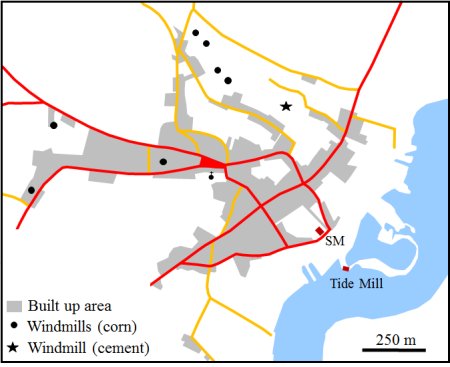
By 1838 corn was being ground in 7 windmills on the high points of the town as well as at the Tide Mill. There was also a windmill that was used to make cement. The location of the windmills in Woodbridge is shown by the map on the right. Later a steam driven mill (SM) was erected, sometime between 1859 and 1874, by the then owner of the Tide Mill.
In 1838 population of the town was about 4,500 so there was one flour mill per 563 people. Across the whole of Suffolk there were 430 flour mills serving a population of 300,000, i.e. one mill per 698 people. The higher milling capacity per head of population in Woodbridge, relative to the whole of Suffolk, could be an indicator that some of the corn being milled in Woodbridge was shipped from the port.
A map of Woodbridge in 1838 and the locations
of windmills. The steam driven mill, which is
marked SM, was built some time between
1859 and 1871
Five of the seven windmills grinding corn were post mills, the earliest form of windmills, which were constructed almost entirely out of timber. The defining feature of the post mill is that the body of the mill, and the machinery which it houses, is mounted on a single vertical post around which it can be turned to bring the sails into the wind.
The two other windmills were tower mills. Such mills had a brick or stone tower, on which sat a wooden 'cap' or roof housing the ‘windshaft’ connected to the sails. The cap could be turned by a set of gears to keep the sails facing the wind and the windshaft connected these sails to an upright shaft running up the centre of the tower. This shaft drove the millstones and other machinery in the tower. The rotating cap and its firm masonry base gave tower mills two great advantages over post mills, they could stand much higher and bear larger sails. Both of the attributes enabled tower mills to collect more power from the wind than post mills. The only disadvantage of tower mills was that they cost more to build.
Although some new windmills were being built in Suffolk during the 1860s and 70s the number of working mills steadily declined. This was due mainly to the increasing use of steam power, the introduction of roller milling from 1878 and improved means of transporting flour and grain. By the 1880s large amounts of American wheat was being shipped to England. The American wheat was harder than British grown wheat and was best ground by using the newly developed roller milling. These mills also converted more of the grain into flour and made it easier to control quality. Many such mills, some of which were very large, were erected at the west coast ports which were importing wheat. They were, however, soon be challenged by the imports of flour from America.
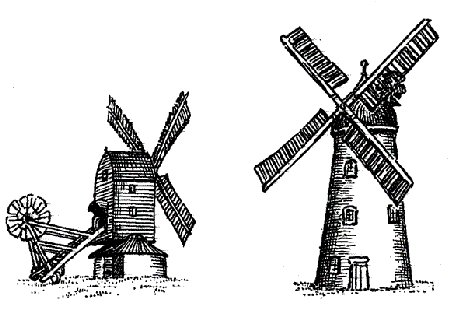
A post mill A tower mill
Only one of the five post mills in Woodbridge remained operating by 1858 and it too had gone by 1874. This only left the town with tower mills and the Tide Mill.
The tower mill on Theatre Street was built in 1818. Originally it had a domed cap which was blown off in 1881 and the present boat shaped cap was built to replace it. The ownership of the mill changed several times and when it ceased working in the 1920s it was being operated by John Stuart Tricker. It was subsequently used by a coal merchant. The cap and remaining pair of sails were removed in 1957, leaving the roofed over cap frame on the tower. In 1973, the mill was threatened with demolition but due to pressure from enthusiasts it was incorporated into Mussidan Place, a sheltered housing scheme for the elderly. Mussidan Place is now owned and managed by Suffolk Heritage Housing Association.
The tower mill on Burkitt Road was built in 1836 on the site of an earlier post mill. The mill was operated by members Trott family until 1861 after which it was leased it to a succession of millers. Sometime after 1877 the mill was sold John Buttrum who installed a roller mill and a portable steam engine to provide power on calm days. The mill ceased operation on the 11 October 1928 after it was damaged by strong winds, and in 1937 the mill was bought at auction by Mr Kenney, a mill enthusiast. The fantail was blown off in the 1940s damaging the cap. A lease on the mill was granted, in 1950, to East Suffolk County Council who wanted to preserve an example of each main type of windmill in their area and open them as visitor attractions. The derelict mill was restored during 1952-4 and further work was done in the 1970s.
The three-storey steam mill on Quayside operated until about 1928 after which it became a door factory. In 1953 Nunn's Corn and Coal bought the building which was eventually destroyed by fire in 1963. The remains of the former mill, and of two adjacent cottages, were demolished and a new mill built on the site. Operated by Nunn's, it remained in business until 1990. The building was then left empty until it was demolished in 2015 after planning permission was granted to use the site for houses and shops. This development is linked to that of the derelict Whisstock's boat yard on the other side of Quayside.
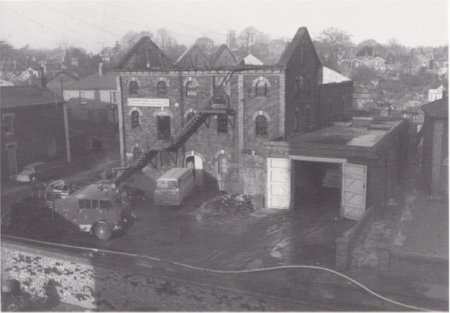
The former steam mill after the fire in 1963.
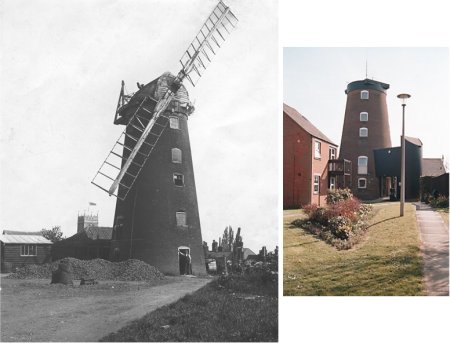
The tower mill on Theatre Street when it was being used by a coal merchant and what is left of it today.
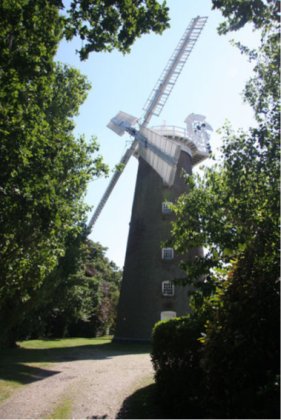
Buttrum's Mill on Burkitt Road has been restored and is now open to the public.