Woodbridge Nurseries
The land around Woodridge has long been judged to be of high agricultural value for market gardens and nurseries. The coastal climate is also ideal.
From about 1890 Fred Smith and Company specialised in growing seeds and traded as the Suffolk Seed Establishment. The office and warehouse were in Church Street and there were seed and trial grounds at the Barrack and Kingston Farms. During the 1970s the company moved out of the town and relocated to Framlingham.
There were also four market gardens within Woodbridge. From the 1880's to the 1960's the Scarff family had a market garden by the almshouses. They also ran a greengrocery shop on the Thoroughfare and advertised that their fruit and vegetables were fresh from their market garden. The Steel family had a market garden in Castle Street, in the area that is now Naverne Meadows. Lower down Castle Street was Whitbread's market garden which supplied their fruit shop in Sun Lane. A canning factory was built, in1933, on Hamlin Gardens where fruit had been grown for Andrews’ shop on the Thoroughfare.
The main horticultural activity in Woodbridge was, however, Woods Nursery which later became Notcutts Nursery. This account of these nurseries is mostly based on articles which appeared in the anniversary catalogues of Notcutts Nursery.
Woods Nursery
Thomas Wood created a nursery 1749 on land which had once been part of the garden of Woodbridge Priory. By 1784 the nursery had been expanded by purchasing a large plot of land abutting Ipswich Road. Eighteen years latter the adjoining plot of land was purchased. These plots of land are shaded yellow on the map to the right.
The original nursery site was in a sheltered valley of sandy soil, fed by a small stream, thus creating ideal conditions for raising young plants. Those requiring damp conditions were grown near the stream, whilst those which could tolerate drier soil were grown either higher up the south facing slope or on the land abutting Ipswich Road.
In 1784 a visiting Frenchman, Francois de La Rouchefoucauld wrote, “I saw nothing but two nursery gardens near the town, one of 9 acres and the other of 4 or 5. They were full of small green trees, some of which were priced very low”.
Within the parish boundary there were three farms. These are each shaded red on the map to the right.
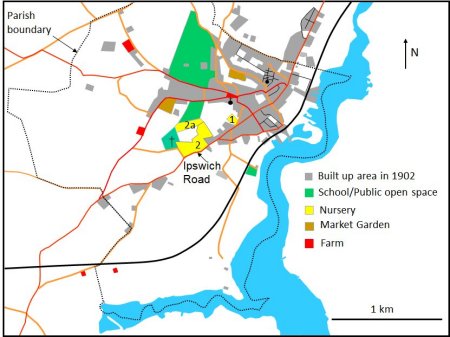
Map of Woodbridge in 1902. Woods nursery was
on the land shaded yellow.
The Wood family ran the nursery for one hundred and fifty years. Business was conducted principally with the owners of large country estates or of town houses with big gardens. The nursery supplied many different types and varieties of fruit and forestry trees, as relatively few ornamental plants were then available.
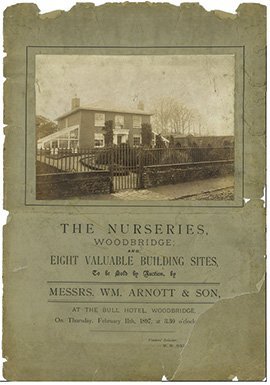
John Wood was the last member of the family to own the Nursery. The catalogue of Fruit Trees and Roses, he published in October 1895, lists no fewer than 95 apples, 35 pears, 16 cherries, 20 trained peaches, 7 nectarines and 123 varieties of roses. He produced his last full catalogue in 1896 and died without succession in 1897. When the nursery, with its fine, old Georgian house, was put up for auction by the Wood family on 11 February 1897 it was bought by Roger Crompton Notcutt of Ipswich.
The sales particulars noted that some of the land for sale could be used for building but thankfully the new owner incorporated it into the nursery.
The front page of the sales brochure for Woods
Nursery
has a photograph of the impressive Georgian house and
garden at the entrance to the nursery.
Roger Crompton Notcutt came from a family with two sons. The elder son, Stephen Abbott Notcutt, who was born in 1865, did what was expected of him and joined the family legal practice. He won a scholarship to Cambridge, completed the Natural Sciences Tripos before reading for a BSc in law. His younger brother, Roger Crompton Notcutt, who was born in 1869, was not burdened by obligations to enter the family legal practice. There were concerns about his health so it was recommended that he should pursue an out-door life. Fortunately, he had a keen interest in nature, particularly in the growing of plants. This was an interest he was able to pursue when, in his ‘teens, he acquired the Broughton Road Nursery in Ipswich.
Starting as an amateur Roger Notcutt began by growing vegetables. He subsequently devoted all his efforts to the breeding and production of chrysanthemums for which he became well known in the 1890’s. In 1895 he received the Royal Horticultural Award of Merit for the Chrysanthemum ‘Edith Tabor’, said to be the “best large yellow Chrysanthemum yet produced.
The Broughton Road Nursery was composed mainly of glass houses and frames and it had a workforce of approximately 45.
Two Chrysanthemum catalogues were produced each year. The one for January 1893 lists 307 varieties, split into early flowering varieties for August to October, and other varieties flowing from September to November. Catalogues were also produced for hardy perennials and herbaceous plants as well as for bedding plants - dahlias, begonias and geraniums – and subsequently for general nursery stock. In 1900 hints on the culture of dahlias were included at the back of the catalogue.
When he was 28 Roger Notcutt realized that his business was outgrowing the Broughton Road Nursery. So, when Woods Nursery was auctioned on the 11th February 1897, he purchased it. Roger Notcutt soon established his business in Woodbridge and he and his wife Maud moved into the old Georgian House by the entrance to the nursery.
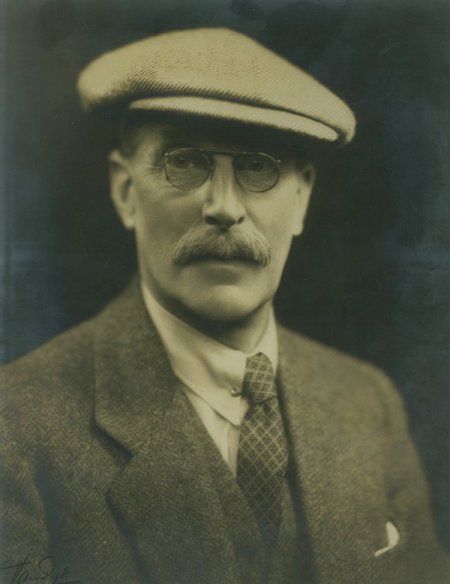
Roger Crompton Notcutt
Soon after he had bought Woods Nursery, Roger Notcutt, recognised the urgency for fresh land because the original land had been cropped continuously with nursery stock for 150 years. In 1899, he rented Martlesham Field (Plot 3), buying it in 1931. Creek Farm (Plot 4) was rented in 1907 and was bought in 1925. The adjacent Sluice Farm (Plot 5) was purchased the following year. All this land had sandy soil, but not so that of the bankrupt Rose Nursery of Morse Brothers at Gazebo farm. Their land (Plot 6), which was purchased by Roger Notcutt in 1934, had sticky heavy clay soil and staff received an extra 2d an hour for working there. Special handles were essential on spades as the ordinary ones soon broke. In 1950 Newfield (Plot 7) and Longfield (Plot 8) were purchased. They were either side of the A12 which was built in 1920 to provide employment for the town.
Map
showing the extent of Notcutts
nursery grounds by 1958
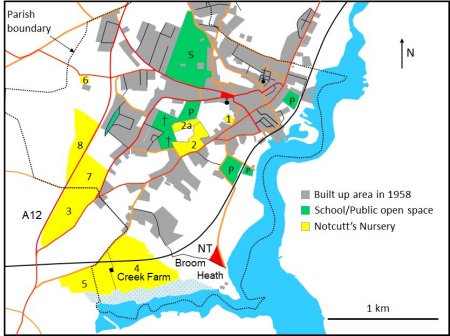
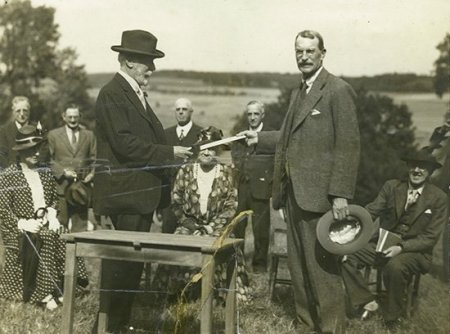
Broom Heath, which abuts, Creek Farm was bought by Roger Notcutt in 1925. This land does not appear to have been incorporated into the nursery and in 1934 most of it was sold. The remaining four acres of parkland overlooking the meandering River Deben, were given to the National Trust in 1934. Ever since the magnificent views from there have been treasured by townspeople and visitors.
Roger Notcutts handing over the
deeds of part
of Broom Heath to the National Trust in 1934.
Notcutts initially grew forest and fruit trees for parkland and the kitchen gardens of large estates. After the First World War the number of staff looking after large gardens declined, as did the annual orders. The business adapted by developing ornamental trees and shrubs for the smaller gardens of more modest houses, and by becoming more mail order orientated.
A landscaping department was established in 1902. It rapidly gained a reputation for quality design and construction and was soon involved in larger and more prestigious commissions. Local projects included the design and construction of the Promenade and Spar gardens at Felixstowe, the Avenue of Remembrance in Colchester in 1926 and the lining of Woodbridge bypass with Cherry and Poplar trees in 1932. After the Second World War the landscapes department was reformed and it took on projects further afield. It had commissions in London and the new towns of Basildon, Harlow, Letchworth, Welwyn Garden City and Witham. By 1965 there were landscape departments in Garden Centres at Woodbridge. Birmingham, Norwich and Tunbridge Wells. They traded under the name Notcutt Landscapes.
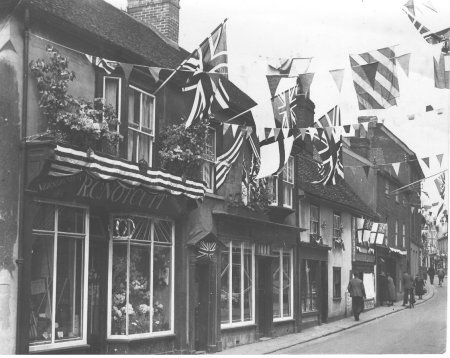
In 1913 Notcutts opened a shop in 31 The Thoroughfare. Orders continued to come from visitors conducted around the Nursery, and from the ever-important shows, but also increasingly from annual catalogues. Originally intended to aid other methods of selling plants, this became the main contact with many customers across the country.
Roger Notcutt became particularly interested in the trees and shrubs being sent back to Britain by plant hunters. He amassed a large collection of both and, in 1926, he published “Flowing Trees and Shrubs: a handbook for gardeners”. Many of the new plants and shrubs were grown on the nursery and introduced into cultivation. His catalogue which listed 961 varieties of general nursery stock in 1897, grew to 2,724 varieties in 1937, including a total of 19 plants which he raised and selected.
Notcutts’
shop on the Thoroughfare
opened in 1913.
As a result of his success of exhibitions at local shows of Chrysanthemums from the Broughton Road Nursery, Roger Notcutt realized that showing locally and nationally would increase the business of the Woodbridge Nursery. The Royal Horticultural Shows (RHS) were then, as now, the key to national renown. A year after taking over the Woodbridge Nursery Roger Notcutt won a Silver Medal for an exhibit of apples and pears at the RHS Crystal Place Show. He also won silver medals in 1901, 1902 and 1904 and Silver Gilt Medals in 1905 and 1906.
In 1912 the International Horticultural Exhibition was held in the grounds of Chelsea Hospital. By then Roger Notcutt’s landscaping skills had developed and he staged a Rose Garden which won a Silver Gilt Medal. The show was such a success that the RHS moved their Great Spring Show to Chelsea in 1913, where it has remained ever since. Roger Notcutt exhibited at this show, but it was not until the following year that his Azalea Garden won a Gold Medal. Notcutts are one of only six nurseries to have exhibited at every Chelsea Show, winning Gold Medals most years.
Roger Notcutt was a member of the RHS Flower Show Committee for 30 years and was a member of the Linnaean Society and of the Council of the Roads Beautifying Association (one of the earliest associations concerned with the environment). In 1912 he was appointed as a JP. He served as a member of the Woodbridge Urban District Council for 33 consecutive years, being elected chairman in 1937.
In January 1938 Roger Notcutt had a heart attack and died. He had not trained his son Tom to succeed him, so his mother Maud took charge of the business. Tom died a few months later.
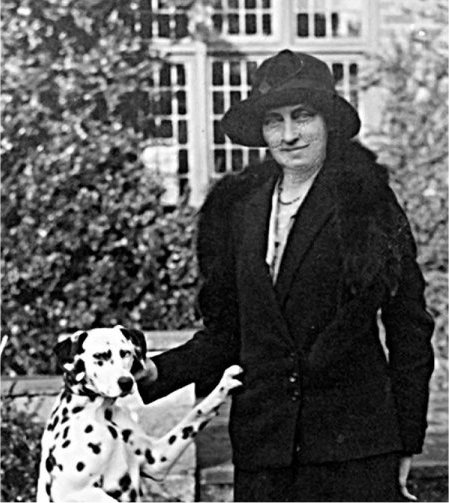
Until 1946 the nursery traded as the “Executors of R C Notcutt”. In that year a limited company was formed with Maud as Chairman and her nephew, Stephen Abbot Notcutt, and a local accountant as External Directors. A Managing Director and Company Secretary were also appointed, and they completed the team which helped Maude face the immediate post war years.
Maude Notcutt
During the Second World War there was a reduction in nursery staff. Fields were turned over the vegetables; five of the seven greenhouses grew tomatoes and the frames were full of cucumbers. Johnny Crane, a propagator, had only two green houses in which to save the precious stock of many plants. Despite his valiant efforts many varieties, including some of Roger Notcutt’s own introductions, were lost. By 1947 only 989 varieties were being grown.
The light soils of the nursery had been over cropped before the war and underfed during it. Plant growth was severely affected by the drought of 1947 and during the drought of 1949 stock began to die. Although demand was picking up there was little to sell. Some 50 years after Roger Notcutt bought the Nursery it nearly went out of business.
In 1954, Maud Notcutt, then aged 80, was heartened to hear that her grandson Charles Notcutt had started his horticultural training following National Service as an officer in the Royal Artillery. Maud died in the following year and her nephew, Stephen Abbot Notcutt was appointed Chairman, a position from which he could oversee the training of Charles when he joined the company in 1958. Charles initially helped to tackle the unending task of stock control. Then, in 1963, he became responsible for field production. In the following year Charles married and became Managing Director. His daughter Caroline was born the following year and in 1967 his first son, Roger William, was born. In 1975 the arrival of Andrew Charles completed the family.
The new management team recognised that fresh land was needed, and it started to move production to heavier but workable soil. Two plots of such land in Woodbridge were purchased in 1950. They were either side of the A12 and were called Newfield and Longfield. The fertility of this land soon gave good stock for sale. Sluice Farm and Creek Farm were sold in 1953 and 54 respectively.
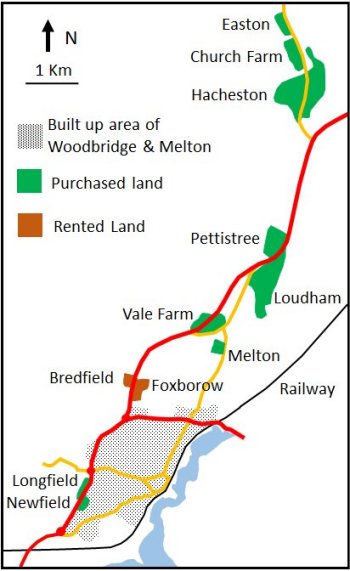
Newfield served the nursery well during the 1950’s but it 1965 it was sold for house building, thereby financing the purchase of more land and the acquisition of other garden centres. The medium light land needed for the expansion of the nursery lay more or less along the line of the A12 north of Woodbridge. The map on the right shows the locations of all the plots of land acquired after 1953. The last plot to be purchased was at Easton in 1986.
The plots of land which Notcutts purchased
or rented from 1950 to 1986
Traditionally the owners of large country houses were tree planters – both of numbers and varieties. There was little space for trees in the many small gardens. Fruit trees were the mainstay of Woods Nursery and of Notcutts until the 1950s but then demand declined as gardens became smaller and spraying became unpopular. The final blow came when supermarkets started to offer a wide variety of fruit all year round.
From planting the rootstock on the nursery to lifting the standard tree took some 4-6 years, so production had to anticipate demand far ahead. Fortunately, during the 1960s as the private sector demand for trees declined, the public sector demand for planting streets and new housing estates took off; the public authorities became the new tree planters.
Notcutts soon became one of the major suppliers of trees and other plants. Sales peaked in the year of “Plant a Tree in 1973”. At that time almost two-thirds of Notcutts plants were then supplied to public authorities. Although this was a major achievement, it was recognised that such reliance on public expenditure had its dangers. Notcutts thus increasingly focused on sapling trees and other plants to the growing group of Notcutts Garden Centres, and to other garden centres and nurserymen.
After the Second World War the nursery’s business increasingly came from the many new housing estates which were being built and orders from the large country estates declined. The nursery adapted and became more mail orientated. Twenty thousand catalogues were mailed out in 1961/62 and the business turnover exceeded £100,000 for the first time.
The hard winter of 1962/63 prevented orders being despatched and no orders could be taken for spring delivery. This winter had a critical effect on the industry. When the weather finally improved, customers discovered the ready availability of plants in garden centres and orders rapidly declined.
During the 1970’s container grown plants became more available. Their key advantages over bare root plants were that they were easier to handle by staff and customers and they were available all year round. The advent of container grown plant production revolutionised the nursery industry. Customers no longer had to choose from colour catalogues or trying to visualise a plant from descriptions. This led to an explosion in demand in garden centres and a decline in mail order. Small orders by mail were finally discontinued in 1994. However, customers were able order from a range of 3,000 plants and collect them from any of the Notcutt Garden Centres. Larger orders can still be delivered direct.
A few plants were not suitable for containers. Lilacs, for which Notcutts had long been known as specialist, were one of these plants, so the nursery’s large field crop of Lilacs remained unchanged.
In 1973 the pig farmer who had bought Creek Farm in 1954 decided to sell it. He had farmed and manured it well, so the nursery brought the land back. The previous owner had also installed a bore hole and irrigation system, and this proved invaluable during the severe droughts of 1975 and 1976. This experience made it clear that there was no point in striving to grow nursery sock on the light soil in Suffolk without bore holes and irrigation systems.
Mist propagation was developed in the late 1950s and Notcutts was one of the first nurseries in the country to seize the advantages offered by this technology. By the mid-1970s the small glass houses used for this work were proving to be uneconomic so, in 1978, a new propagation department with three-quarters of acre of glass was built on Creek Farm and was extended by a further half-acre in 1988. When it opened it was one of the most advance propagation houses in Europe. By 1997 a wide range of propagation techniques were being used to grow the almost 3000 varieties of plants for which Notcutts became famous. These included growing from seed, stem and root cuttings, division, layering and grafting.
By1953 the small town centre shop was in need of repair and was becoming outdated. Despite concerns that people would be unwilling to travel half a mile from the town centre to buy flowers, plants, seeds, bulbs and other supplies, the shop was closed in 1958. It was immediately replaced by a garden centre built on part of the Ipswich Road nursery. It was one of the first purpose-built garden centres in the country. A ‘planteria’ – display of the plants for sale – was created soon after. The term ‘planteria’ was a created by Notcutts and is now used throughout the plant retailing industry.
By 1982 Notcutts had built 4 new garden centres and purchased 4 others. Two of the latter had a nursery which enhanced the range of products Notcutts could supply. These two nurseries were Waterers, one of the oldest and most respected names in horticulture, and Mattocks Roses.
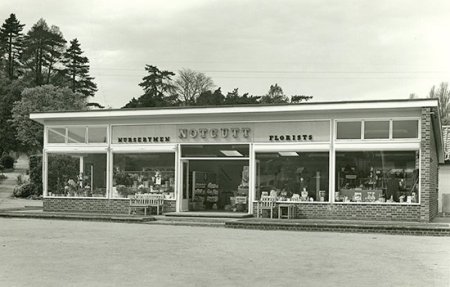
Notcutts garden centre when it opened in 1958
Waterers had a 30-acre nursery and a garden centre in Bagshot, Surry. For over 150 years Waterers showed considerable skill, patience and persistence in breeding and improving varieties of Rhododendrons. In the 1950s they started to work on producing compact growing Rhododendrons for the smaller gardens. The result was an outstanding series of low growing, free flowering plants. In 1982 Notcutts took up an offer to buy the nursery and garden centre. This deal gave Notcutts a garden centre in prosperous Surrey, a well respective trade name with many valuable garden centres as customers, a distribution base by London, additional propagation facilities, 30 acres of nursery land and finally expertise and stock of ericaceous plants which had not been a strength at Woodbridge. The name Waterers Nursery was retained. The nursery continues to provide ericaceous and general nursery stock to Notcutts garden centres and the trade.
Mattocks Roses, a family business at Nuneham Courtney, near Oxford, was bought by Notcutts in 1985. Mattocks Roses continued to be the agent in this Country for the Rose breeder, Kordes of Germany. Through Mattocks, Notcutts have remained at the fore front of the exciting world of rose breeding, introducing many new varieties each year. Mattocks exhibits at the Chelsea flower show and wins Gold Medals most years.
By 1997 Notcutt’s had twelve garden centres, all different and each justifying a visit in their own right.
In 2004 Notcutts applied for planning permission to redevelop some its land adjacent to the Woodbridge Garden Centre. Part of this land abutted Ipswich Road and on it there were some dilapidated sheds and customer parking. The rest of it was part of the original nursery. Notcutts also proposed to build a Medical Centre and 76 retirement apartments on this land. Opposition to this proposal centred on the scale of the proposed buildings and the loss of an open space which had been attractively planted with shrubs and trees.
Notcutts also wanted to erect houses on the rear part of Nursery and finally to build a new garden centre on the site of the old one.
Planning permission was eventually given for all aspects of the development, but the scale of the retirement complex was cut back. The medical centre opened in 2007 and Clarkson Court, which had 69 apartments, opened in 2008. Work on building a new garden centre on the site of the old one started in 2019.
In 2007 Notcutts announced that, in the foreseeable future, its garden centres would buy in all their plants from other growers. The nursery side of Notcutts was sold off to John Woods Nurseries, a new business set up by former Notcutts staff. The new company grew hardy plants on a 95 acre site at Pettistree. More than 1.3 million plants were produced each year and John Woods Nursery was one of the top five nurseries supplying garden centres in the UK. Sadly, the company went into administration on the 11 Nov 2015 the Pettistree site is currently being diversified by the current owner.
In 2008, just as Charles Notcutt retired, his firm bought a chain of six garden centres in the North West. This brought the number of Notcutts Garden Centres up to 18. The garden centres continue to be run by the Notcutt family.
During his career Charles was involved in many aspects of the horticultural industry, especially research and education. In 1977 he was awarded the Pearson Gold Medal by the Horticultural Trades Association. In 1986 he became the first Treasurer of the newly formed Institute of Horticulture and was President in 1988/89. He became a member of the council of the RHS in 1989 and, in1993, he received an OBE for Services to Horticulture. The Royal Horticultural Society awarded him the Victoria Medal of Honour in 1997, the Centenary Year of both Notcutts and the Victoria Medal of Honour.
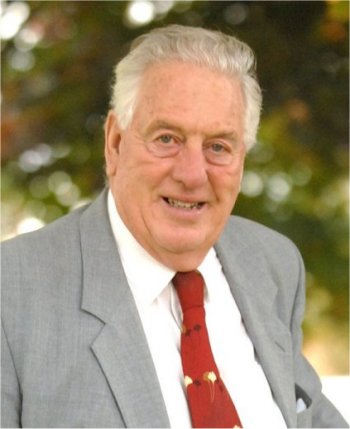
Charles Notcutt
1934-2015
After he retired as chairman of Notcutts Charles remained as very active member of Woodbridge Town Council and was keenly involved with various groups in the town. He died of cancer on July 1, 2015 aged 81. His obituary in the Times described him as an “Ebullient horticulturalist who transformed a nursery into the largest chain of family run garden centres in Britain” and as “a towering force in campaigns in the horticulture industry, whether fighting industrial or political causes, such as the modernisation of the Sunday Trading Law.
Last edited 12 Aug 23