Local Governance
Charitable Bequests to Help the Poor
During the reign of Henry VII, John Dodd gave 51 acres of land in the parish of Martlesham “for the maintenance of the poor and the benefit of the town”. A second bequest of land in Martlesham was made in by Jeffery Pitman in 1687 when he gave 9 acres of copyhold land for the “reparations and maintenance of the church (in Woodbridge) and members there of". By 1844 these lands were being let for £56 a year, out of which £10 was contributed towards the support of the free school and the remainder was applied in the service of the church.
In 1637 John Sayer left just over 15 acres of land in Melton, in trust, so than “the rents thereof should be applied to providing a weekly dole of 15 two-penny loaves and a yearly distribution of clothing among the poor of Woodbridge. The land was partly copyhold and in 1855 it was let for about £30 a year, which was distributed by the church wardens in bread, of which 42 threepenny loaves are given every Sunday among the aged poor attending the church.”
In 1660 the churchwardens and principle parishioners let the 11 acre town common, which had been used from time immemorial by the parishioners, on a 999 year lease and 10s annual rental. In 1823 the newly formed Charity Commission decided to investigate how the title to the town common had been transferred to the churchwardens or inhabitants of Woodbridge. The Commission eventually ruled that, because it was unable to ascertain how the title to the common had accrued to the churchwardens or inhabitants of Woodbridge, it could not challenge the 999 year lease granted to Edward Mundy by the then churchwardens (Messers John Mundy and Francis Willard). In 1823 this property, generally known as Lime Kiln Quay, encompassed a dockyard, shipyard and Quay. By 1844 the then leaseholder obtained an annual income of £400 from property of and he paid 12s 6d to the town.
A yearly rent charge of 40s, left by Alice Osbourn in 1677, out of her messuage (house with garden) called the Malting Office, was distributed among the poor parishioners in coals.
In 1781, John Rutland charged his estate at Hasketon with a yearly payment to the Congregational Meeting House in Woodbridge, to be laid out in three gowns for three poor widows in the parish on 2nd of April.
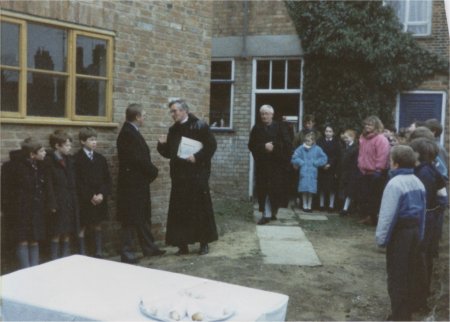
The Rev Pat Ashton about to start distributing
bread to pupils from local schools.
On Candlemas Day (2nd Feb) a distribution of bread to the poor was made out of the yearly rent charge of 20s from a house left by George Carlow in 1738. He was a member of a Christian Sect called the Separate Congregation who kept the Sabbath on a Saturday. His house on New Street was adjacent to the Bull Hotel. George Carlow was a member of a Christian Sect called the Separate Congregation who kept the Sabbath on a Saturday. Rather than be buried is a churchyard he had a tomb built in his garden. His house was eventually demolished when the Bull Hotel was expanded but access to the tomb was still allowed. It is from there that the bread was distributed until the access to tomb was now longer allowed by the current owner.
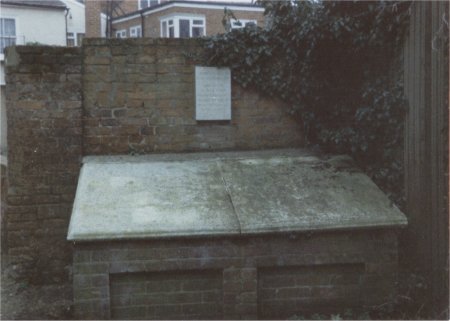
Carlow's tomb
Some of the wealthier people in Woodbridge chose to make gifts of houses "for the use of the poor for ever". Such houses became known as variously as the Town's Houses, Poor’s-houses or Poor Houses and they were used to provide accommodation for the poor. Unfortunately many of the donors were not so forthcoming with funds to keep these properties in repair and they fell into disrepair and eventually had to be sold.
In 1837 the Charity Commissioners produced a report described the Parishes Poor's Houses. The relevant section is reproduced on the right. (Each property listed has a 1840 Tithe Map number. Using this number you will be able to locate the property using the maps in the Area Histories Section.)
A house in Pound Street given by William Bearman in 1668 for the use of the poor. It is used as the parish workhouse. (1840 Tithe Map number 510)
Two houses with a garden adjoining, belonging to the parish, which were used as pest houses and are now inhabited by paupers. (1840 Tithe Map number 56)
A house in the New-street called the hospital, and formerly used as a Bridewell. Purchased by the inhabitants of Woodbridge in 1641. (1840 Tithe Map number 408)
Two houses in Turn Lane, one given by William Smith, in 1601, the other by Jeffery Pitman, in 1608, for the use of the poor, and which are occupied in six tenements by poor families, rent free. (1840 Tithe Map numbers 454 and 457)
Two houses in the Thoroughfare (now Cumberland Street), also given by William Bearman, in 1661, for the use of the poor, and which are occupied rent-free by poor persons. (180 Tithe Map numbers 210)
A piece of ground belonging to and adjoining the house given by William Smith, which is held by Thomas Wade at a rent or acknowledgement of 2s/6d a year, and a stable and other buildings have been erected thereon; and there is also a piece of ground belonging to the houses in Thoroughfare-street, part of which, containing about 21 perches, is used by the occupiers of the house as a garden, and the remainder, containing 1 Rod, 12 perches, is held by the Rev. John Clarke, under a lease for 61 years from 1766, at the yearly rent of £2/2s. The rent is perhaps almost a fair equivalent for the ground as it is at present used, but the ground might possibly be rendered of great value if it were let for building upon. (1840 Tithe Map umber 197)
The rents of these pieces of land used to be carried by the churchwardens to their general account, but since 1824 they have been paid to the overseers of the poor, towards the liquidation of a sum advanced out of the poor-rates, for defraying the expenses attending the appointment of new feoffes or trustees of the poor’s premises, or some part thereof and subject to the payment of this charge, it appears to us, that the rents are applicable to the maintenance of the buildings, and the use of the poor.
Between 1925 and 1950 the two houses given to the town by William Smith in 1601 and by Jeffery Pitman in 1608, had been disposed of. Most of the land incorporated into the grounds of the Abbey School and the remainder is a parking area on Turn Lane.
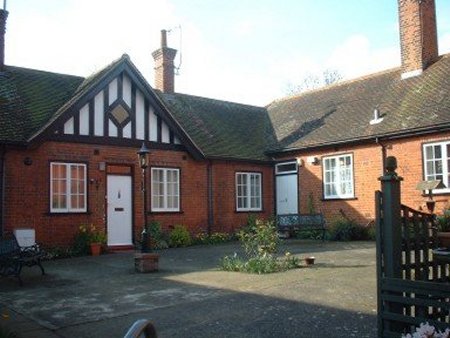
In 1908 seven almshouses were built in the yard of the Hospital. These almshouses were a bequest from John & William Andrews in memory of their father Jonathon Andrews of London “A former resident, well-known for his good works in his old town." Each almshouse comprised a bed sitting room, a scullery and an external earth closet. They were let to the deserving poor for sixpence a week.
In 1960 the Poor’s Houses Charity was set up. This Charity was endowed with various buildings and properties which had been given to the town to help care for the poor. When the Poor’s Houses Charity was registered with the Charity Commission in 1963 its revenue was obtained from:-
-
The almshouses built in the yard of the Hospital
-
The hospital, New Street
-
Numbers 74 & 76 Grundisburgh Road (the Pest Houses)
-
Land having frontages to Cumberland Street and Station Road known as the Old Surveyors Yard.
-
Land having a frontage to Cumberland Street on which formerly stood the Old Poor Houses
-
Land having a frontage to Cumberland Street with the old Fire Station thereon
The Charity also had some £1743 of investments of which £157 was designated as Bearman's Gift.
In 1964 the Poor’s Houses Charity sold four of the properties by public auction. These were the hospital on New Street, the two Pest Houses and the land on which the Fire Station had been built in 1853. The proceeds of the sale was used by the Poor’s Houses Charity by combining the 7 units in almshouses to 5.
The Trust retained the rest of the land in Cumberland Street. This land was by then rented to the National Health Service who erected a number of single storey buildings on the site to form a clinic. This land was eventually sold for housing development in 1996.
The proceeds from the sale of these assets were used to modernise the New Street almshouses. They now consist of two units having a single bedroom and a unit, with two bedrooms, which is fully wheelchair accessible. One of the original external earth closets has been conserved for historical interest.
The entrance to the New Street Almshouses. The former
hospital, now a private residence, is on the right.
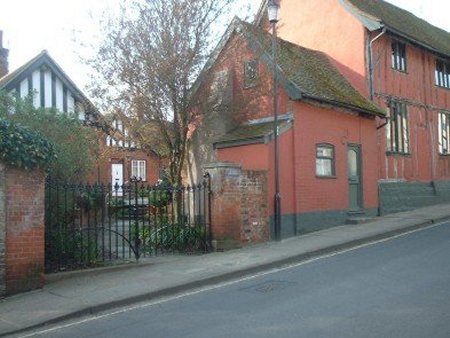
The courtyard of the New Street Almshouses.