Improving the Town's Water Supply
For centuries the people of Woodbridge obtain fresh water from wells sunk into the crag layer. The larger houses would have their own wells but the cottagers would have used a communal well which was often some distance away. Rain water, collected in a water butt, was prized for its softness and would be saved for cosmetic functions, i.e. shaving, hair washing and the delicate skin of babies. By the start of the 19th century water was still being drawn up from wells in buckets although, by then, the richer houses had a hand pump. Over the next twenty years large towns were provided with conduits and cast iron pipes to distribute water from springs or reservoirs, but Woodbridge had to wait until 1902 before it was freed from the chore of obtaining its water from wells via buckets or hand pumps.
The progress made in 1902 and 1903 in providing the new water supply is recorded in Lambert's Almanack. The relevant entries are reproduced here:
1902 The question of a better water supply is now within reach of being accomplished, and will be a great boon. The Woodbridge District Waterworks Company has been incorporated by special Act of Parliament, and at the first statutory meeting, held on 30th September, it was stated that out of the issue of £12,500 capital, all had been subscribed except £500. The registered list comprised 147 shareholders, the great majority of whom are residents of the town. Land has been purchased in Brook Street and Mill Hills, and the work of sinking a well on the Brook Street site has been already started. It is expected that by January 1903 the town will be in receipt of water from the waterworks.
1903 The Waterworks Company have completed their various works, and by the time our readers will be perusing these pages they doubtless will be supplying their customers with water. The pumping station has been built on land on the Bredfield Road after the failure to secure a supply on their property in Brook Street. The test of the water was, from all points of view favourable, Dr. Stevenson recommending for a public supply.
The pumping station and bore-hole were adjacent to the present water tower on Bredfield Road. The bore-hole obtained its water from the chalk layer some 140 ft down. (The numerous wells in Woodbridge would not have been so deep. They would have been sunk into the crag layer.) Water from the bore-hole was pumped up by a steam engine housed in the one storey brick built building that is behind what was then manager’s house adjacent to the entrance on Bredfield Road. This house (20, Bredfield Road) is now a private residence but the engine house remains, albeit without its chimney.
By 1950 the output of the Bredfield Road water works had been increased by sinking two 140 ft bore holes into the chalk and three wells into the crag. Each well was equipped with a separate pump. A 100,000 gallon water tower had been erected and there was a new pump building. The old buildings were retained for storage. Water delivered to customers was about equal parts of crag and chalk water. There were ‘Candy’ pressure filters to remove iron but there was no attempt to soften the water which was classified as 'very hard'. (Softening of the water was contemplated at various times but was not put into operation because of the cost of installing and maintaining the necessary plant.)
By 1967 Woodbridge’s water was the responsibility of the Ipswich Corporation Water undertaking. Water was still distributed from the Bredfield Road site but this was now one of five pumping stations feeding a ring main that linked Ipswich, Woodbridge, Pettistree, Raydon and Stowmarket.
In 1995 the bore holes and wells at Bredfield Road were closed down because of concerns about the high levels of nitrates in the water, but the site remains as the distribution point and treatment works for Woodbridge.
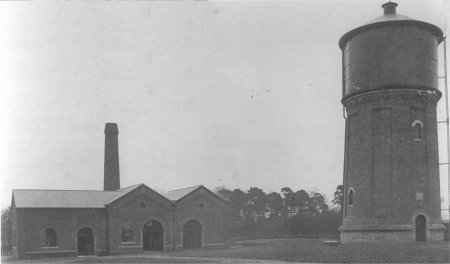
Bredfield Road Waterworks in the 1920s

Interior of the pumping station in the 1920's