Local Governance
The Woodbridge Local Board of Health
The biggest problem that most Local Boards faced was how to cope with the disposal of the human faeces (excrement) which built up in the primitive outdoor toilets, the privies, that most urban dwellers used. The commonest way of disposing of this smelly material was to have it collected at night. The men who did the work were euphemistically called the night soil men and their cart was referred to as the violet cart.
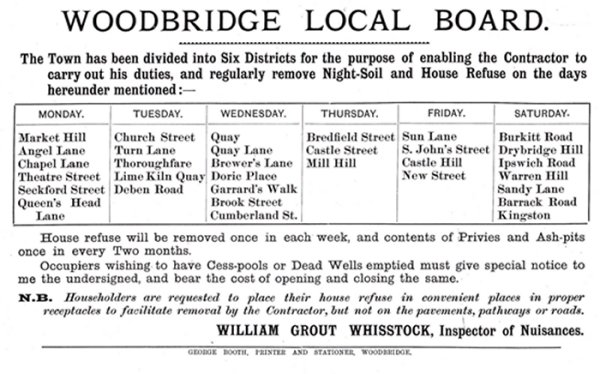
The undated notice below shows how the Woodbridge Local Board organized the collection of night soil and house refuse (predominantly ash from fires). Everything else which was disposed of could be recycled and thus had a value. It would have been collected by rag and bone men.
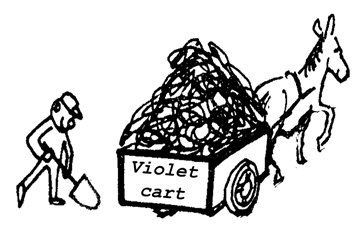
The night-soil men and their violet cart emptied the town’s privies.
The Public Health Act of 1872 transferred the responsibilities of the Local Boards of Health to the newly created Urban Sanitary District and Rural Sanitary District authorities. Three years later another Act gave these authorities wider powers of enforcement in relation to drainage, sanitation and water supplies. It also required the authorities to appoint health inspectors.
By 1872 Woodbridge was covered by an Urban Sanitary District and the rest of the Woodbridge Poor Law Union was a Rural Sanitary District. The immediate impact on life in Woodridge was not as great as in the big towns and cities. It was not until 1902 that the inhabitants of Woodbridge were freed from the chore of obtaining their water from wells via buckets or hand pumps. They had to wait even longer for a modern sewerage system. The night soil men and their violet cart were needed to keep Woodbridge smelling sweet until a comprehensive sewerage system was completed in 1965.
Link to article on improvements to the towns water supply.
Link to article on the installation of a comprehensive sewerage system.
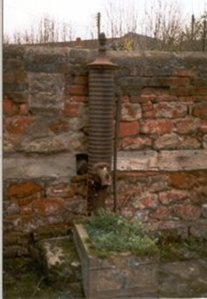
Until 1902 inhabitants of Woodbridge obtained their water from wells via buckets or from hand pumps like this one.
The Creation of the Modern System of Local Government
Towards the end of the nineteenth century it was becoming clear that the piecemeal system which had developed in response to the vastly increased need for local administration could no longer cope. Many of the Sanitary Districts were run by unpaid officials and there was often no one who could be held responsible for the failure to undertake the required duties. The first step towards creating a standard system of local government was the passing of the 1888 Local Government Act which created 66 County Councils. Each was run by councillors, elected by ratepayers every three years, and aldermen, elected by the councillors every six years.
The government made grants to these councils to cover some of their expenditure on police, main roads, sanitary officers and elementary education. These grants gradually increased to a level which ensured that the infrastructure of basic services in a given area was no longer dependent on the state of the economy in that area.
The 1894 Local Government Act created a second tier of local government. Henceforth, all administrative counties and county boroughs would be divided into either rural or urban districts, based upon the earlier sanitary districts, to enable a more localised administration. This Act created the Woodbridge Urban District Council and the Deben Rural District Council.
The Local Government Reorganization Act of 1972 set up a new system of local government. When this Act came into force in 1974, the Woodbridge Urban District Council became the Woodbridge Town Council and the Deben Rural District Council was incorporated into the much larger Suffolk Coastal District Council which took over the Melton offices of the former Deben Rural District Council.