Installation of a Comprehensive Sewage System
Woodbridge did not have a comprehensive sewerage system until 1965. Before then most of the houses in the town would have had pail closets that would have been emptied weekly. Some of the larger houses would have had cesspools that probably overflowed into the land drains installed to carry away the surface water due to rain. Ipswich fared rather better – the main sewer there was installed in 1880.
By the 1950 the main problem facing the Urban District Council was the provision of new housing and the lack of a satisfactory system of sewers and sewage disposal. Since 1939 the Council had undertaken the service of emptying pail closets (weekly) from the parts of the town developed before 1875. Other areas of the town were served by cesspools that were emptied periodically by the local authority. The more recent housing had discharged into large communal septic tanks. The scale of the problem is set out in the 1950 Annual report of the Sanitary Inspector.
In 1950 there were two main sewers, primarily for service water. Numerous branch sewers were connected to them and they carried overflows from septic tanks and cesspools as well as surface water.
-
In the areas of the town which had been developed post 1850 there were 878 cesspools which were emptied each year, some requiring 3 or 4 loads, by two men.
-
There were two areas on the west of the town which had been developed post 1940 where cesspools overflowed in public sewers.
-
In the older area of the town a team of 3 men operated the night soil collection and disposal service and dealt with 1000 pails a week.
The map on the right shows the extent of each of these areas, the locations of septic tanks and the outflows of the public sewers.
Between 1950 and 1958 those parts of the two main sewers which existed as open ditches were piped or covered. Cesspools formally emptied periodically by the local authority were adapted to overflow into the new sewers.
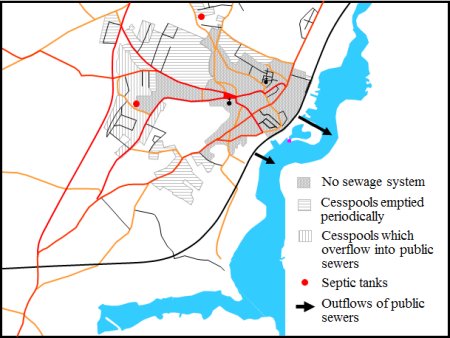
Woodbridge's sewerage system in 1950
In the early 1960 it was decided a more comprehensive system was needed to cope with any significant expansion of Woodbridge. Plans were drawn up but the Woodbridge Urban District Council decided that they could not afford it. Thus new house building in the town went ahead without the sewage system that was originally intended for it.
Work on implementing a revised scheme was started in 1963 and finished in 1965. The two main valley sewers augmented by two others, and the sewage works were built at Melton and Martlesham.
By 1965 most of the sewage from Woodbridge went through the sewage treatment works (Creek Farm) near Martlesham Creek. This was jointly operated with the Deben Rural District Council. At that time most of Woodbridge was drained by 4 main valley sewers that ran down from near the A12 to a pumping station just behind the pool for the Tide Mill. The area around the Duke of York corner (lower Kyson) had a separate sewer having a pumping station near Martlesham Creek. The area south east of the railway line was the only part of Woodbridge not connected to the main sewer. The only buildings in this area were the boat yards and their sewage was discharged untreated into the harbour.
Creek Farm was designed to serve a population of 16,000 (9,000 in the Rural District and 7,500 in Woodbridge) but extensions to the pumping station could increase to 23,000. At the time the works was built the population served was 14,000.
Parts of Melton and Parts of Woodbridge were also served by a pumping station and sewerage works in Melton which also had scope for expansion.
By 1966 it was clear that problems existed and further work was needed to increase the capacity of parts of the system. During bad weather the additional ground water flowing in the 4 valley sewers was overloading the pumping station and untreated sewage had to be discharged into the river from five overflow chambers on the connecting sewer that joined up the four valley sewers. Furthermore certain manholes were overflowing at times. These manholes were on the sewers carrying the water from the Naverne Brook along Castle Street and the overflow of the Pond in the Abbey fields (i.e. near Steynings Brook). The cure to these problems was to increase the pumping capacity for the valley sewers and to increase the size of some of the pipes.
In 2007 storm tanks were sunk on Quayside and behind the Community Hall. Then in 2009 another was added on Brook Street.