Thomas Seckford - Benefactor of the Aged and the Poor
The Revenue From Clerkenwell Increases
By 1767 the Clerkenwell was highly developed and Seckford’s estate was leased (for 60 years) in 6 parts. They produced an annual income of £565. In that year the bequest to the poor of Clerkenwell (at Christmas) was increased from £2 to £10. Almshouse expenditure was;- the Principal poor man £27, twelve poor men £20 each, three nurses £12 each, the Minister £10 and the two Church Wardens £5. The surplus income was accrued for future repairs. These reserves were substantially boosted, in 1823, when a portion of the Clerkenwell estate was sold for £39,456 to the Middlesex magistrates for a new prison. The following year the Woodbridge Almshouses were ‘new-fronted in a neat and appropriate style’ at a cost of £1,470.
An Act of Parliament obtained in 1826 enabled the Governors to make major changes to the Clerkenwell estate. They were able to demolish or alter buildings, to erect new ones and change the road layout. By 1830 over £20,000 had been spent transforming the area. A distillery, a factory, a chapel, a public house, a school and a number of terraced houses had been constructed. As a result of the changes the annual rental revenue increased to over £3,000.
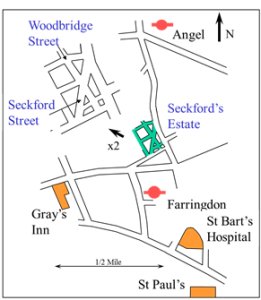
Map showing the Clerkenwell Estate today.
.
Expansion of the Seckford Almshouses in 1832
By 1832 the accumulated reserves had so greatly increased that the Governors determined to double the number of almsmen. For their reception they commenced the erection of a large and handsome Hospital with 32 bed-sitting rooms, each with a kitchen and a bathroom. Construction of the east wing started in 1834 and by 1839 the residents of the old Almshouses were moved in to it. By 1842 the western wing and a lodge (for a porter/gardener) were completed and the massive gates and railings erected. The total cost of the new complex was about £28,000. The chapel between the two wings was completed in 1843 at a cost of £1200. There was seating accommodation for 150 to 200.
During the years following the expansion of the Almshouses there was considerable debate within the town on how to use the remaining money which had been accruing from the Clerkenwell estate. Some wanted it to be used to help the poor of the town but others suggested that it should be used to support the, then ailing, Woodbridge Grammar School. This had been founded in 1662 by three local people one of whom was Dorothy Seckford, the last of the Seckford family.
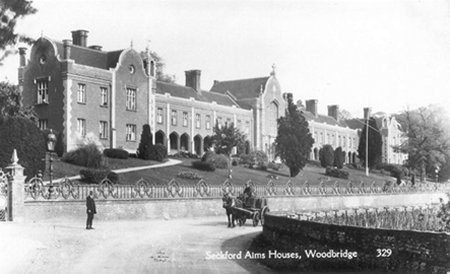
The Seckford Hospital circa 1900.
The churchwardens, as Trustees of the Woodbridge Grammar School and as local representatives of the Governors of the Seckford Charity, recommended a compromise solution. They proposed amalgamating the Seckford Charity with that of the Grammar School while at the same time expanding the services to the poor of the town. This recommendation formed the basis of a scheme for the management and regulation of the amalgamated charities which was drawn up by the Attorney-General and then approved by the High Court of Chancery in June 1861.
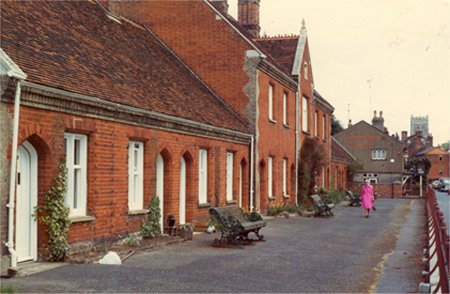
The new almshouses erected in 1869
In a statement explaining the reasons for supporting the amalgamation of the charities, the High Court of Chancery noted that using the surplus funds for indiscriminate poor relief could result in "pauperising the town of Woodbridge" . This was a view which was in accord with the actions of the then infant Charity Commission which regularly criticised trusts that had been established to give grants to the poor of a particular place. Though some were well managed, most made little effort to ensure that grants were only given to those who had scant prospect of finding employment.
The 1861 scheme allowed for an expansion of the services offered to the poor of Woodbridge by (i) refurbishing or rebuilding the old almshouse (ii) providing a dispensary, lending library and public pump and drinking fountain (iii) making annual payments to the elementary schools in Woodbridge and giving grants towards apprenticeships for children educated in these schools. The remaining income of the charity could be spent on the Grammar School and a sum of up to £3,500 from the accumulated funds of the charity could be spent on a new building for the school. The Scheme also specified that the number of children of the deserving poor who would be offered free places was to be increased from 10 to 20.
In 1869 the old almshouses, and the adjacent nurses’ home, were demolished and the present two story building opposite Fen Meadow was erected. They provided accommodation for eight married couples, eight single women and a nurse.