Woodbridge Theatre
During the eighteenth century troupes of actors occasionally came to Woodbridge to give performances. For example, in 1769, the Saddler’s Wells gave a 'great variety of new performances each night of their stay' in Woodbridge. The pieces were mostly of a burlesque character:- the Enchanted Girdles or Winki the Witch; The Lawyer, the Jew and the Yorkshireman; and Magic in two colours, or Fairy blue and Fairy red. It was announced that 'they belonged to the only Wells from which may be drawn WINE; three shillings and sixpence a full quart'.
The Norwich Company of Comedians also came to Woodbridge and it was an offshoot of it that eventually built a theatre in the town. The first record of a visit by The Norwich Company of Comedians is an advertisement placed in the Ipswich Journal for July 20th, 1750. The performances it describes were held at the Town Hall (Shire Hall) where additional seating was provided for the audience by the construction of 'Boxes' and an 'Upper Gallery'. The Norwich Company returned to the Town Hall at Woodbridge from 31st Aug to 13th Sept 1754, and on the 29th Aug, 1768.
The first reference to the Norwich Company of Comedians appears in 1726 when it was it was styled 'The Duke of Grafton’s Servants'. In 1736 it assumed the title The Norwich Company of Comedians, Servants. The company moved to a custom built theatre in 1758 and it received a Royal patent in 1768. They then became known as 'His Majesty’s Servants from the Theatre Royal in Norwich.
The Norwich Company took performances around towns in East Anglia. By 1760 they had settled into a pattern of touring which remained more or less unchanged for well over a century. The players usually wintered in Norwich, during which time sets could be built or repainted ready for the start of the country tour of King’s Lynn, Great Yarmouth, Cambridge, Bury St Edmunds, Colchester and Ipswich. The map shows the location of their theatres and the order in which they visited them. From year to year, there were variations on the established route and smaller towns, such as Woodbridge, were visited. In all places their arrival coincided with the town being full of visitors who had come to attend an Assize or to view the sights of a fair.
In 1785 the Norwich Company split into two separate troupes, "the Outer Circle" only visited the principal towns in East Anglia and "The Inner Circle", which became known as "Mr Scaggs' Company of Comedians", visited some of the smaller town. The first visit of Mr Scraggs' company to Woodbridge was in January 1886 and they put on two performances, which started at 6.00pm in the Town Hall.
In 1792 an actor called David Fisher formed a partnership with William Scraggs and Fisher eventually took control of the company, when Scraggs retired in 1808, and he renamed it "The Norfolk and Suffolk Company of Comedians".
David Fisher and The Norfolk and Suffolk Company of Comedians
David Fisher, a Norwich carpenter, was attracting attention in musical circles during the 1780s. He had a startlingly good voice which he exercised to greatest effect in patriotic sea songs. He was induced to join the Norwich Company as a singer and his first appearance on a playbill was in 1786 when he was mentioned as singing interludes. The Norwich manager then offered him a part in a play and was so impressed that he urged him to take up acting as a profession and Fisher soon established himself as a competent character actor and then as a manager.
After Fisher took over The Norfolk and Suffolk Company of Comedians he tried to encourage a taste for drama in towns which the troupe had not visited regularly. To that end he sent a pioneer or advance company to perform in any available building or yard. For a season or two the company would return to the same place until he was able to able to gauge public demand for drama.
If Fisher decided that the demand was sufficient to justify a dedicated theatre he would set about building one at a location which was likely to make it prominent in the town's social life. In this simple and methodical manner he scattered East Anglia with thirteen new theatres in the space of sixteen years from 1812 to 28. Over a two year cycle the troupe visited all of them. The map on the right shows the location of the theatres and the circuit in 1832-34. By that time the theatre at Thetford had been abandoned, because the assizes had been transferred to Norwich in the early 1830's. Without the influx of people to the assizes the theatre would have been poorly attended.
It took almost two years to make the complete round of these theatres, with a season of up to two months in each town. Visits were timed to coincide with Assizes, fairs, races and other crowd-pulling events; also sixty days was the maximum period for which, by the terms of the 1788 Theatre Licensing Act, Magistrates were empowered to allow travelling companies to perform in one place.
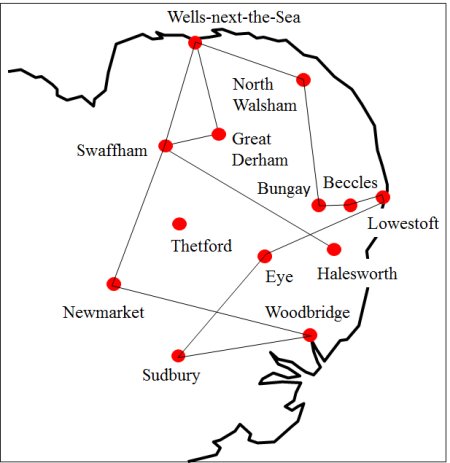
The locations of the theatres built by David Fisher and the circuit the troupe travelled during the two year cycle from 1832.
There is no evidence that the Fisher theatres were used by other touring troupes but they were made available for other types of entertainment. For example, in Woodbridge Fisher gave permission for a series of concerts to be given in the theatre by the Woodbridge Amateur Music Society.
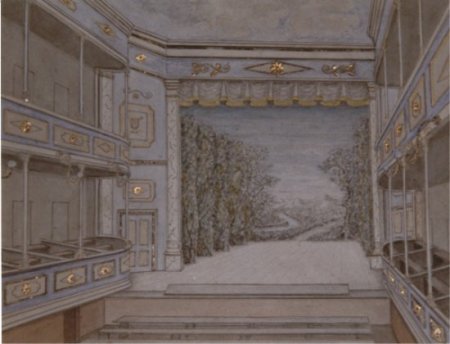
Typically, the Fisher theatres were moderate-sized buildings with a steep sloping roof. Hard backless benches covered with green baize furnished galleries, boxes and pit alike. There were two 'doors of entrance' facing the audience. A green baize curtain hung upstage of the doors, leaving a deep fore-stage. A painting which is reputed to depict the interior of a typical Fisher Theatre is on the right.
Stage properties, scenery, costumes and other impedimenta were conveyed from town to town in three large wagons, each bearing six tons of goods and drawn by a team of six horses. Living accommodation for the company was provided where possible.
Painting showing the interior of a
typical Fisher Theatre
Woodbridge Theatre
David Fisher selected the site for the Woodbridge Theatre on 21st October 1813. By that time the Woodbridge Barracks has been established and Officers, and their families, would doubtless swell the audience. The selected site formed part of the premises of The Angel public house. There was no frontage to the road (then called Bridewell Street), and the entrance to the plot was by means of a long passage, 12ft wide, lying between The Angel and a cottage. The area of the land upon which the theatre stood formed a rectangle 100ft by 32ft. The shell of the theatre and the passage way still remain and a photograph of them is on the right.
A local builder, Mr Thomson, erected the building at a cost of £2000 and the theatre opened on 5 February 1814. The account of the opening night given in the East Anglian contains this description of the interior of the theatre.
The structure - as to form, rather old-fashioned than new - is judicious; for the size of the house the accommodation is, in every respect, good; and the painting, decorations etc, are such as give it a neat, light, and airy appearance. It is calculated to hold from 170 to 180. The stage, which possesses great depth, is sufficiently large for any scenic representation, not depending on spectacle or procession. On each side of the stage there are two tiers of boxes, four boxes in each tier; the lower tier having also three centre boxes, at the back of the pit. The pit contains about ten or eleven and the gallery seems well proportioned to the other parts of the theatre. The house is lighted with Liverpool lamps; illuminators which, as is obvious at Ipswich Theatre, require more attention, to give them their full effect, than they receive. The upper tier of boxes seems to require at least one additional lamp on each side.
Each playing night was a marathon. The actor F C Burton, last surviving member of the Fisher company, who lived until 1917, wrote in his old age: 'Ordinarily the performances lasted from 7 pm to midnight, commencing with a five act tragedy or comedy, followed by a song by the comedian. Then one of the young ladies would dance or sing a ballad, to be followed by a farce, and the evening would conclude with a two or three act melodrama. The members of the company had to be well equipped in all the arts of the profession'.
David Fisher built a family home near to his theatre in Woodbridge. This house, built in 1814, may well have been the first permanent home David Fisher and his wife Elizabeth ever had. Sadly, she died there only a few weeks after the opening of his third theatre, and was buried in Woodbridge churchyard.
When David Fisher died in 1832 his second son Charles took up the management role at a time when theatres throughout England were enfeebled by declining patronage. A leader from The Times of 3rd Oct 1826 pronounced:- 'Theatrical performances seem to be losing speculations not only in this country, but even in France. . . The state of theatrical property in England is wretched beyond description. Many of the large towns which supported a theatre three or four months in the year do not now encourage even a week’s acting, and in many of the places where theatres are open, the performers are almost starving.'
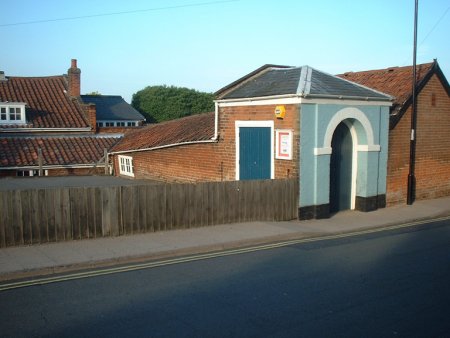
Entrance to the Woodbridge Theatre was via this arched door leading to a long passage. The open area on the left was occupied by a separate building which was demolished in 1872 when the main body of the old theatre was used as a school.
In 1843, Woodbridge theatre reported 'little support in comparison with former times' and a much more dramatic falling away was evident in the smaller Fisher theatres In 1844, after more than fifty years, the company was dissolved, the victim of a changing social pattern. Leases were terminated and theatres were sold one by one.
Until January 1863 the Woodbridge premises continued to be used for a variety of performances and it was some times billed as "Theatre Royal, Woodbridge" In 1862 the managers of the National School on Burkitt Road rented it for an Infant School and in 1883 it was auctioned with them as sitting tenants. Soon after two cottages to the left of the entrance were demolished to make space for a playground (now a private car park) The school moved out in 1955 and the building was acquired by Dr Littler of Melton who used it as a store. From 1963 it was being used as the auction room of Neal Sons and Fletcher.
The Norwich Company was not immune to a decline in audiences and its own collapse, though more prolonged, exactly mirrored that of the Fishers. The Norwich circuit was curtailed in 1842 and from 1845 to 1853 a succession of managers came and went. Finally, in 1854, the comedian Charles Gill set about restoring the old pattern of the circuit, refurbishing the disreputable playhouse at Ipswich and reviving some of the money-spinners of the past. It was, however, too late. By 1849 a cheap second-class return fare from Norwich to London was 10s. Third class return cost 7s 6d. Wealthier patrons had long since started to seek their pleasures farther from home and this new mobility soon spread through the social strata.
Last edited 15 Oct 21