Woodbridge During the First World War
The Zeppelin Raid on Woodbridge
On 12th August 1915, just before the Yeomanry left Woodbridge, a German Navy Zeppelin dropped 28 high explosive and incendiary bombs on Woodbridge. This map shows where the high explosive bombs landed. The first fell on St John's Hill at10.30 pm and the last on the Ipswich Road a few minutes later. During the raid six lives were lost, 23 people were injured and over a hundred houses were destroyed or damaged.
The injured were first treated at the Council School and then taken to a temporary Hospital at Hamlyn House, Cumberland Street, where some of the Red Cross VADs attended them until they could be moved to Ipswich Hospital. Woodbridge Fire Brigade led the funeral procession of the six people who died in the raid. One of the victims was a fireman on his way to the fire station. Their graves and a memorial to them are in Woodbridge Cemetery. The funds to create this memorial were raised at the same time as those to establish the Market Hill memorial to those who were killed in action or died from injuries received.
Woodbridge was not particularly unlucky to have suffered such an attack; other Suffolk towns were bombed by Zeppelins from April 1915 and in May that year a Zeppelin dropped bombs within a mile of both sides of Woodbridge. The press had given copious details of most of the earlier attacks but by the time of the one on Woodbridge there was clearly concern that such information, even in provincial newspapers, may be of interest to the enemy. The Reporter’s account of the Woodbridge Raid was simply “On Thursday night a Zeppelin dropped bombs on the East Coast – 6 people were killed and 23 injured.” Subsequent appeals for those affected by the raid just referred to “The Explosion”. The Reporter did not print a full account of the raid until the war was over.
Increasingly stringent black-out restrictions were imposed and in March 1916 green lights were placed at certain locations around the town to warn that an air raid was imminent. It was not until the end of 1917 that an electric air raid siren was installed.
The reign of terror of the Naval Zeppelin L10 which bombed Woodbridge was short lived. On the afternoon of 3rd September it was on a reconnaissance flight over the North Sea. On its return it could not avoid flying through a thunderstorm and was struck by lightning. It fell in flames into Elbe Estuary. None of the crew of 19 survived.
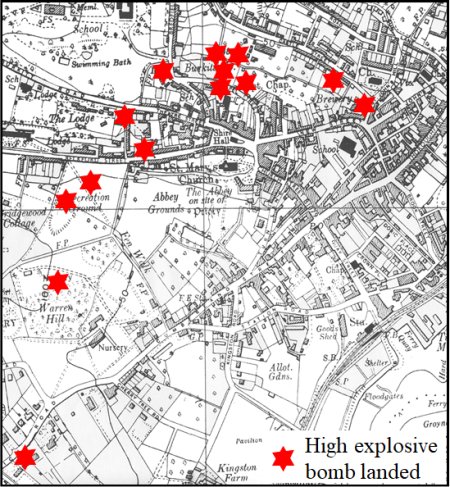
Map showing where the high explosive bombs dropped by
Naval Zeppelin L10
The Home Guard
Those injured by the by Zeppelin raid on Woodbridge would have been helped by the troops in the area and by the precursor of the Home Guard. From the very start of the war there was anxiety over a possible German invasion of the east coast of England and in time honoured fashion many unofficial town or civic 'guards' soon appeared to take on the task of local defence. At first the government gave no encouragement to these local amateurs, but, in November 1914, when a rapid German advance towards the Channel coast caused alarm, a 'central association of Volunteer Training Core' (VTC) was given official sanction. From July 1916 it became part of the Territorial Forces, and those serving in it received proper service uniforms and mandatory training. Most of them were retired soldiers and, because they had an armband or badge with GR on it, they were sometime called the 'Genuine Relics' and 'Grand papa's Regiment'.
The Woodbridge and Wickham Market Recorder for 4th Feb 1915 stated that “The great desire of those above military age to do something in defence of their country in the event of an invasion, found expression at a large and representative gathering at the Lecture Hall. After an explanation of the change in the government’s position, it was moved that that 40 to 50 men be recruited to form a platoon of the VTC for the Woodbridge District.
In Suffolk the VTC became the 4th Volunteers Battalion of the Suffolk Regiment. There were four companies each having four platoons. Each platoon was centred in a different town or village from Aldeburgh in the north to East Bergholt, Brantham, Stutton and Shotley in the south. Woodbridge, in the centre, was the headquarters of the battalion. No1 Platoon of A Company drew it men from Woodbridge and Melton. Some of its officers were probably former soldiers but they would not have experienced anything to match the horror and carnage which beset their fellow townsmen who fought during the First World War.
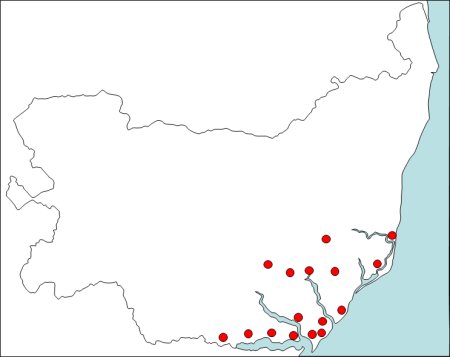
The red dots on this map of Suffolk mark the locations of the Platoons of the 4th Volunteer Battalion, Suffolk Regiment.
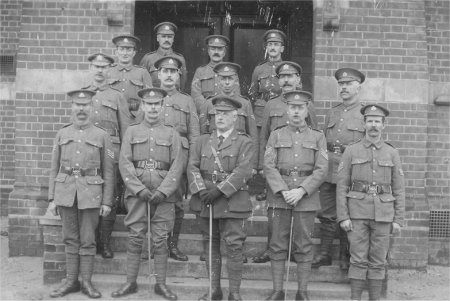
The officers and NCOs of No 1 Platoon of
A company of the 'Home Guard'.
Four days after Britain entered the war the Defence of the Realm Act was passed. It allowed the Government to take control of all the major industries, to requisition buildings, homes and land and to tell people what they could not do. Many aspects of ordinary life were changed but many remained as before – for example children still went to school.
When the war started the general impression was that it would be all over by Christmas and thus there would be no need for women to fill the vacancies created by the men recruited into the armed forces. But when the war dragged on, and German submarines began to sink ships importing essential supplies into to Britain, the government realized that women had an important role to play on the Home Front.
Last edited 15 Sept 21