Woodbridge During the First World War
The Memorial to the Fallen
The early thoughts on what would be the most fitting memorial to the men who made the supreme sacrifice for King and country were summarized in The Woodbridge and Wickham Reporter of 30 January 1919. The options were then a Hall or Institute for young men, a bridge over the Deben to replace the Sutton Ferry and a plain granite column on Market Hill inscribed with the names of the fallen.
On the 30th May 1919 the newly elected Woodbridge Urban District Council held a public meeting to consider proposals for a memorial. A representative committee of 25 members was appointed and they were asked to look into three proposals:- (i) a hospital, (ii) houses to be erected and then rented to the widows of those who fell and (iii) a red granite cross or obelisk on Market Hill with the names of the fallen men inscribed thereon. The committee eventually rejected the hospital option on the grounds of cost and did a detailed analysis of (i) cottages for war widows (ii) a memorial cross and (iii) financial help for the children of the fallen. The committee estimated that building four cottages would cost £1,800, the Cross and inscriptions would cost £350 and that a £1000 would produce a £90pa annuity for 15 years to support the children of the fallen.
A public meeting was held towards the end of September 1919 to consider the options and the resolution that a memorial cross be erected was carried by 35 votes to 5. It was also agreed that a public subscription be started to raise the required funds and that any money left over should be to used to help the children of the fallen, and within two weeks an appeal for funds was launched.
By the end of March 1920 the public subscription had raised £828 and the Woodbridge War Memorial General Committee started to discuss where the cross should be placed. By late June it had decided that the cross should be placed in the small public garden on Market Hill.
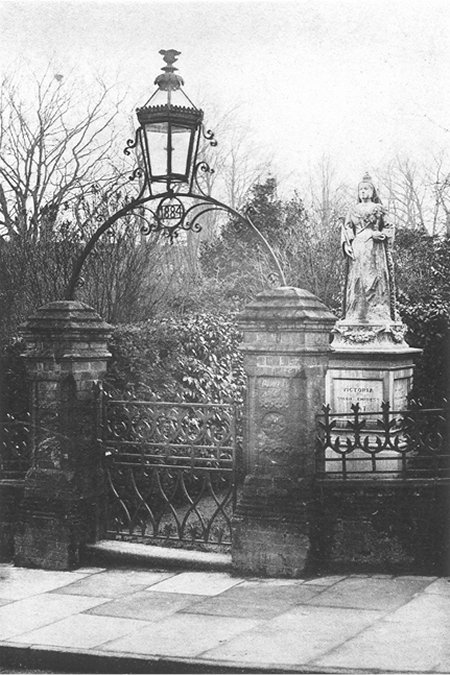
The land for the garden was given to the town by the American naval captain William Mann in memory of his father who was born in Woodbridge. Three years after garden was opened it was decided that it would be appropriate place to put a statute of Queen Victoria in order to commemorate the 50th anniversary of her reign.
The statue of Queen Victoria was set back
from the elegant wrought iron gate which
formed the entrance to the public garden,
The War Memorial was dedicated on the Sunday before the second anniversary of the Armistice. The statute of Queen Victoria was moved from the centre of the enclosure to make way for this simple cross based on those which, before the seventeenth century, stood in the market places of many East Anglian towns. While the last hymn, For all the saints, was being sung, the relatives came forward with their floral tributes and laid them at the foot of the column. Those attending the dedication filled the whole of the lower end of Market Hill. That evening all the services in the Churches in the town were of a Memorial nature.
The Woodbridge War Memorial Committee raised £876 by subscription. After meeting the costs of memorial, £522 was left to be used to provide finical support for the children of the fallen and in early January 1921 the Committee announced that a list of beneficiaries was to be created. Unfortunately it has not yet been possible to find out what subsequently happened to this fund.
The 133 names inscribed on the memorial were all put forward by relatives and friends. It is not a definitive list. There would appear to be 7 other men with Woodbridge connections who do not appear on the memorial. Take for example the case of Arthur Wood. Tributes to him appeared to in both the W & WM Reporter and an Almanac, and his name is also on a Street Shrine, but it is not on the war memorial. He was a regular solider who had served in India and was killed in action in December 1914. His parents were living in Woodbridge at the time.
The memorial records the names of those who made the supreme sacrifice but it also proper to remember those who were crippled, gassed or wounded. For them, and their families, life would never be the same again. Most of those who returned also had horrific memories which tormented them for the rest of their lives. Memories that they often felt could not be shared with their families.
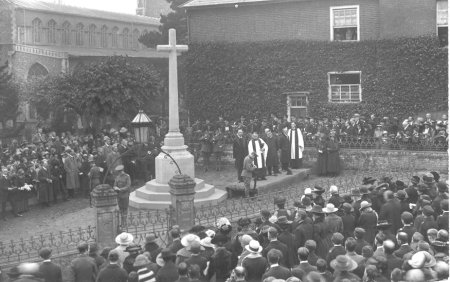
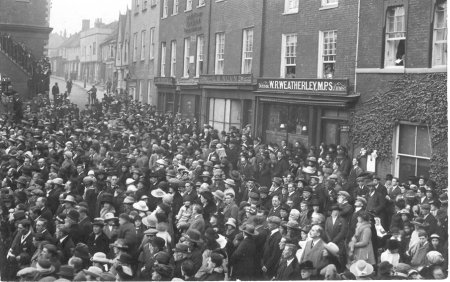
The Dedication Service on 11th November 1920
The Post War Period
The war time government had started to plan for it two years earlier and had appointed a Minister of Reconstruction to centralize post war planning of industry, housing, public health, and transportation facilities. These proposals assumed the existence of a stable economy and the temporary continuation of wartime rationing and price controls. In the event, none of these proved possible and most of the initiatives were not implemented.
However, one initiative of the war time government changed Britain for ever. In February 1918 Parliament passed The Representation of the People Act. It eliminated property qualifications for male voters and gave every male over 21 the right to vote. Women over 30 were also given the right to vote. The age differential remained for a decade because of a lingering fear that English political life might be dominated by a female majority. In other respects men and women, for the first time in British history, became politically equal. Thus the aim that the pre war suffragettes had been unable to achieve by violence was granted to women en masse as a reward for their patriotic support of the war effort.
The changes in the franchise increased the electorate of the Woodbridge Division from 13,454 to 30,421. But in the General Election of December 1919 only 46% of the electorate of the town of Woodbridge voted.
The returning veterans did not find "Civvy Street" paved with gold, but in most areas of the country they had no difficulty locating jobs because many companies worked overtime filling orders for civilian goods and poured capital into plant expansion.
Although there is evidence that many returning Woodbridge servicemen were immediately taken back by their former employers this was not the case for all. In May 1920 a letter published by The Reporter stated that many ex-service men in Woodbridge were near starvation because their former employers could not find jobs for them
The other major national problem was a shortage of housing and this was also a problem in Woodbridge. Although most of the billeted troops had left the town by May 1919 the Urban District Council was concerned that the Military Authorities were still holding on to many houses although they were not needed. The local paper noted that many of these houses were now empty and that this was a disgrace to the town because there were a large number of people requiring houses.
In June 1920 the Urban District Council agreed to award a contract to erect 14 houses on Barrack Road for rent. These houses were completed by March 1921.
No sooner had employers and their employees become accustomed to the immediate post war boom than, in 1921, the economic bubble burst because international trade did not return to the pre-War levels. Long-term unemployment became a major problem and it got worse, in 1929, when the stock market cashed in the United States. It world wide impact caused British industrial output to drop by a third and, during the years 1921-1938, one in seven of the working population was looking for a job.
In 1930 the population of Woodbridge was still about the same level as it had been for 70 years but the town’s long period of stagnation was about to end. In that year the bypass was built as a venture to provide work for the unemployed and a number of new businesses began to spring up in or around Woodbridge. The population started to rise again and it has not stopped since.
Last edited 15 Sept 21