Woodbridge During the Second World War
A Contemporary Accounts Relating to the Home Guard
Regiments like the Liverpool Scottish, the Beds and Herts, occupied some of the larger houses in and around Woodbridge. Seckford Hall was requisitioned for use by an Ack Ack unit. The guns were so positioned on high ground at Seckford Hall, one assumed to fire at any would be raider of the Luftwaffe, seeking out the Royal Air Force Station at Martlesham Heath. In addition to there being troops stationed in Woodbridge itself, various units were dispersed around the town in adjoining villages, the Royal Tank Regiment at Clevering Hall and park to mention but one.
Woodbridge used to benefit from an influx of these troops from time to time, swelling the already crowded public houses, eager to sample the local ‘brew’. The local Cinema became very popular with troops and civilians alike, with all the latest American films on offer, providing a welcome relief from the weary day to day drudge of the War.
An Officers Commando Army Training School was established across the River on the Sutton side, and on their off duty hours used to use the services of the ferry to visit the Woodbridge Inns. Many a soldier has taken a ducking falling from the Ferry boat on the return journey having imbibed too much ale, much to the consternation of the ferryman, a Mr. Dick Elvin. On a more ‘sober’ note, however, most of the Church and Chapel members opened service ‘canteens’ in the evenings, where a very welcome ‘cuppa’ and homemade cakes could be obtained, for a few pence, and a game of ping-pong played.
As far as I can remember, Woodbridge did not receive a direct hit from a bomb, during the War. I witnessed from a safe distance, the bombing of Martlesham RAF station, by German Stuka dive bombers, on a sunny August afternoon, also a gigantic explosion one night from a land mine which landed at Bredfield, the blast from which pitched me out of bed, and shattered a window. I guess one could say that Woodbridge was lucky in that respect, although there were no actual military installations in the town which could have provided a target. Crashed aircraft were quite numerous in the Woodbridge area, both friendly and alien. An Italian Fiat bomber crashed at Tangham Forest, on its way to bomb Martlesham. An American Flying Fortress ditched in the Deben at Ramsholt, and many more.
George Cole was an agricultural worker and a member of the Home Guard. He worked for Tile Brothers (vegetable merchants) at The Old Maltings in Station Road. He supervised the market gardening being done by women (sometimes as many as a hundred), the majority of whom were Land Army Girls.
Permits were needed for all lorries when they travelled past checkpoints placed on roads leading from the coast. There was a checkpoint near where the Sutton/Hollesley Roads converged.
The Home Guard was formed when invasion threatened two weeks before Dunkirk. The Prime Minister declared that he had 3 million recruits overnight. Locally recruitment was done in the Army Drill Hall, Station Road, opposite the Boat Inn. This hall was originally built in 1920 for the Territorial Army, B Company. Cadets used it later.
Officers from the regular army (Bury St Edmunds) were in charge of the Home Guard. Mr Cole had a Sten gun issued to him but most had 12 bore guns. All wore uniforms, carried a spy-light pack and ammunition pouches. They kept their ammunition at home when not on duty. Their orders where to blow up Wilford Bridge should an invasion occur. Training on how to do this was given, and because of this objective, Wilford Bridge was also the collection point for the regiment.
In the early days every time a siren went all the Home Guards rushed to the Bridge. Later a system was worked out that five Home guards were permanently on duty and they called on reserves as needed. Every recruit had four nights a week when they had to sleep at the Headquarters at Ivy Lodge, Cumberland Street. They took it in turn to keep awake next to the telephone.
A Spigot mortar (anti-tank) guarded Bromeswell Road from the 18th hole of the Golf Course. Ack Ack guns were in place at Melton Grange and at Seckford Hall.
The only incident that Mr Cole remembers was a 15 bombs being dropped in the river during a German attack on mock landing craft.
Agricultural workers were given a double cheese ration and they supplemented their diet with rabbit meat.
A London couple were billeted on the young Cole family. They stayed, in their house on Edwin Avenue, for the entire war.
A Declaration of Peace was made from the steps of the Shire Hall. Edwin Avenue held a street party to celebrate
With a very real possibility of a German invasion, various defences were set up across the country. These included concrete blockhouses (or pillboxes) at strategic points. To fool the invaders these were imaginatively (and naively) disguised - the designers must have had a lot of fun! On the west side of the A12, opposite the xxx junction there was a big hoarding advertising ‘Hotel Endisnear - Continental Visitors Particularly Welcome’. Further south on the A12, our bike rides to Ipswich were cheered by a ‘Roadman’s hut’, with painted spades and a neat board saying ‘A. Mole, Deepdownham’. One proposed strategy in the event of an invasion was for our defence forces to lie low while the Germans moved forward, and then to harass them from the rear. To this end ‘secret’ underground bunkers were dug in selected places. One of these was just inside what was known as Arnie’s Wood off Doe’s Alley, a track running from the Bxxx at the Foxboro turn down to the xxxx in Melton. We knew about this bunker during its construction as the men digging it had borrowed our ladder to get in and out. Once it was occupied (I’m uncertain if this was by troops or the Home Guard) it was even less secret because in the evenings the inhabitants (and their local visitors) stood outside chatting, their voices audible and their cigarettes visible in the dark.
Despite wartime campaigns to discourage rumour mongers all sorts of misinformation flourished. One story, concerning a mother and son with a Germanic name, claimed that they signalled to German bombers by hanging out sheets. Just what they signalled was unclear. Later in the War there was pressure in some quarters for the Allies to open a ‘Second front’ to defend Russia from the Germans. I remember people withdrawing their custom from a shop whose owners supported the Second front and, as a result, were deemed to be Communists.
The Red Cross established a First Aid Post in a building in a lane behind the Crown Hotel. It was manned every night but never put to the test so far I know. I was under the impression that Woodbridge itself escaped any bombing despite its proximity to RAF and US airfields at Debach and Tunstall. Aldeburgh was certainly bombed though I am not sure how often.
In the summer of 1942, I came home from my Boarding School and was given a message at Woodbridge Station telling me to walk home. My mother, who was in the Red Cross, had gone off in the ambulance with members of the Woodbridge Detachments (Suffolk 1 for men, and Suffolk 2 for women) to help with the casualties. I think it was on the journey to Aldeburgh that one of the women was irritated by a member of Suffolk 1 who claimed male superiority. As the ambulance was passing a Cemetery, she put him in his place with ‘There’s plenty in there as thought they were indispensable!’ My mother was usually on duty at the First Aid Post on Sunday nights. It was very difficult to get batteries for bike lights (which in any case had to be kept dim during the blackout) so we resorted to acetylene lamps. These gave a feeble glow, smelt horrid and frequently went out. When the First Aid Post was dismantled at the end of the war one of the helpers, a rather sheltered elderly lady, came across the urinals and said ‘I never realised we had these useful umbrella stands.’
Photographs Relating to the Home Guard
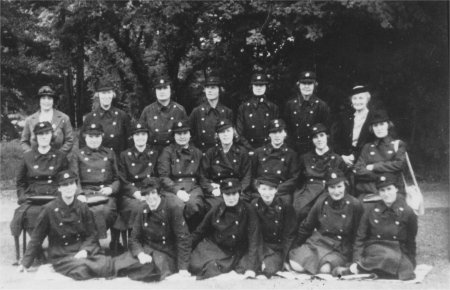
Ambulance Service
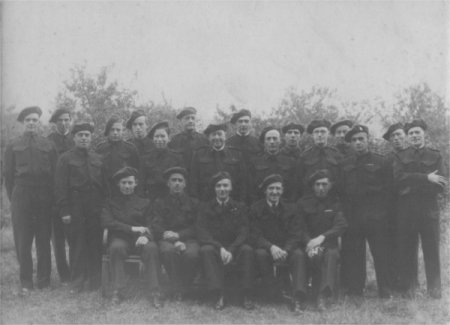
Members of the Woodbridge ARP First Aid Party.
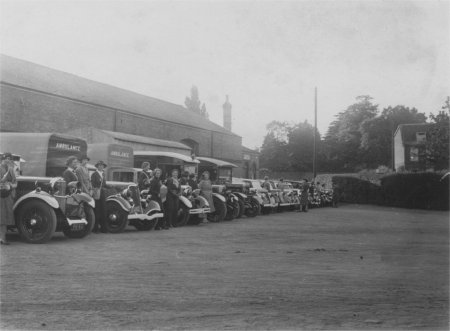
Inspection of Woodbridge Ambulances by the Grain Store at Station
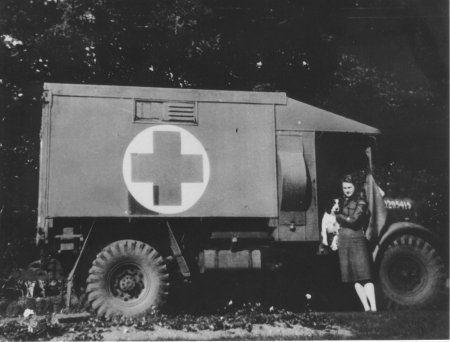
Ambulance at The Wilderness, Pytches Rd
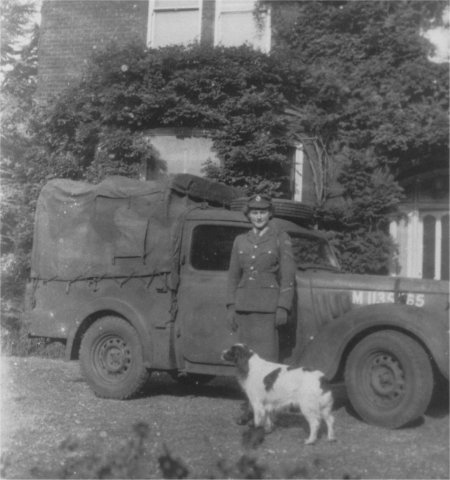
Command Supply Dept Truck
I

Miss Bobby Warren - Woodbridge Transport

May Cutting - Ambulance Service
Last edited 15 Sept 21