Norman Heatley "The Unsung Hero of Penicillin Production During the Second World War "
In 1928 Alexander Fleming discovered that the mould penicillium notatum secreted a juice which contained something which killed bacteria. He was, however, unable to extract the antibacterial substance and thereby produce something that could be used for clinical trials. Ten years later Howard Florey and Ernst Chain, at Oxford University’s Dunn School of Pathology decided to start work on the mould juice and try to extract the antibacterial substance which they called ‘penicillin’. They were unsuccessful until they invited Norman Heatley, who was born and brought up in Woodbridge, to help them. Heatley, who had recently been awarded a PhD by Cambridge University for a thesis on ‘The application of micro-chemical methods to biological problems’, developed a method of extracting penicillin from the mould juice and a way of measuring its strength.
After tests on mice showed that injecting penicillin into mice had no harmful effects, and that it could cure them of bacterial infections, a public announcement of the work was made the August 1940 issue of The Lancet. The team hoped that the publication would stimulate a pharmaceutical company to start making penicillin to test on humans but this failed and there was no other option but to scale up the production at Oxford. Florey assigned the task to Healey who designed a special vessel in which to ferment the mould. Seven hundred of these vessels were made in ceramic by a manufacturer in Stoke-on-Trent and a production line, tended by six technicians, was set up in the university.
.
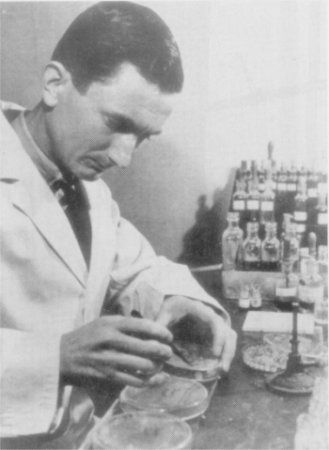
Norman Heatley assaying penicillin.
By January 1941 enough penicillin was being made to start tests on humans. These showed that penicillin had the potential to be a miracle cure but there was insufficient penicillin to perform a full clinical trial. To increase production Florey tried to interest British pharmaceutical companies but they were too tied down by wartime commitments. He also approached other academic institutions but they were not prepared to help either.
Florey’s final option was to ask the Rockefeller Foundation, which was funding some of the work, to solicit the help of an American pharmaceutical company. The Foundation agreed and paid for Florey and Heatley to travel to the USA to meet with prospective partners.
Florey and Heatley flew to New York in June 1941 and within two weeks they had been offered the help of the government’s fermentation scientists at the Northern Regional Research Laboratory at Peoria, Illinois. Heatley spent 5 months there and then 7 months working with Merck, the American pharmaceutical company which agreed to produce penicillin. By the time Heatley returned to England in July 1942 the scientists at Peoria had increased the yields of penicillin more than thirty-fold by using different fermentation techniques and a new strain of mould, discovered growing on a melon. Within a year four other American pharmaceutical companies had started to produce penicillin. Treatment of US soldiers in the Pacific war zone began in April 1943.
By the end the year the production of penicillin was the second highest priority of the American War Department and another twenty-one companies were making penicillin. Only the development of the atom bomb was considered more important. In the first 5 months of 1943 enough penicillin to treat 180 severe cases was produced. In the following 7 months enough to treat 9,225 such cases was manufactured. By D-day, June 6th, 1944, there was enough to treat 45,000 cases per month. When the work on the new fermentation techniques was published by the American team Heatley’s contribution was not mentioned and much of the ensuing financial rewards from penicillin went to the US.
During Heatley’s absence from Oxford his colleague scaled up his production line. By September 1942 this apparatus was also processing mould juice from Kemball-Bishop, the London fermentation company, and soon after ICI was sending mould juice as well. From 1942 to 43 some 183 patients were treated and in May 1943 Florey went to North Africa to oversee the use of penicillin on wounded soldiers. The Therapeutic Research Corporation, a consortium of the five largest British pharmaceutical firms, eventually took up the production of penicillin and shared information with the American companies and the US Office of Science Research and Development.
Fleming and Florey were knighted in June 1944 and in October 1945 the Nobel Prize for Physiology and Medicine was award to Fleming, Florey and Chain for the discovery of penicillin and its curative action. There was no award for Heatley who was the first to extract penicillin in a form that allowed its therapeutic potential to be demonstrated and who designed and set up the first production line. Florey and Chain received the Nobel Prize because they were the leaders of the Oxford team. Heatley was judged to be just a technician who solved a series of problems they identified.
It is a matter of speculation as to what might have happened if the rules of the Nobel Prize had not restricted the maximum number of recipients to three. In 1998 Professor Sir Henry Harris, former Head of the Dunn School of Pathology, was of the opinion that Heatley's work would likely be more appreciated today, in a time when the Nobel Committee places greater value on direct contribution. Sir Henry went on to say that Heatley 'was put up for the Royal Society but the rumour was that, because of his diffidence, people regarded him as just a pair of hands for Florey. It was a great injustice. When assessing the contributions of the main protagonists in the penicillin story Sir Henry stated ‘Without Fleming, no Florey and Chain; without Florey, no Heatley; without Heatley, no penicillin.'
Heatley was always very modest about his role in the team and never complained about his lack of recognition. He worked with Florey for 30 years. Heatley was appointed a Nuffield Research Fellow at Lincoln College Oxford in 1948 and received an OBE in 1978. The most significant indication of the value of his work on penicillin came when Oxford University awarded him an Honorary Doctorate in Medicine in 1990, the first given in its 800-year history. When he died in 2004 the obituaries in many newspapers called him “the unsung hero of penicillin production during the Second World War".
Last edited 15 Sept 21