Woodbridge During the Second World War
The Arrival of the Americans
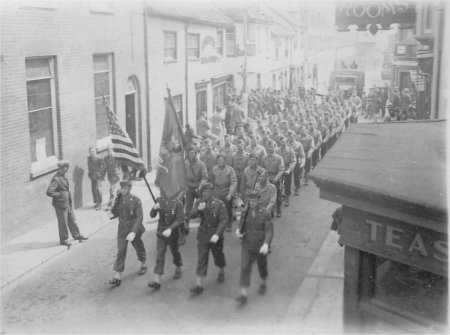
From the end of 1942 Woodbridge played host to the first batch of American servicemen who came to construct the Parham and Debach airfields. "The personnel were mainly coloured Americans which some of the locals found strange. They had never seen a real black skin, much less, one in a uniform. The American bases at Parham and Debach seemed to be completed and operational in a very short time and soon aircraft were leaving and arriving on their missions over Germany." American servicemen were frequent visitors to Woodbridge and landlords of the various inns were hard put to keep pace with the demand. A resident recalls that “the main form of transport for our American allies, appeared to be bicycles, which they rode with gay abandon, mostly on the wrong side of the road”.
American Servicemen marching up Church Street 4th May 1944.
RAF Sutton Heath, which later became known as RAF Woodbridge, was completed in November 1943 as an emergency landing strip for damaged aircraft returning from operations over Europe. It had a single runway, about twice as long as the usual and of extra width, divided into three lanes so that aircraft could land in rapid succession. There was ample provision of rescue vehicles, with cranes and bulldozers to move wreckage out of the way as quickly as possible. There were two other emergency runways constructed on the east coast of England. The location was chosen because it was 'nearly fog-free and had no obstructions for miles.
Within two months of opening the airfield it was realized that, despite the predictions, fog and low cloud was sometimes a problem in the area and it was necessary to install a fog dispersal system. Petrol injected under pressure into steel pipes running either side of the runway fed regularly spaced burners. The heat thereby generated was so intense that it lifted the fog to about 100 ft and thereby provided pilots sufficient visibility to land. The large amount of petrol needed by the system was delivered to Melton Station and was then pumped through a 4 mile long pipe into 350,000 gallon fuel tanks on the northeast of the runway. The Sutton Heath fog dispersal system was the largest of the 14 other systems installed around the country.
There were two other emergency runways constructed on the east coast of England. They were at Carnaby in Yorkshire and Manston in Kent.
By the end of 1944 a total of 2,719 damaged aircraft had landed there and this increased to 4,200 by the end of the war. The airfield also provided refuge to a German night fighter (a Ju 88) whose crew had lost their way. They were overpowered before they could remedy their mistake, and the aircraft was a valuable prize, complete with the latest enemy radar and confidential code books.
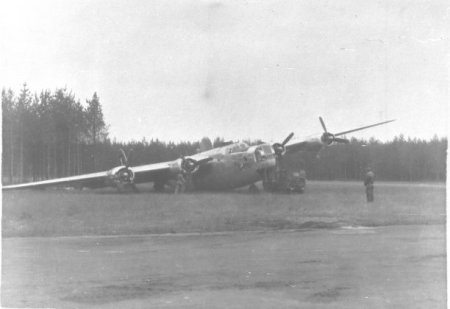
Crash landing of a US Air Force bomber at RAF Sutton Heath on 16th June 1944.
After the war name of the airfield was changed to RAF Woodbridge. It was used for mainly experimental work until March 1948 when it was considered to be surplus to requirements and was placed under care and maintenance. Then in June 1952 it was taken over by the United States Air Force who had taken control of RAF Bentwaters in March 1951. Although most of the service men and their families lived on the bases there some also lived in a housing estate just outside Woodbridge in the neighbouring parish of Melton.
Until the USAF relinquished these airfields in 1993 they would be known as the ‘twin bases’.
In 1928 Alexander Fleming discovered that the mould penicillium notatum secreted a juice containing something which killed bacteria. He was, however, unable to extract the antibacterial substance and thereby produce something that could be used for clinical trials. Ten years later Howard Florey and Ernst Chain, at Oxford University’s Dunn School of Pathology, decided to start work on the mould juice. They were unable to extract the antibacterial substance which they called ‘penicillin’ until Florey invited Norman Heatley to help him. Heatley, who was born and brought up in Woodbridge, had recently been awarded a PhD by Cambridge University. He developed a method of extracting penicillin and a way of measuring its strength. He went on to conduct the first trials on mice and set up a production unit to produce enough penicillin for tests on humans in January 1941.
Greater quantities of penicillin were needed for full clinical trials but British pharmaceutical companies were too tied down by wartime commitments to help. Florey’s had no option but to solicit the help of American pharmaceutical companies and, in June 1941, he and Heatley travelled to the USA to meet with prospective partners. Heatley spent a year working in America and by the time he returned to England the American team with whom he had collaborated had increased the yields of penicillin more than thirty-fold. They did this by using different fermentation techniques and a new strain of mould, discovered growing on a melon. By D-day, June 6th, 1944, there was enough penicillin to treat 45,000 cases per month.
Fleming and Florey were both knighted in June 1944 and, in October 1945, the Nobel Prize for Physiology and Medicine was award to Fleming, Florey and Chain for the discovery of penicillin and its curative action. There was no award for Heatley.
Florey and Chain received the Nobel Prize because they were the leaders of the Oxford team. Heatley was judged to be just a technician who solved a series of problems they identified. But those with greater knowledge of Heatley's work had a different view. Sir Henry Harris, former Head of the Dunn School of Pathology at Oxford, when assessing the contributions of the main protagonists in the penicillin story, stated ‘Without Fleming, no Florey and Chain; without Florey, no Heatley; without Heatley, no penicillin'.
Heatley was always very modest about his role in the team and never complained about his lack of recognition. He worked with Florey for 30 years. Heatley was appointed a Nuffield Research Fellow at Lincoln College Oxford in 1948 and received an OBE in 1978. The most significant indication of the value of his work on penicillin came when Oxford University awarded him an Honorary Doctorate in Medicine in 1990, the first given in its 800-year history. When he died in 2004 the obituaries in many newspapers called him “the unsung hero of penicillin production during the Second World War".
The End
The End