Evolution of the Town and its Maritime Trade
Reminisces of Maritime Trade in the Early Nineteenth Century
Writing about Woodbridge during the early part of the nineteenth century a resident, William Lockwood, recalled that ‘The market at that time was held on a Wednesday, and on the following, and for several succeeding days, wagon loads of corn that had changed owners in the market, might be seen coming in by twenties and by fifties, if not by hundreds; and the quays would be thronged with men, wagons and horses shooting corn into the holds of vessels lying in the docks, which were generally full of craft, some loading for London, some for Liverpool, and some for Newcastle or another large port in the North.’
Lockwood goes on to say ‘Other vessels would be lying in the river, perhaps laden with coal, waiting for an outward bound vessel to make room at the quays for them to unload their cargoes of coal. At that time there was a duty on sea-borne coal, and two or three sworn government meters had to be employed, and were generally at work all day long measuring every bushel or basket of coal as it was pulled up out of the hold.’
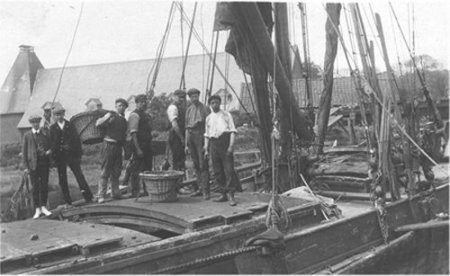
Unloading coal from a barge. The two government meters can be identified by their pristine while collars and one has white shoes.
Lockwood’s account ends thus ‘Loaded corn wagons making their way down to the quays, and the empty corn wagons and coal laden ones returning, would all the morning throng the streets, or the approaches to the quays. The farm men from distant parishes used to start overnight so as to arrive in early morning, coming from Hoxne, Eye, Diss, Stradbroke and such places over 20 miles, in order to give their horses a good rest, and to get back before dusk on the next day, generally having to take a return of coal, timber, shop goods and lime.’
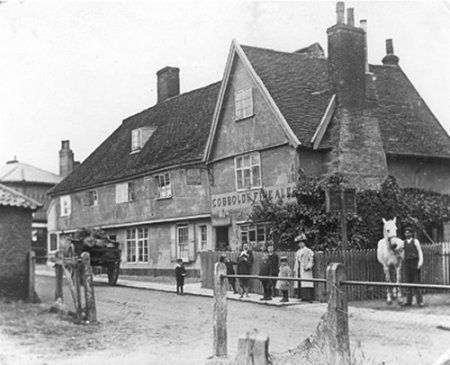
The Ship is in the centre of this photograph which was taken from a yard by the side of The Boat. The Anchor can just be seen on the left.
All the hard work at the quays would have created a thirst but nearby there were three pubs, appropriately named, The Ship, The Boat and The Anchor, to deal with that. The Ship and The Boat long since closed and are now houses but photographs below show them when they were still open.
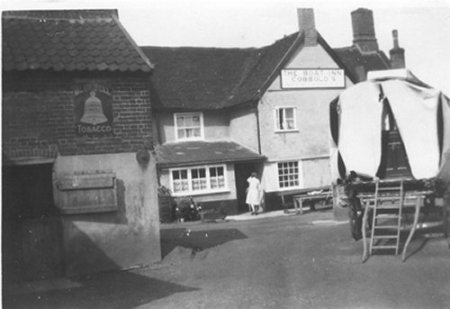
This photograph show the rear of The Boat. For many years a gypsy lived in the caravan on the right.
The Bell and Steelyard, a public house on New Street, was also important to the maritime trade. It was where loaded carts were weighed when they were on route from the market to the quays. The steelyard is on the right hand side of this photograph.
.
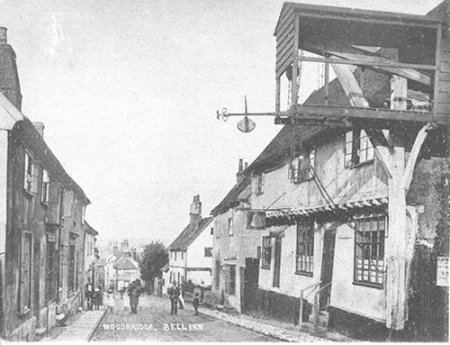
The Bell and Steelyard on New Street.