Evolution of the Town and its Maritime Trade
The Pilots of The Deben
It would have been no mean feat to navigate large vessels over the bar at the entrance of the estuary and through the tortuous reaches beyond. It was thus necessary to employ local seamen who had a detailed knowledge of the area to pilot large vessels. Eventually these pilots were licensed by Trinity House.
The Corporation of Trinity House of Deptford Strand was created in 1514 and it eventually became the principal maritime authority in the UK. It had general powers to organize pilotage and, from 1604, the exclusive right to licence pilots on the Thames. A system of ‘outports’ was not formally created until 1808 and it is from that year that a comprehensive record of examination and licensing of pilots began. Each pilot had to renew his licence yearly when his general health, eyesight and knowledge of local waters were tested. The Corporation financed its pilotage service from the fees paid by vessels and it retained its right to organize pilotage until 1988.
From 8 June 1847, the Corporation exercised its right to pilot ships and vessels into and out from “the sea over the bar into Bawdsey Haven and up the River Deben to Woodbridge and vice versa”. From that time there were Trinity pilots at Woodbridge and at Felixstowe Ferry.
The approach to the Port of Woodbridge has a line of 15 beacons (buoys) marking the channel through the mud flats. It is not known when these beacons were put down but some were there by 1847. (There would have been much earlier channel markers, especially when the half-finished hulks of Woodbridge built men-of-war were taken down stream in the seventeenth century, but nothing is known of them.) The locations of some of these beacons are shown on the map on the right. The first of them is called the Bowship Beacon. It was the point where the Woodbridge pilots took over from those at Felixstowe Ferry.
The Woodbridge pilots kept watch from Tempe Common which was at the top of a ridge running down to Kyson Point. From there they could look down river. When a ship was sighted, a pilot would walk along a path skirting Tempe Wood to his lug-sail boat moored at Kyson point. From there he would sail down river to the Bowship Beacon.
In 1856 there were a total of 12 pilots stationed at either Woodbridge or Felixstowe Ferry. By 1871 their number had dropped to 11 and by 1873 to 6. The records from which this data has been obtained ended in 1903 and by then there were still 6 pilots. All the pilots were local men with many years of experience. In 1861 the ages of the 6 pilots stationed at Woodbridge varied from 34 to 65 and their average age was 47.
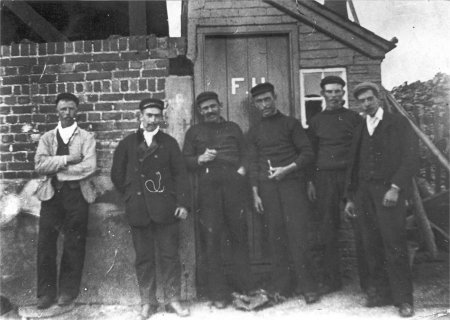
The Woodbridge pilot F Adams is on the left of this photograph which was taken around 1900. The four men on the right are probably 'huffers' who unloaded and loaded vessels.
By 1952 commercial traffic on the river had faded away and so had the need for a Woodbridge Pilot. The last of the Trinity House Pilots for Woodbridge was Frank Knights. In the 1940s he took over the job from Ted Marsh, who had served for 40 years on square-rigged sailing ships before returning to Woodbridge to become a pilot.
Link to fact-sheet with short descriptions of all the locations marked on the map.
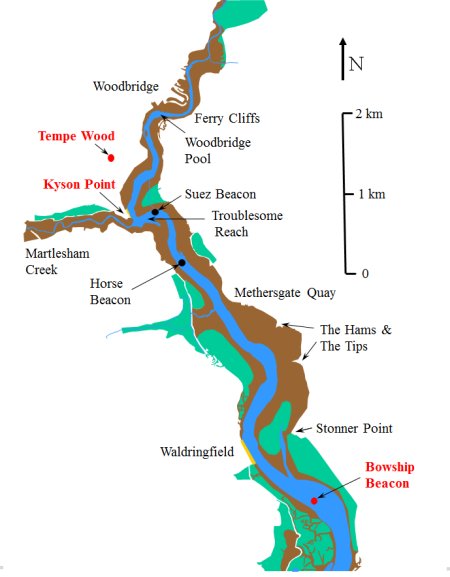
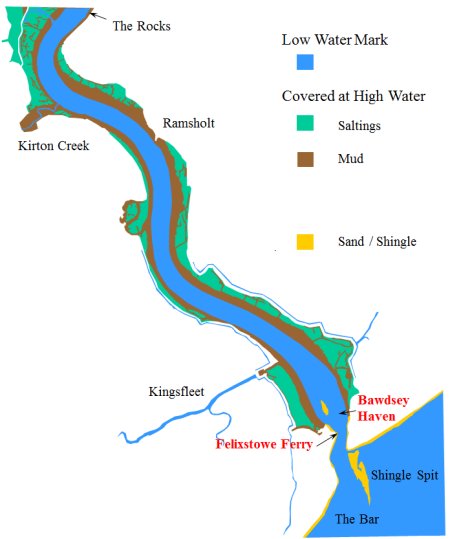
The extent of the Deben Estuary at low and high tide and the locations of the main beacons marking the deepest channel.
Woodbridge Seaman’s Benevolent Society
The heavily rigged little schooners on which the trade of the port depended during the first half of the nineteenth century had a bad habit that worried the town's conscience. They often sailed off into the cold grey North Sea and did not come back. The loss of men at sea, and the hardship it caused their families, could not pass unnoticed in a small community.
In 1840 a group of worthies formed the Woodbridge Shipwrecked Seaman’s Benevolent Society to give financial aid to the relatives of drowned seamen and to compensate for any personal 'gear' lost. Most of the money was collected through donations from wealthy residents. By 1874 the society had 174 seafaring and 245 honorary members and it paid about £133 a year to 29 widows. Payments continued until the closure of the society in 1910. Some of the annual reports of the society are in the Woodbridge museum's collection.