Retailing
Post 1930 – A Period of Rising Population and Prosperity
During the 1930s retailing was transformed. The number of food stuffs coming ready packed increased as did the number and range of ready-made clothes. The buying process became less time consuming for the customer and consequently fewer food shops and clothes shops were needed to serve a given population.
Then, with rising prosperity during the 1950’s, there was a demand for luxury goods such as carpets, furniture, radios and refrigerators. When the house had been furnished there was a rapid expansion in shops dealing in other luxury goods – jewellery, books, records, sports equipment, cameras and a succession of new products. To meet this new demand there was a growth in the number of shops selling luxury goods.
By the mid 1960s retailing in the town was still in transition. There were still a number of butchers and grocers in the town but by 1985 many of them had closed. This was due to the rapid growth in the number of supermarkets during the 1970’s and they soon dominated the retail trade. Because of the rise in car ownership, many of the new retail outlets were located in or near the larger urban centres and this resulted in a noticeable reduction of the number of food shops in the smaller towns. The growth of large chain stores selling clothing in the cities had a similar impact on the number of shops selling wearing apparel in small towns.
Most of the independent shops left in the smaller towns like Woodbridge have to either specialize in niche products and/or to attract customers who value personal attention. As a result the number of shops has fallen slightly since 1985.
The independent shops are now facing a new threat. Over the last few years many of the big chain stores have spawned smaller outlets and these are increasingly appearing in the smaller towns. In Woodbridge the number of chain stores has risen from 5 in 1937, to 13 in 1985 and to 15 in 2004. If this goes on unchecked there is a danger that the high street will loose its individuality and it will become the same as in many other towns.
The Change in the Distribution of the Shops
Shops were to be found on most of the streets in 1844 but, by 2004, all but a few shops were on The Thoroughfare, Church Street, Market Hill, New Street and Cumberland Street. Only The Thoroughfare had more shops in 2004 than it had in 1844. The Thoroughfare became the commercial heart of the town and it is the focus of attraction for locals and visitors. Far fewer people now come to the Market Hill, the historic centre of the town. The change in the distribution of the shops about the town is clearly indicated by this map which gives the number on each street in 1844 and 2004.
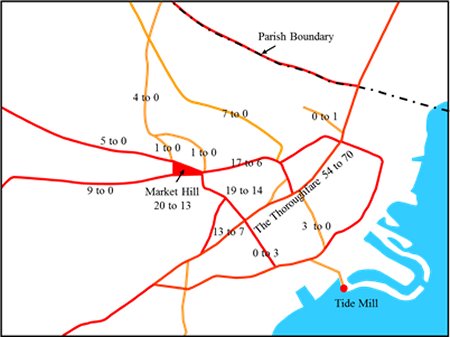
The change in the number of shops on each street in the town from 1844 to 2004.
Despite the reduction of shops in Woodbridge the main retail areas still seem to be busy. This is because some of the shops which have disappeared have been replaced by travel agents, estate agents, hairdressers, banks and building societies. The number of public houses has also reduced but this has been partly compensated by a dramatic increase in restaurants. These changes are summarized in this table.
