Diversification of Religious Worship
Quay Congregational Church
When the Civil War started Robert Cade, who had been minister at St Mary’s for nearly 20 years, was asked to yield the pulpit to a number of lay preachers or ‘lecturers’ at least two of whom were townsmen. Eventually the parishioners invited Frederick Woodall, a lecturer of Yarmouth, to come to Woodbridge.
By 1650 most of the parishioners at St Mary’s decided that they wanted the former minister back so Frederick Woodall, together with fifty five ‘brethren and sisters’, left St Mary’s and set up what was to become the Quay Independent Church. Not much is known about the early years of this church. It is believed that they held their first meetings in a room of The Ship Inn.
When Charles II proclaimed his Indulgence in 1672 Frederick Woodall was granted a licence to be the teacher of a congregation in the house of Jonathan Bass ‘for those who do not conform to the Church of England’ and who ‘are of the persuasion commonly called Congregational’. The Rev Woodall served the congregation as pastor until he died in 1681, by which time the persecution of Dissenters had started again. In the church book there is the entry - ‘It was a gloomy time for those who were left behind.’ All that is known about the next 8 years is that there was no minister. When the Toleration Act was passed in 1689 John Bass, purchased the piece of ground on which the Quay Congregational Church now stands. The first building to be erected on the site stood for 117 years and could seat 500. The present building was erected in 1805 and in the same year adjacent land was purchased for a burial ground. The building was subsequently altered in 1877 and 1897.
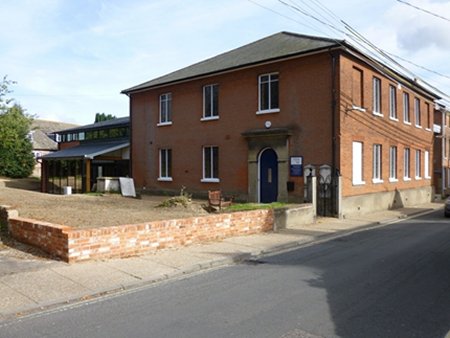
The Quay Congregational Church was built in 1689. A larger church was built on the same site in 1805 and it has subsequently been refurbished or altered in 1877, 1897, 2006 and 2015.
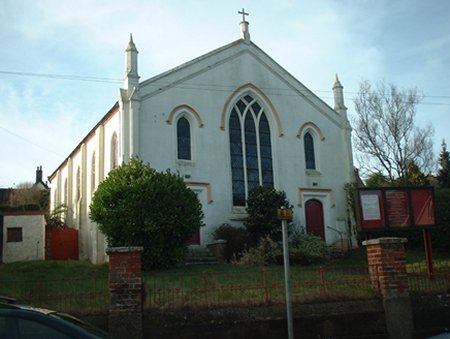
In 1787 some members of the Quay Congregational Church left to worship at the house of Jonathan Beaumont. In 1810 he built the Beaumont Baptist Church in Cuttings Lane (now Chapel Street). The worship was congregational and the chapel had strong links with the Quay Street Church until 1904, when it became a strict Baptist Chapel. In 2006 the Quay Beaumont Baptist Chapel was reunited with the Congregational Church and the Chapel Street building was converted to a private residence. The combined church is a member of the Baptist Union and is known as Woodbridge Quay Church.
The Beaumont Baptist Church on Chapel Street.
Since this picture was taken the building has
been converted to a private residence.
.
The first references to converts to the Quaker way of life and worship in south east Suffolk are from 1655. In that year George Whitehead and other Quaker evangelists, the ‘First publishers of Truth’, arrived in Suffolk and held meetings across the county. The first Woodbridge converts would have met together for worship and discussion in their own houses, not only in Woodbridge but also in some of the surrounding villages.
During 1678 a Meeting House was built in Turn Lane. This was some 6 years after Charles II had proclaimed an indulgence which enabled dissenting preachers and preaching places to be licensed and by then persecution of Dissenters was on the rise again. In December 1678, the Justices of the Peace issued an order to the Constables of Woodbridge complaining of ‘this Meeting House newly built near the Church’. Should five persons or more, of age of sixteen and upward, attempt to meet there the Constables were to ‘charge and command them peaceably to disperse and depart forthwith to their several homes and abodes, and not break His Majesty's peace by meeting in such an unlawful manner.
When the Toleration Act was passed 1689 the Quakers were able to worship in the way they wanted, but this did not swell their numbers in Woodbridge or nationally. Between 1680 and 1800, the numbers of Quakers in Woodbridge fell by a half, with a further reduction of one third by 1860. In 1935 the Woodbridge Monthly Meeting regretfully came to the conclusion ‘that the time has come to close the meeting at Woodbridge where no regular Meeting for worship has been held for some time and where there are now only two members’.
Link to an account of the persecution of the Quakers in Woodbridge.
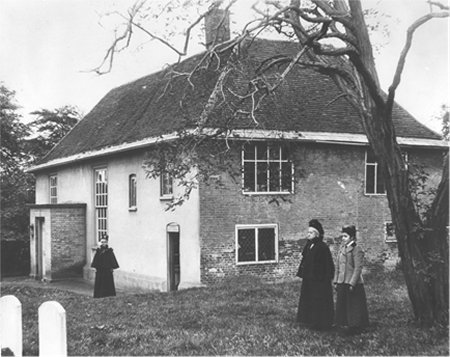
The Quaker Meeting House on Turn Lane. It was sold in 1937 and for a time was used as a warehouse for a shop on Church Street. In 1971 it was converted it into a residential dwelling. The burial ground remains as a place for quiet contemplation and is leased to Woodbridge Town Council.