Diversification of Religious Worship
The Methodist Chapel
In 1812 a soldier drummer of the Lincolnshire Regiment, who was also a Methodist local preacher, was granted permission to hold services in the Woodbridge barracks. Later, services were held in two hired rooms in the town. Then, in 1829, a chapel was built in Brook Street. It is now a private residence (No. 20) having been replaced, in 1872, by the chapel on St John’s Street.
When the new Methodist Chapel was opened it could seat 350. The interior of the church was subdivided, in 1963, to form a school room and a smaller sanctuary. Further changes were made in 1972 and then, in 1990, a new church hall was built on the side and it was thereby possible to bring the sanctuary back to its original size.

The former Methodist Chapel, built in 1829, on Brook Street.
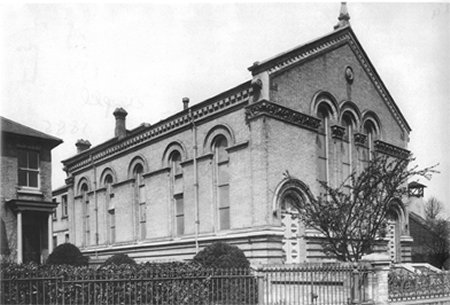
The new Methodist Chapel, built in 1872, on St John’s Street.
St John’s Church
St John’s Church was built as a result of the energy of the Reverend Henry Hardinge. He became rector at St Mary’s in 1839 and his preaching filled the church to overflowing. He then started the project of building a new church or ‘chapel of ease’ on part of some former grazing land at the bottom of Castle Street. This land, which had been put up for sale in 1840, had previously been rented for grazing. Within two years £2,600 had been raised to build the church. The foundation stone was laid in June 1842 and the church was eventually consecrated in 1846.
The church originally had a tower topped with an elegant spire rising to the height of 138 feet but the spire had to be removed, in the 1970s, because the iron bars used to reinforce the stonework had corroded. The remaining stumpy tower never looked right but this was rectified when an anonymous benefactor came forward to fund a new spire which was erected in 2003.
St John’s Church with its original spire.

St Thomas of Canterbury Roman Catholic Church
The renaissance of Catholicism was slow to arrive in Woodbridge. In 1770 there was only one Roman Catholic living in the town out of a population of 2331. By 1801 there were 4 in a population of 3020 and the town remained strongly anti-Catholic. The bells of St. Mary's, Woodbridge, were pealed in protest when the Catholic Emancipation Act was passed in 1829.
A celebration of Mass ''as it was thought for the first time since the Reformation" was held in Dr Moore's house in Church Street, on 22nd March 1865. Seven years later a Catholic Church was built, in 1872, in Crown Place, as a result of a donation by a priest in Ipswich. However, the small number of Catholics in Woodbridge found it hard to raise enough money for the upkeep of the church and for the support of a resident priest. Sometimes they had to resort to paying for a priest to come from Ipswich.
The eventual resurgence of Roman Catholicism in Woodbridge was due to Father William Cooper who came to the town, in 1919, on his retirement from his ministry at Felixstowe. Two years later he founded a Carmelite Convent in Church Street. He was also instrumental in persuading the Sisters of Mercy to found the Convent of Our Lady of Lourdes and the Convent School of St Philomena in Woodbridge. Both were established, during 1923, in a five bed roomed house adjacent to St John’s Church.
By 1929 the number of Roman Catholics in the town had increased significantly. The dioceses responded by purchasing a former Public Lecture Hall and converting it into St Thomas of Canterbury Roman Catholic Church.
Link to an article on the two Convents in Woodbridge
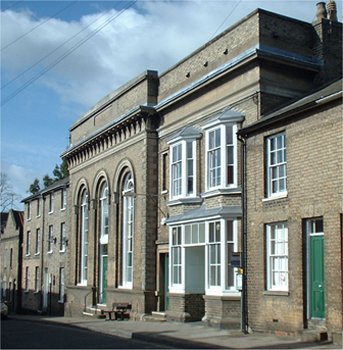
The former Public Lecture Hall which, in 1929, was converted into St Thomas Roman Catholic Church.