Roman Catholic Convents in Woodbridge
Introduction
Catholic services were held in Woodbridge in 1812 and 1815, but the number of Catholics amongst the local population was small. The services were conducted by Abbe Simon one of the French clergy who fled the anti-clerical regime of the French Revolution. From 1793 he was Chaplin to the barracks on Rushmere Heath. There is a local tradition that Abbe Simon was stoned by some inhabitants when he came to Woodbridge. Certainly the town was anti-Catholic. The bells of St. Mary Woodbridge, were pealed in protest when the Catholic Emancipation Act was passed in 1829. It removed discrimination against Roman Catholic teachers and schools.
In 1872 a Catholic Church was built in Crown Place, as a result of a donation by a priest in Ipswich, but the small number of Catholics in Woodbridge found it hard to raise enough money for the upkeep of of the church and to pay for a resident priest. Sometimes they had to resort to paying for a priest to come from Woodbridge.
The eventual resurgence of Roman Catholicism in Woodbridge was due to Father William Cooper who came to the town in 1919, on his retirement from his ministry at Felixstowe. Two years later he persuaded the Carmelite nuns from Notting Hill, London, to found a convent in Woodbridge by giving then his house in Church Street. Father Cooper was also instrumental in persuading the Sisters of Mercy to found the Convent of Our Lourdes, and the Covent School of St Philomena, in Woodbridge.
In 1921 Father William Cooper persuaded the the Carmelite nuns from Notting Hill, London, to found a convent in Woodbridge by giving then his house in Church Street. The nuns subsequently financed the chaplaincy that enabled a resident priest to be appointed for the parish. The community grew rapidly to about 25 members and in 1927 they bought properties in Church Street on either side of the original house.
The nuns had a rigorous regime of worship, prayer and work. Only two of them were allowed to venture into the outside world, but there was a parlour where visitors, who came to ask for advice or for a prayer to be said, could talk to the nuns through a grill. Messages and goods for the convent were put into a 'turn', a revolving cylinder fixed into the wall. The cylinder was then rotated so that its contents could be taken out inside the convent. Some say that this is where the name Turn Lane comes from but they are wrong. The name Turn Lane dates back to at least 1765.
By 1938 the premises in Church Street had become too cramped and noisy for the nuns, and they moved to Rushmere. Then, in 1948, they moved to Quidenham near Attleborough in Norfolk, where the community remains. The Church Street buildings were used by the military during the war, and afterwards it was sold the the Culmark brush company. In 1982 a residential development was built on part of the site and was given the name Carmelite Place.
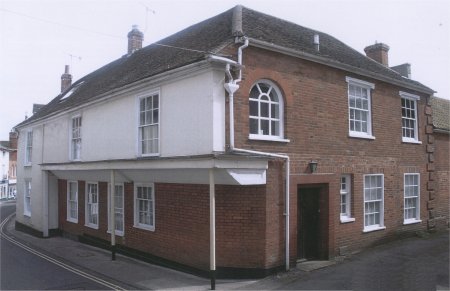
This photograph shows part of what remained of Carmelite Convent after the nuns move to Rushmere. Church Street is on the left and Turn Lane is on the right.
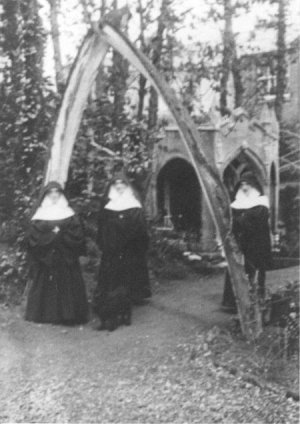
This entranceway on Church Street was created when the former Carmelite Convent was redeveloped in 1982.
Convent of Our Lady of Lourdes and the Convent School of St Philomena
Father Cooper was also instrumental in persuading the Sister of Mercy to found the Convent of Our Lady of Lourdes and the Convent School of St Philomena in Woodbridge. Both were established, during 1929, in a five bed-roomed house behind 2, Castle Street. There were only 24 Catholic children in Woodbridge when the Convent School opened in