The Liberty of St Etheldreda
The 1066-1600 The Foundations of the Modern System of Criminal Justice
The first major changes to the Anglo-Saxon legal system were made during the reign of Henry II (1154-1189) and they were continued by his successors. From 1166 royal justices toured the country and presided over at both criminal and civil cases at the biannual county courts. At these courts, which later were called the assizes, representatives of each hundred and township were called upon to present all those accused of serious crimes for judgment. A ‘grand jury’, which had representatives of all hundreds in the county, then had to examine each case and to decide whether there was sufficient evidence to warrant the accused being tried.
By the middle of the thirteenth century the recording of serious crime was reported to royal officials, called coroners, who were appointed in every county. The appointment of the coroner reduced the role of the sheriff who was left with the jurisdiction over personal actions such as debt and private wrongs and the responsibility for collecting the king’s taxes and for maintaining the prisons. The latter were then only used to detain those awaiting trial or execution.
From 1277 keepers of the peace were appointed for each county to instigate proceedings against people who were believed to have broken the laws, and to have them held in custody until they could be brought before a royal justice. The function of the keepers of the peace were eventually taken over by justices of the peace. In 1388 there were eight justices of the peace in each county and they were enabled to try criminal cases, but not civil ones, at the ‘courts of quarterly sessions’ held at four set times each year. The justices of the peace, who are now called magistrates, were mainly leading landowners. By 1565 there were 30 or 40 justices of the peace per county.
Each manor appointed an unpaid constable who was initially just responsible for keeping the peace and good order within the manor but, in 1285, The Statue of Winchester gave the manorial constable royal authority for maintaining the King’s peace. The manorial constables had the powers of arrest but they did not investigate crimes. The victims of crime usually had to discover the culprits themselves and then fetch the constable to arrest them and bring them before the magistrates. Moreover, the victim was expected to pay the constable for his services.
.
The legal system in South East Suffolk
It is not known for sure where the sessions of the Liberty of St Etheldreda were held. Wickham Market is the most likely candidate but Hacheston, Sutton and Melton have also been mentioned by some historians. The only facts which can be verified are that, in the sixteenth century, the steward and bailiff of the Liberty resided at Melton where, by order of the Constitutions of Clarendon in 1164, the common gaol of the Liberty was erected.
After the Abbey at Ely was dissolved in 1539 the legal system of the Liberty was incorporated into the national one but it continued to have its own coroner, assizes, quarter sessions and gaol. In effect the former Liberty continued to operate as a mini-shire.
Sometime during the reign of Elizabeth I the eminent lawyer Thomas Seckford, who held the manor of Woodbridge late Priory, became steward of the Liberty. In 1575 he moved its sessions to a Sessions House which he had built in the centre of the Market Hill in Woodbridge. He gave the upper part for the use of the County Court in perpetuity, and the open hall below was used as a covered market for the manor of Woodbridge late Priory. The building has since been referred to as the Sessions House, the Shire Hall or the Town Hall.
By 1800 the Sessions House was still being used for the Woodbridge County Court and Petty Sessions of the 64 parishes that were in the Liberty of Etheldreda. The Quarter Sessions were in January, April, June and October, and the Petty sessions every Wednesday. The last Quarter Sessions were held there on the 17th October 1860. In recent years the Sessions House has been used as a Magistrates’ Court. This court was moved to Ipswich in 1986 and the Town Council purchased the Shire Hall in 1987. The Coroner of the Liberty of St Etheldreda had an office on Market Hill until 1933.
The Liberty’s gaol at Melton remained in use until about 1800 but it was not demolished until 1962. By then the Steward's and the Bailiff's residences had already been removed and all that remained were the gaolers' and the prisoners' quarters. These comprised a two storey, oblong medieval structure constructed of brick on the ground floor and timber framed on the upper floor. Dutch prisoners who had spent time at the gaol after the battle of Sole Bay in 1672 had left carvings of ships and windmills cut deep into the walls of the rooms they had occupied. Offenders sentenced to death are believed to have been hung on the gallows which were on the hill beyond Wilford Bridge - a site that is also believed to have been an ancient "hundreds" meeting point.
The Melton gaol was replace by a House of Correction which was built on Theatre Street in about 1804. According to reports the conditions in the new building, which was owned by Suffolk County Council, were harsh. White’s Directory 1844 records “in 1835 it had many prisoners crowded together without any classification of the sexes, and having only one day room, eleven feet by eight, The number confined here, for various periods in that year, was 140”.
The last prisoner committed to Woodbridge was discharged on 25th April 1842. After that they were all sent to Ipswich. The building was subsequently used as a Police Station until 1931 after which it was converted into private housing. The plaque above the main entrance, however, still proclaims the building is a House of Correction.
Link to article on policing in the Liberty.
Link to a comprehensive account of the evolution of the criminal justice system.
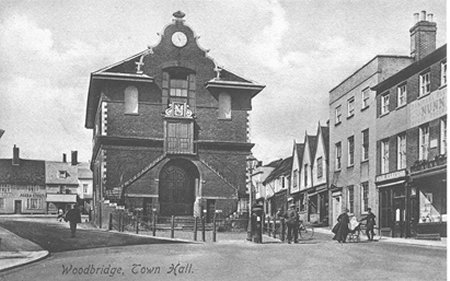
The Shire Hall or Sessions House which was built on Market Hill in 1575.
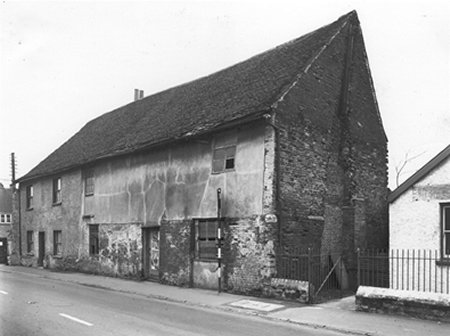
Melton gaol shortly before its demolition in 1962.
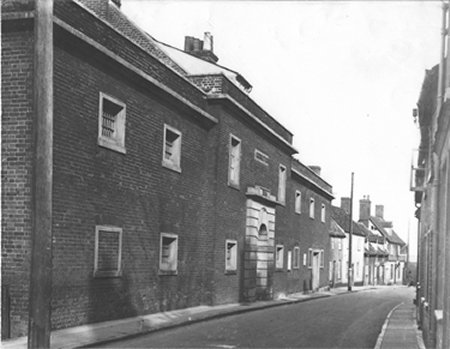
The former House of Correction on Theatre Street.