Local Governance
The New Parish Workhouse
In 1672 the new workhouse was established in what is now 11, Theatre Street. This building had been bequeathed, in 1669, “towards the relief of the poor of Woodbridge”.
Some of the poor rate returns for the 1756 to 1807 have survived. In 1756 there were 437 families listed on the return. Of these 55 (12.5%) were excused payment because they were too poor. A similar percentage is found in all the poor rate returns which survived from the 1756 to 1807.
By 1756 Woodbridge’s workhouse on Theatre Street had some 24 beds and the inmates were set to work spinning wool on 21 spinning wheels. In 1770 there was a full time Governor living in the building and the number of beds had increased to 37. The records for the period are incomplete but, from 1756 to 1768, there were on average 32 people being given varying amounts of out-relief and 20 people in the workhouse. The expenditure on out-relief and in-relief was comparable and the money made from spinning wool in the workhouse was about 15% of the expenditure on in-relief.
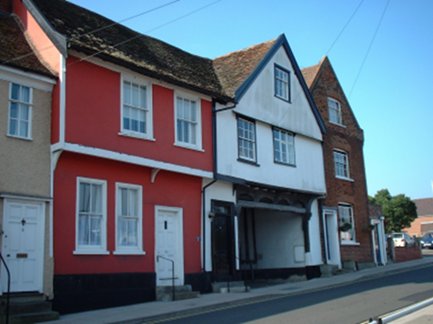
The building on Theatre Street which, from 1672, became the parish workhouse.
The Creation of the Poor Law Unions in 1834
By the 1760s it was clear that the number of paupers across the county was increasing and the government responded by encouraging parishes in each hundred to join together and build a communal workhouse. The one for this area was built at Melton but both Woodbridge and Wickham Market did not want anything to do with it. This proved to be a sensible decision. The hundred’s workhouse at Melton was poorly managed and repeatedly ran into financial problems. It was eventually wound up in 1826 and, by 1829, the buildings had been converted to the Suffolk County Asylum– later to be renamed St Audry’s.
In most other areas the hundred's workhouses were a success and many parish workhouses were closed. Nevertheless the cost of poor relief continued to rise because the number of people receiving out-relief was increasing.
By 1832 the government had decided that the time was ripe for a root-and-branch reform of the poor laws. A Royal Commission was appointed and its report concluded that the most effective means of reducing the poor rates was to make it much less attractive for the able-bodied to apply for poor relief. To this end it was proposed that all able-bodied applicants for poor relief would have to enter a workhouse where they had to perform a variety of irksome tasks. By this means, the commissioners argued, rate-aided poor relief would become so repellent an option for the able-bodied poor that they would be bound to embrace self-reliance as the alternative.
Most of the recommendations of the Royal Commission were enshrined in the Poor Law Amendment Act of 1834. Parishes in rural areas were required to join together into Poor Law Unions in order to provide a unified method of coping with the Poor. The authority which ruled over a Union was called the Board of Guardians. The Justices of the Peace in the district were made Guardians ex officio. The rest of the Board was elected by rate payers.
Within a year of the passing of the Poor Law Amendment Act seventeen Unions had been set up across Suffolk. The boundaries of these unions are shown by this map as are the locations of the workhouses. In most cases the old divisions of hundreds were ignored in setting these boundaries and, in some cases, county boundaries were ignored as well. The Woodbridge Poor Law Union, which is shaded green on the map, comprised some 47 parishes and it used the existing workhouse at Nacton. This had been built by the parishes of Colneis and Carlford in 1756. In terms of population Woodbridge was by far the biggest parish in the Union. It had about 20% of the population.
After the inmates of the Woodbridge’s parish workhouse had been transferred to Nacton the premises were used as the boardroom of the Guardians of the Woodbridge Poor Law Union. In 1844 part of the building was hired out as an infant school and in 1867 the whole building was sold by order of the Charity Commission.
Despite the creation of the Poor Law Unions, each parish still had to pay the full costs of caring for the poor of that parish. To do so each parish had to base its poor rate on the average cost of providing relief to its poor over the previous 3 years. There was no equalizing mechanism whereby rich parishes contributed to costs of the poorer parishes. It was not until 1865, with the passing of the Union Chargeability Act, that it became possible for the financial burden of pauperism within a Union to be spread evenly across all the parishes in a Union.
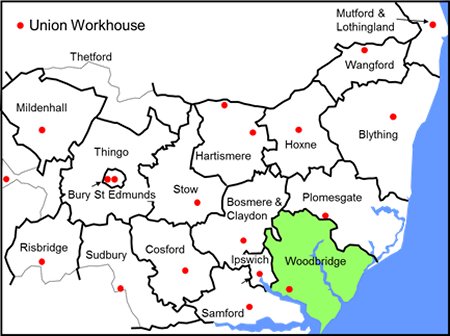
The Poor Law Unions covering Suffolk and the locations of the workhouses. The Woodbridge Poor Law Union is shaded green. Its workhouse was at Nacton.