Evolution of Education
A British and Foreign School was founded in 1819 under the auspices of the “Woodbridge Society for the Education of Poor Children”. The original committee had 12 members, most of whom were prominent members of the town. The school was started in a large, white, bay fronted house, which used to be near St John’s Church. The house was owned by the British and Foreign School which was founded in 1819 under the auspices of the “Woodbridge Society for the Education of Poor Children”.
Later William Lockwood Snr, a builder, erected a new school building further up Castle Street in the 1840's.
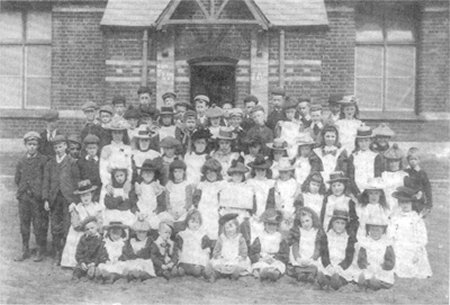
The British and Foreign School built by William Lockwood on Castle Street. It has since been demolished and replaced by two houses.
Independent Schools
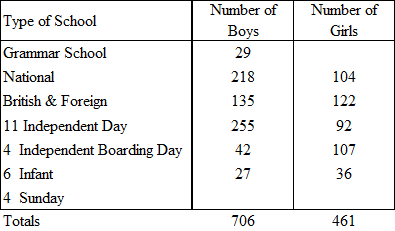
Sometime around the end of the eighteenth century a number of Independent Schools started to appear in the town. These schools charged parents the full cost of tuition and accepted boarders. It has been suggested that they provided a commercial education, an attractive alternative, in changing times, to the classical education provided by the Grammar School. This table show the number of schools of all types in Woodbridge by 1833 and the number of pupils in each type.
Information published on the schools in Woodbridge in 1833.
The Provision of Adult Education in 1835
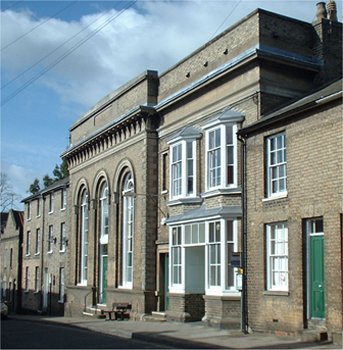
From 1812, a new form of educational establishments started to form across the country to provide adult education, particularly in technical subjects, to working men. The Woodbridge Literary and Mechanics’ Institute was established in 1835 and was originally located in a building in Church Street. A premises in St John’s Street was built in 1852, at a cost of £300, by a company of shareholders who also erected an adjoining Lecture Hall. The latter was a large handsome building of white brick, and cost £1000, raised in £5 shares. It was let for various purposes and could accommodate 500 persons. At its zenith in the 1870’s the institution had about 160 members and a library of about 5000 volumes. By 1892 it was being reported that "this institution does not flourish and the end of its usefulness certainly appears close at hand". Sometime later the building was being used by the Young Men's Christian Association (YMCA). In March 1929 the building was purchased by the Roman Catholic diocese and converted into the new St Thomas’ RC Church.
The Woodbridge Literary and Mechanics’ Institute
and the adjoining Lecture Hall. The building
has since become St Thomas RC Church.
The Expansion of Grammar School in 1861
In June 1861 the High Court of Chancery approved a scheme to amalgamate the Seckford Charity with the Woodbridge Grammar School. This ruling was made at a time when there was a national debate about whether non-educational endowments, which had arcane obsolescent purposes or which had become insignificant in comparison of the endowment, could be converted to educational purposes. Eventually it was decided that such endowments should be used for educational purposes and the Endowed School Commissioners were set up in 1868 to oversee the process.
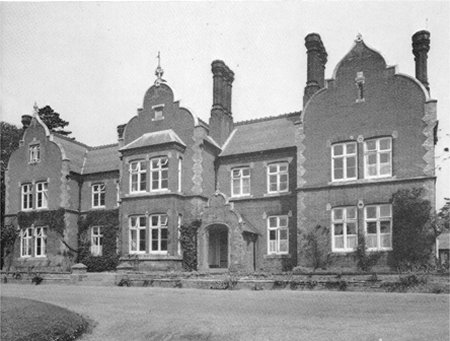
By 1865 the Grammar School had been relocated to a new building – Marryott House – which had been built school on a three acre site to the east of Burkitt Road. The building included a residence for the Head Master and accommodation for 25 boarders. The number of children of the deserving poor of Woodbridge who would be offered free places was increased from 10 to 20.
Marryott House was erected in 1865 on three acres
of land to the east of Burkitt Road.
Last edited 15 Sept 21