Evolution of Education
The Creation of School Boards in 1870
The Government did not become involved in education until the 1830s and eventually took full control in 1870. Ten years later school attendance, up to the age of 10, was made compulsory and by 1890 elementary education was free to all.
In 1870 the government created School Boards (i) to establish elementary schools in areas where school provision was insufficient and (ii) to oversee the existing schools set up by voluntary bodies – e.g. the British Schools and the National Schools. The latter were also given grants the size of which depended on the reports made by School Board’s inspectors. Over the years these grants fell as the School Boards set higher standards.
Within six years both the National School and British School in Woodbridge were complaining about a fall in the size of the grants received to meet the required standard. In 1902 the Education Committee (the descendant of the School Board) suggested that the two schools should consider amalgamating in order to improve their facilities. Representatives of the schools met to discuss the possibility of setting up a United Voluntary School but the two sides could not agree over the religious ethos of such a school and were daunted by the difficulty of raising the money for such a purpose.
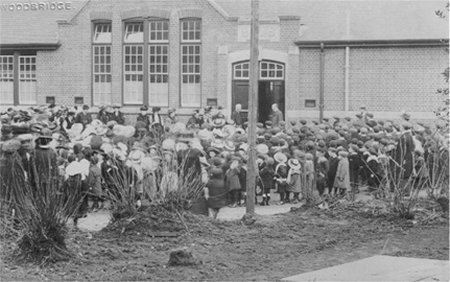
By 1907 the non-conformists had withdrawn their support for the British School on Castle Street and this was taken over by the Education Committee. They considered the premises to be inadequate on the basis of “want of accommodation, bad ventilation and sanitation” and they commenced building the Woodbridge County School off New Street. It opened in 1908.
The Church of England continued to support the National School and it was later to become St Mary’s Voluntary Aided School.
The opening ceremony of the
Woodbridge County School.
.
Further Expansion of the Grammar School
In 1880 the Charity Commissions, with the powers conferred on them by "The Endowed School Act, 1869", produced a new scheme for the management and regulation of the Seckford Hospital and the Grammar School. The scheme did not foresee any expansion of the facilities provided by the Hospital but it stated that "the residual income of the Charity, if any, may be applied to the purpose of the Grammar School, in improving accommodation …. or generally promoting the efficiency of the school.”
In 1890 the governors of the school prepared for its expansion by purchasing land around the school and eight cottages on Bredfield Street. The grounds of the school were thereby increased to 34 acres. The cottages were demolished in 1891 and, by 1895, the new School House had been erected at cost of £12,000. The latter provided accommodation for 40 boarders, the assistant masters and the headmaster whose previous accommodation in Marryott House was taken over by the Science Master. By the following year a block of seven classrooms and School Hall had been built. Extensive playing fields were also laid out and the present retaining wall along Burkitt Road was built along with the entrance from that road.
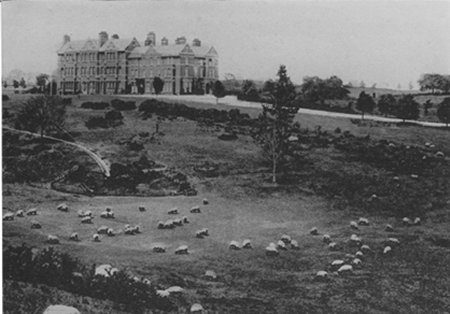
School House and its extensive grounds. Marryott house just out of sight to left.
.
Impact of the 1899 Education Act
Until the Board of Education Act of 1899, Education Committees were just concerned with elementary schools. The new Act inaugurated a secondary school system which was under the overall control of the Education Committees. When new secondary schools were built, however, they still charged fees and thus access to them remained dependent, for the most part, on parental income. It was not until 1902 that Education Committees were empowered to offer free places to pupils who would benefit from going to the new secondary fee paying schools. Then, in 1906, the newly elected liberal government considerably expanded the number of free secondary school places. Up to one quarter of secondary school places were to be allocated – free of fees – to elementary school pupils who passed a qualifying examination.
Woodbridge Grammar School became a Direct Grant School in 1920 and started to accept boys who passed the exam. A year later Thomas Mills Grammar School at Framlingham followed them and started to accept girls. Children who did not pass the exam remained at their Elementary School until they reached the school leaving age of 12. This was raised to 14 in 1918.
Impact of the 1944 Education Act
The foundations of the education system we have today were laid down by the 1944 Education Act. It organised schools into three progressive stages to be known as primary, secondary and further education. All children aged 5 to 11 were to attend a primary school. They were then to sit an examination, the 11 plus, to decide which type of secondary school would suit them best. The options were to be grammar, technical and secondary modern schools but few technical schools were established. The 1944 Act also raised the school leaving age to 15 and this was subsequently raised to 16 in 1972.
Farlingaye Secondary Modern School opened in June 1955. It removed the 11 to 15-year-olds from the Woodbridge County Primary School and from the St Mary’s Voluntary Aided School. The latter was then able to relocate its infant department from Theatre Street to the Burkitt Road site.
When comprehensive education was introduced in 1976 Woodbridge School opted out from being a direct grant grammar school and Farlingaye High School started a sixth form.