The Landscape
Landscape plays a key role in determining how settlements evolve. The foundation of the landscape of Woodbridge was formed during those periods when that part of the earth's crust which is now East Anglia was under the sea. During these periods of immersion, layers of sedimentary deposits were laid down.
This map shows how the top layer of the sedimentary deposits varies across East Anglia and around the Thames estuary.
The chalk was formed during a period which started 144 million years ago and ended 70 million years ago. The layer extends from the north-west corner to well beyond the coast.
Between 60 and 49 million years ago most of the southern area was beneath a broad estuary into which flowed the early Thames and other rivers. The silt they carried formed a layer of clay, called London clay, on top of the chalk.
From 4 to 1.8 million years ago the north eastern part of the region was beneath a shallow sea which deposited a layer of shelly sand called crag.
A gradual tilting of the earth’s crust has resulted in the layers of crag, London clay and chalk, in south east Suffolk being stacked as shown below. Under Woodbridge the crag is about 13m thick, the London clay about 15m and the chalk 400m.
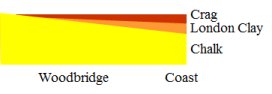
A simplified cross-section through the sedimentary
deposits between Woodbridge and the coast.
Map showing the extent to which rivers and streams have cut into the sedimentary deposits
Having described the wider area it is now possible to restrict the rest of the discussion to south east Suffolk.
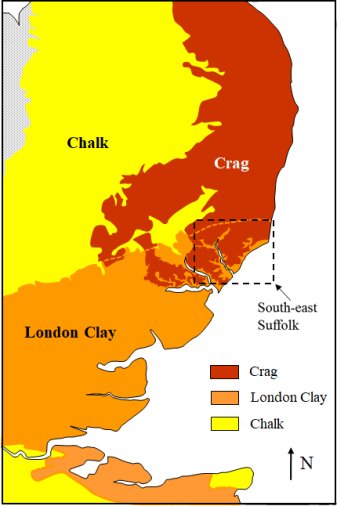
Map showing how the top layer of sedimentary deposits varies across East Anglia and around the Thames estuary.
The Heavy Clay Soils which covered High Suffolk were formed from material deposited by an ice sheet which moved slowly down from the north about 400,000 years ago and reached the edge of what is now Woodbridge. It covered the area shaded orange on this map.
When the ice sheet melted it left a layer, up to 30 m thick, of clay and boulders on the ground it covered - the area now called High Suffolk. Sands and gravel were carried away by the melt waters and were spread over the coastal region - the area now called The Sandlings.
Woodbridge is on the boundary between two distinct soil types. The surrounding area is thus the source of a diverse range of agricultural produce. The town prospered as a market centre because the navigable estuary enabled produce to be shipped to London area. For a while the town also prospered because ships were built here using fine oaks from High Suffolk.
Most of the settlements of our Stone Age, Bronze Age and Iron Age ancestors were in the areas of light sandy soil along the coast. Although these were areas of poor fertility the intensity of farming was low enough for it not to be a problem. Some of the key features of the coastal area were, however, significantly different from those today.
Links to maps showing the locations of Stone Age, Bronze Age and Iron Age settlements in Suffolk
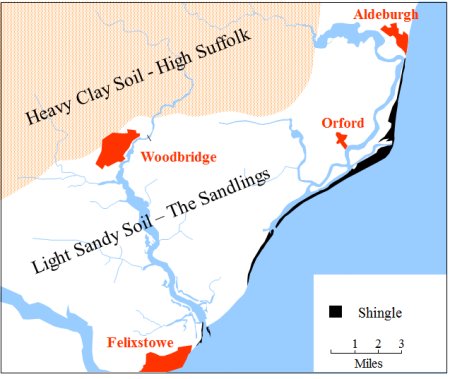
The variation in the type of soil across south-east Suffolk.
Last edited 12 Aug 23